
Subscribe to Airspeed using iTunes, visit us at http://airspeed.libsyn.com, or use the following RSS feed. http://airspeed.libsyn.com/rss.
This is the second of the three-episode series called “So You Want to Be an Astronaut.” I’ve researched the information that NASA and others have made available about the astronaut selection process and I’m condensing it and presenting it here.
Remember through all of this that I don’t have any particular “in” with NASA. I’ve simply done a bunch of research for you and I’m presenting it to you in a mildly entertaining way. If you happen to hear something that ain’t so, please e-mail me at steve@airspeedonline.com and I’ll be happy to correct or update the information. In any case, make sure that you listen to the disclaimers in the first episode in the series.
So on to Part 2: Selection
Once you apply to become an astronaut, NASA determines whether you have the qualities that qualify you as an astronaut on paper. Panels of experts in the relevant disciplines screen the applications to determine who’s qualified and who gets to be a finalist.
Provided that you make the “paper cut” and are selected as a finalist, you and several hundred other applicants get interviewed, poked, and prodded in person. It’s a week-long process that includes personal interviews, medical evaluations, and orientations. In addition to your physical status, NASA reviews your education, training, experience, and any other qualifications that might make you a valuable astronaut. Remember that you have several hundred candidates milling around down there and each of you already qualifies on paper. The real selection is going to happen in the personal interviews.
If you’re selected as an astronaut candidate, you go to the Johnson Space Center in Houston and begin a one- to two-year training and evaluation program.
Astronaut candidates receive training in space vehicle systems, math, geology, meteorology, navigation, oceanography, orbital mechanics, astronomy, physics, and materials science, in addition to other technical subjects. They also train in land and sea survival techniques, scuba diving, and space suits.
Every astronaut candidate gets tossed in the pool in a flight suit and tennis shoes during the first month of training and must swim three lengths of a 25-meter pool dressed that way. You can freestyle, breast stroke, or sidestroke and there’s no time limit. You also have to tread water for ten minutes.
You have to go through the military water survival training syllabus before you begin flight training. I get the sense that that includes the simulated inverted cockpit escape like the one in An Officer and a Gentleman. That gives me the willies just thinking about it, although it’s probably worth it.
You also have to become SCUBA qualified in order to do your extravehicular training because the primary extravehicular practical training facility is a great big pool where neutral buoyancy simulates the zero-gee work environment.
NASA also trains candidates in high- and low- atmospheric pressure environments (think Officer and a Gentleman again).
Candidates also get zero-gee exposure in an aircraft flying parabolas designed to give about 20 seconds at a time of weightlessness. New candidates are trained in a McDonnell Douglas C-9, the successor to the perennial favorite Boeing KC-135 Vomit Comet was retired in 2004.
Pilots get 15 hours or more a month of proficiency flying in the Northrop T-38 Talon, a two-seat jet trainer. Pilots destined for STS missions fly one of four Shuttle Training Aircraft or “STAs,” which are Gulfstream II business jets modified to perform like the STS orbiter in the landing phase. NASA says that pilots assigned to this duty get about 100 hours in the STAs, which is equivalent to 600 orbiter landings. The implied landing every 10 minutes seems a little quick to me, but maybe not. The STAs come in with thrust reversers on and the gear down to get the 17-20 degree glideslope and the brick-like handling qualities of the orbiter right. Bear in mind that most commercial and general aviation aircraft land using a three-degree glideslope.
Mission Specialists also get to fly a minimum of four hours a month, but it’s always dual training. Still, time in a T-38 is time in a T-38.
If, at the end of the training program, NASA selects you, you’re an astronaut.
But the training doesn’t stop there. Much of the astronaut training is a continuation of the training that started in the astronaut candidate program. You augment a lot of your training by training in both the single systems trainers (which, as the name implies, simulate discreet systems or system groups) and you train in the Shuttle Mission Simulators.
You may train at the Sonny Carter Training Facility or the Neutral Buoyancy Laboratory. You’ll almost certainly train on the full-scale mockups of the spacecraft that are current at that time, as well as on mockups of the subjects of your mission, such as satellites and other research platforms. A lot of scientists on the ground are going to depend on you to be their eyes, ears, and hands. They’ll have perhaps ten years tied up in that little drawer or compartment in the payload area and they’re going to depend on mission specialists and others to make sure that their experiments go perfectly.
Civilian astronauts are government employees and are classified for pay as GS-11 through GS-14, which equates to an approximate range of $56,000to $128,000, assuming the Houston, Texas Locality Pay Area (about 26% greater than the base level for those grades in other areas). You placement in the pay grades depends on your education, experience, and other factors. Military personnel continue with their military pay and are simply detailed to NASA. Civilians who are selected as astronauts are expected to stay in the program for five years. Military astronauts are assigned a specific tour of duty with the space program.
That’s it for Part 2 of “So You Want to Be an Astronaut.” In the next episode, I’ll go into some ruminations on the selection process and pass on some ideas that seem to make sense if you’re looking for an advantage in the selection process.
Thursday, July 06, 2006


Tuesday, July 04, 2006
Battle Creek Airshow - Days 3 and 4

Just back from days three and four of the five days at the Battle Creek Field of Flight Airshow. As you can see from the picture,lots of cool stuff happened. For one thing, I got a balloon flight, courtesy of Dave Emmert in Cloud Nine. I also met and interviewed a Thunderbird, a Snowbird, and several others. Lots of editing and production to do, but we'll get the material up and on both the podcast and the blog as soon as we can.
Saturday, July 01, 2006
Battle Creek Airshow - Day 1
Airshow update:
I hit the Battle Creek Balloon Championships and Field of Flight Airshow on Friday. See www.bcballoons.com for background.
 Wandered the field a little andscoped out the concessions. Good-looking barbecue for starters. Turkey legs, ribs, chicken - you name it. And the usual assortment of elephant ears, lemonade, sausage, and other stuff.
And the Budweiser Clydesdales. They were blaring the theme music the whole time. I've still got that damned music in my head.
Here comes the king, here comes the big number one . . . I can only imagine how annoying that would have to be if you toured with the Clydes. Maybe you become impervisous to it after awhile. Beautiful horses, though. And well-trained.
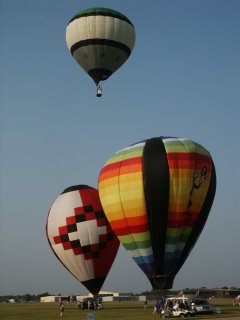 I saw my first balloon launch. Rotten photo opportunity because it was impossible to get up-sun of the balloons. So they were either harshly side-lit or blacked out against a too-bright sky.
Plus, it was hazy. Actually a good thing, that haze. It means that there's not a lot of lifting action and that the atmosphere is pretty stable. If it were more clear, it would mean that the atmosphere was churning around enough to more the particulate matter around.
But on to the good stuff.
This is a powered pilot's commentary. I can't help but wonder about a flying apparatus where you can take your hands off of the controls for 20 minutes at a time without dying. It's probably very cool in that you have to land the thing without as much control of where you're going to land it. That takes some talent. I also understand that the balloonists had banners that they were supposed to drop on Xs marked in town near schools. I would imagine that then jockeyed around for altitude trying to find layers of wind that would take them over the places where they wanted to be. I also understand that the football-shaped balloons are easier to control, although I have no idea how one would control direction even with the oblong shape.
But here's the thing that captivated me. They launched 44 balloons in about a half hour. As many as a dozen or so were aloft within a 1,000-foot cube at one point. It seemed (and was) a lot more three-dimensional than powered flight feels. When you fill a three-dimensional space with a lot of balloons, the whole scene just looks a lot more three-dimensional. The scene out the window of an airplane looks pretty flat in comparison.
Maybe it's the proximity. Airplanes move faster and are harder to see so we keep ourselves separated (or ATC separates us). Heck, a few of the balloone collided. The commentator (now being very informtive) explained that this is "kissing." And it's no big deal. I saw a guy drag his gondola right up the side of another balloon. Apparently, it's no great shakes.
You don't want to ascend into someone so you collide with the top of your ballon. Apparently, they have velcro-attached top panels designed for quick release upon landing and you could inadvertently rip that open while aloft. It's apparently not 100% fatal because one of the pilots that went up on Fruday had had that happen. But heaving for the planet with a rapidly emptying and floppy envelope above you has got to suck.
Anyway, I'll try to interview one or two of the balloon pilots and might do a podcast on it.
I'm heading back tomorrow and will be there July 2-3. The Thunderbirds arrive tomorrow and many of the other performers should be there as well.
I'm doing some more homework tonight so I can be ready. I get the sense that I may have a big group of folks around and that I may not have enough time to corner everbody serratim. So I'll see if anybody's going to object if I hang around on the ramp looking for interviews. Should be fun regardless.
I hit the Battle Creek Balloon Championships and Field of Flight Airshow on Friday. See www.bcballoons.com for background.
 Wandered the field a little andscoped out the concessions. Good-looking barbecue for starters. Turkey legs, ribs, chicken - you name it. And the usual assortment of elephant ears, lemonade, sausage, and other stuff.
And the Budweiser Clydesdales. They were blaring the theme music the whole time. I've still got that damned music in my head.
Here comes the king, here comes the big number one . . . I can only imagine how annoying that would have to be if you toured with the Clydes. Maybe you become impervisous to it after awhile. Beautiful horses, though. And well-trained.
 I saw my first balloon launch. Rotten photo opportunity because it was impossible to get up-sun of the balloons. So they were either harshly side-lit or blacked out against a too-bright sky.
Plus, it was hazy. Actually a good thing, that haze. It means that there's not a lot of lifting action and that the atmosphere is pretty stable. If it were more clear, it would mean that the atmosphere was churning around enough to more the particulate matter around.
But on to the good stuff.
This is a powered pilot's commentary. I can't help but wonder about a flying apparatus where you can take your hands off of the controls for 20 minutes at a time without dying. It's probably very cool in that you have to land the thing without as much control of where you're going to land it. That takes some talent. I also understand that the balloonists had banners that they were supposed to drop on Xs marked in town near schools. I would imagine that then jockeyed around for altitude trying to find layers of wind that would take them over the places where they wanted to be. I also understand that the football-shaped balloons are easier to control, although I have no idea how one would control direction even with the oblong shape.
But here's the thing that captivated me. They launched 44 balloons in about a half hour. As many as a dozen or so were aloft within a 1,000-foot cube at one point. It seemed (and was) a lot more three-dimensional than powered flight feels. When you fill a three-dimensional space with a lot of balloons, the whole scene just looks a lot more three-dimensional. The scene out the window of an airplane looks pretty flat in comparison.
Maybe it's the proximity. Airplanes move faster and are harder to see so we keep ourselves separated (or ATC separates us). Heck, a few of the balloone collided. The commentator (now being very informtive) explained that this is "kissing." And it's no big deal. I saw a guy drag his gondola right up the side of another balloon. Apparently, it's no great shakes.
You don't want to ascend into someone so you collide with the top of your ballon. Apparently, they have velcro-attached top panels designed for quick release upon landing and you could inadvertently rip that open while aloft. It's apparently not 100% fatal because one of the pilots that went up on Fruday had had that happen. But heaving for the planet with a rapidly emptying and floppy envelope above you has got to suck.
Anyway, I'll try to interview one or two of the balloon pilots and might do a podcast on it.
I'm heading back tomorrow and will be there July 2-3. The Thunderbirds arrive tomorrow and many of the other performers should be there as well.
I'm doing some more homework tonight so I can be ready. I get the sense that I may have a big group of folks around and that I may not have enough time to corner everbody serratim. So I'll see if anybody's going to object if I hang around on the ramp looking for interviews. Should be fun regardless.
So You Want to Be an Astronaut - Part 1
Subscribe to Airspeed using iTunes, visit us at http://airspeed.libsyn.com, or use the following RSS feed. http://airspeed.libsyn.com/rss.
If you’ve been listening to Airspeed for very long, you know that I have a huge thing for the space program. Although we cover a lot about airplanes and flight training here, let’s all take a moment to acknowledge the obvious. Being an astronaut is being at the pinnacle of aviation and aerospace. Ever since NASA selected the first seven astronauts, these men and women have captured our imaginations and been examples of what humans can achieve. They’re not the only examples, mind you, but they’re high on the list and they deserve most or all of the admiration that goes their way.
Everybody knows, or should know, the names Cooper, Grissom, Slayton, Glenn, Carpenter, Schirra, and Shepherd. Many know the names Ride, Collins, and Lininger.
But to you know Smith and Garcia? Bob Smith and Carmen Garcia are middle school students. Bob lives in a suburb in the Midwest and likes to study weather and computers. Carmen lives in New Jersey and loves chemistry and animals. Both take their studies seriously. Bob’s mom took him to the Very Large Array in New Mexico last summer and Carmen’s dad is a pilot for a regional airline. They’ll become good friends when they’re assigned to a long-duration flight on the next-generation International Space Station.
Okay, I made up both Bob and Carmen, but the fact of the matter is that this is how it starts. At some point, whether in middle school, high school, college, or whenever, a person gets bitten by the space bug.
But here’s the thing. Most people have no idea how one gets to be an astronaut. And it’s possible and even likely that many potential astronaut candidates – even ones who might be better astronauts than many already in the astronaut corps – never even apply because they don’t know the requirements or because they make a decision along the way that, though small in and of itself, makes them ineligible.
So I thought, hey! Let’s do a show or two about what it takes to become an astronaut. NASA’s technical requirements, some characteristics that seem to give a person a better or worse chance of selection, and whatever else I can dig up.
So here it is. Part 1 of a three-part series I’m calling “So You Want to Be an Astronaut.” Let’s call this episode “Qualifications.”
This information is based on the best information I could find on the net. NASA itself doesn’t appear to have a lot of information out there. Most of the links to materials like the astronaut application are dead at the moment. Some of the information dates back to 1997. And that’s probably reasonable, considering that the shuttle fleet is probably going to be retired soon and NASA is probably working on coming up with the next set of requirements for astronauts based on what astronauts will need to know or be able to do for the next generation of space vehicles and missions.
This is all based primarily on the criteria that NASA has used for the STS-era (that’s Space Transportation System or “Space Shuttle” era). I can’t imagine that the criteria are going to change much. NASA has been at this awhile and probably has a pretty good idea of what makes a good astronaut regardless of the equipment or mission.
If you’re listening with the idea that you might want to become an astronaut (and if you are, you’re the primary audience here) bear in mind that the criteria may already have changed and, if you’re planning to apply ten or fifteen years down the road, things will probably be even more different. Don’t rely entirely on this information. If you’re going to make life-changing decisions because you want to be an astronaut, do your own research and, better yet, contact NASA yourself. Don’t go changin’ to try and please me.
Remember through all of this that I don’t have any particular “in” with NASA. I’ve simply done a bunch of research for you and I’m presenting it to you in a mildly entertaining way. If you happen to hear something that ain’t so, please e-mail me at steve@airspeedonline.com and I’ll be happy to correct or update the information.
Okay, on with the information.
NASA brings in two kinds of astronauts that we care about. Note that we’re not going to talk about payload specialists here because those folks come through a path that is largely dictated by the contracting foreign government or foreign or domestic institution.
Most astronauts come in on either the commander/pilot track (I’ll refer to those folks simply as “pilots”) or the mission specialist track. Pilots fly spacecraft. Those that are commanders have responsibility for the entire mission, as actually doing stick and rudder operations. Pilots may also help with deployment of satellites and other operations. Mission specialists work with the pilots, but primarily handle systems operations, conduct experiments, and do most of the meat-and-potatoes scientific work on the spacecraft.
Physically, pilots have to be able to pass a NASA Class I space physical, the requirements for which are very similar to those of an FAA Class I medical certificate. Among the requirements are vision of 20/70 or better uncorrected, correctable to 20/20, in each eye. Blood pressure can’t be higher than 140/90 in a seated position. Height has to be between 64 and 76 inches. I guess you have to be tall enough to reach the pedals and short enough so that the instrument panel of a T-38 won’t take off your kneecaps if you have to eject.
Mission specialists have to be able to pass a NASA Class II space physical, which, again, is similar to the equivalent class of FAA medical certificate. Vision has to be at least 20/200, correctible to 20/20 in each eye. The maximum blood pressure is the same, but your height can be between 58.5 inches and 76 inches. Apparently, the pedals in the shuttle are further away than they are in the T-38.
Lest you think that NASA will take expert pilots who don’t know much other than aviation, there are stringent educational requirements. An astronaut candidate must have at least a bachelor’s degree from an accredited institution in engineering, biological science, physical sciences, or mathematics. Be careful how you pick your major. Degrees in “technology” (like Engineering Technology and Aviation Technology) don’t qualify. Certain kinds of psychology don’t work either.
Mission specialists also have to have three years of related, progressively responsible professional experience after the bachelor’s degree. Advanced degrees are preferred, and NASA lets you substitute a master’s degree for one year of experience and a doctorate covers all three years.
Pilots have to have at least a thousand hours of pilot-in-command time in jet aircraft and they really prefer flight test experience. Remember that the earliest astronauts were all test pilots and NASA has really fond memories of those guys.
You must also be a US citizen.
Civilians apply directly to NASA. NASA takes applications on a continuous basis and then selects new astronaut candidates from the pool of applications every couple of years or so. Military applicants apply through their branch of the armed services and that branch makes recommendations to NASA of the candidates that apply.
That’s it for Part 1 of “So You Want to Be an Astronaut.” In the next episode, we’ll cover the selection process and the astronaut candidate training and evaluations.
If you’ve been listening to Airspeed for very long, you know that I have a huge thing for the space program. Although we cover a lot about airplanes and flight training here, let’s all take a moment to acknowledge the obvious. Being an astronaut is being at the pinnacle of aviation and aerospace. Ever since NASA selected the first seven astronauts, these men and women have captured our imaginations and been examples of what humans can achieve. They’re not the only examples, mind you, but they’re high on the list and they deserve most or all of the admiration that goes their way.
Everybody knows, or should know, the names Cooper, Grissom, Slayton, Glenn, Carpenter, Schirra, and Shepherd. Many know the names Ride, Collins, and Lininger.
But to you know Smith and Garcia? Bob Smith and Carmen Garcia are middle school students. Bob lives in a suburb in the Midwest and likes to study weather and computers. Carmen lives in New Jersey and loves chemistry and animals. Both take their studies seriously. Bob’s mom took him to the Very Large Array in New Mexico last summer and Carmen’s dad is a pilot for a regional airline. They’ll become good friends when they’re assigned to a long-duration flight on the next-generation International Space Station.
Okay, I made up both Bob and Carmen, but the fact of the matter is that this is how it starts. At some point, whether in middle school, high school, college, or whenever, a person gets bitten by the space bug.
But here’s the thing. Most people have no idea how one gets to be an astronaut. And it’s possible and even likely that many potential astronaut candidates – even ones who might be better astronauts than many already in the astronaut corps – never even apply because they don’t know the requirements or because they make a decision along the way that, though small in and of itself, makes them ineligible.
So I thought, hey! Let’s do a show or two about what it takes to become an astronaut. NASA’s technical requirements, some characteristics that seem to give a person a better or worse chance of selection, and whatever else I can dig up.
So here it is. Part 1 of a three-part series I’m calling “So You Want to Be an Astronaut.” Let’s call this episode “Qualifications.”
This information is based on the best information I could find on the net. NASA itself doesn’t appear to have a lot of information out there. Most of the links to materials like the astronaut application are dead at the moment. Some of the information dates back to 1997. And that’s probably reasonable, considering that the shuttle fleet is probably going to be retired soon and NASA is probably working on coming up with the next set of requirements for astronauts based on what astronauts will need to know or be able to do for the next generation of space vehicles and missions.
This is all based primarily on the criteria that NASA has used for the STS-era (that’s Space Transportation System or “Space Shuttle” era). I can’t imagine that the criteria are going to change much. NASA has been at this awhile and probably has a pretty good idea of what makes a good astronaut regardless of the equipment or mission.
If you’re listening with the idea that you might want to become an astronaut (and if you are, you’re the primary audience here) bear in mind that the criteria may already have changed and, if you’re planning to apply ten or fifteen years down the road, things will probably be even more different. Don’t rely entirely on this information. If you’re going to make life-changing decisions because you want to be an astronaut, do your own research and, better yet, contact NASA yourself. Don’t go changin’ to try and please me.
Remember through all of this that I don’t have any particular “in” with NASA. I’ve simply done a bunch of research for you and I’m presenting it to you in a mildly entertaining way. If you happen to hear something that ain’t so, please e-mail me at steve@airspeedonline.com and I’ll be happy to correct or update the information.
Okay, on with the information.
NASA brings in two kinds of astronauts that we care about. Note that we’re not going to talk about payload specialists here because those folks come through a path that is largely dictated by the contracting foreign government or foreign or domestic institution.
Most astronauts come in on either the commander/pilot track (I’ll refer to those folks simply as “pilots”) or the mission specialist track. Pilots fly spacecraft. Those that are commanders have responsibility for the entire mission, as actually doing stick and rudder operations. Pilots may also help with deployment of satellites and other operations. Mission specialists work with the pilots, but primarily handle systems operations, conduct experiments, and do most of the meat-and-potatoes scientific work on the spacecraft.
Physically, pilots have to be able to pass a NASA Class I space physical, the requirements for which are very similar to those of an FAA Class I medical certificate. Among the requirements are vision of 20/70 or better uncorrected, correctable to 20/20, in each eye. Blood pressure can’t be higher than 140/90 in a seated position. Height has to be between 64 and 76 inches. I guess you have to be tall enough to reach the pedals and short enough so that the instrument panel of a T-38 won’t take off your kneecaps if you have to eject.
Mission specialists have to be able to pass a NASA Class II space physical, which, again, is similar to the equivalent class of FAA medical certificate. Vision has to be at least 20/200, correctible to 20/20 in each eye. The maximum blood pressure is the same, but your height can be between 58.5 inches and 76 inches. Apparently, the pedals in the shuttle are further away than they are in the T-38.
Lest you think that NASA will take expert pilots who don’t know much other than aviation, there are stringent educational requirements. An astronaut candidate must have at least a bachelor’s degree from an accredited institution in engineering, biological science, physical sciences, or mathematics. Be careful how you pick your major. Degrees in “technology” (like Engineering Technology and Aviation Technology) don’t qualify. Certain kinds of psychology don’t work either.
Mission specialists also have to have three years of related, progressively responsible professional experience after the bachelor’s degree. Advanced degrees are preferred, and NASA lets you substitute a master’s degree for one year of experience and a doctorate covers all three years.
Pilots have to have at least a thousand hours of pilot-in-command time in jet aircraft and they really prefer flight test experience. Remember that the earliest astronauts were all test pilots and NASA has really fond memories of those guys.
You must also be a US citizen.
Civilians apply directly to NASA. NASA takes applications on a continuous basis and then selects new astronaut candidates from the pool of applications every couple of years or so. Military applicants apply through their branch of the armed services and that branch makes recommendations to NASA of the candidates that apply.
That’s it for Part 1 of “So You Want to Be an Astronaut.” In the next episode, we’ll cover the selection process and the astronaut candidate training and evaluations.
Thursday, June 22, 2006
Shooting a GPS Approach at Flint
Subscribe to Airspeed using iTunes, visit us at http://airspeed.libsyn.com, or use the following RSS feed. http://airspeed.libsyn.com/rss.
If you wish, you can follow along on the approach using the approach plate available at the link below.
Approach plate for RNAV (GPS) Runway 36 at Flint Bishop International Airport
http://www.naco.faa.gov/d-tpp/0606/00618R36.PDF
More information about US terminal procedures is available at the following link.
FAA - Aviation System Standards - Main Page for US Terminal Procedures
http://www.naco.faa.gov/index.asp?xml=naco/online/d_tpp
If you wish, you can follow along on the approach using the approach plate available at the link below.
Approach plate for RNAV (GPS) Runway 36 at Flint Bishop International Airport
http://www.naco.faa.gov/d-tpp/0606/00618R36.PDF
More information about US terminal procedures is available at the following link.
FAA - Aviation System Standards - Main Page for US Terminal Procedures
http://www.naco.faa.gov/index.asp?xml=naco/online/d_tpp
As regular Airspeed listeners are no doubt aware, I’m training for my instrument rating. For those non-pilots out there, an instrument rating essentially qualifies a pilot to fly an aircraft without looking out the window – To fly solely by reference to instruments. To simulate those conditions on nice days, I fly with a view-limiting device that attaches to my headset. At about 400 feet off the ground, I flip it down and I can only see the instruments in front of me. Sure, I could cheat a little if I wanted to (it’s hard not to catch a glimpse out the front window when you look at the magnetic compass up on the dash), but I expect to go fly in the clouds for real once I get the rating, and I really need to learn this without sneaking peeks.
Anyway, I thought I’d take you along on a flight so you could get a better understanding of one of the most crucial aspects of instrument flight, and that’s communication with Air Traffic Control or “ATC.”
Air traffic controllers are some of the most talented people with whom I interact. Bear in mind that I interact with some of the smartest people in the country on a daily basis as a technology and aerospace lawyer, so when I say that ATC personnel are special, I’m really saying something. I talk to at least a half dozen on each flight. They’re ground controllers, tower operators, approach and departure controllers, center controllers, and others. Each does a special job that bears on a different phase of flight.
The flight today is a standard training flight as I prepare for my Stage Three check flight as part of the Part 141 program at Tradewinds Aviation at the Oakland County International Airport just outside of Pontiac, Michigan. The airport is called “Pontiac,” even though it’s located in Waterford, and I tell you this because you’re going to hear me call it that on radio calls.
We’re going to take off from Pontiac and then fly about 30 miles north to Flint Bishop International Airport. On this particular day, we shot a total of five approaches. An approach is a way of navigating an airplane to a runway to land without being able to see out the windows until you’re very close to the runway. Many approaches will make it so that you can be in clouds and rain and other clag all the way until you’re 500 feet or so off the ground and a half mile from the runway. Believe me, that’s low and close.
You’re going to hear the first approach we did, which the “RNAV” approach to runway 36 at Flint. “RNAV” stands for “area navigation” and you fly RNAV approaches using GPS – the Global Positioning System. An RNAV approach is just one of about a half dozen different kinds of approaches that I have to know how to do.
Runway 36 is a strip of pavement that runs basically north-south. When you land on it going north, it’s Runway 36 (“36” meaning that the nearest ten-degree magnetic heading to the landing direction, which is 360 or 36 for short). That same strip of pavement is Runway 18 if you land on it going the other direction because your heading is roughly 180.
RNAV approaches usually look like the letter “T.” The runway is at the foot of the T. There are named waypoints at each end of the crossbar of the T and at the intersection of the lines of the T, as well as along the vertical part of the T. Because we’re inbound from the south, you have to turn the T upside down to visualize it on a map that has North at the top.
There’s a link to both the FAA’s Aviation System Standards office, which prepares the approach charts, as well as a link to the chart for the RNAV 36 approach in the show notes at http://www.airspeedonline.blogspot.com/. We’ll repeat that link at the end of the show. Download it and follow along if you can.
Anyway, let’s go flying. We’ll start out sitting on the ground at Pontiac with the engine running. I have my view limiting device at the ready and my flight instructor is in the right seat. Ground control has cleared us up to a taxiway intersection near the departure end of the runway. I key the mike and call the tower to tell them that I’m ready to go.
[Audio 1]
I’m now cleared to pull up to the runway – but not onto it – and wait for clearance to take off. The tower controller is checking to see if the route I’m flying is clear and make sure that there will be room for me to land when I get to Flint.
Then it’s time to go.
[Audio 2]
Here’s the takeoff run. I self-brief the important airspeeds as the aircraft gets going and then call out the speeds up to rotation at 55 knots.
[Audio 3]
Very shortly after I get off the runway, the tower hands me off to a controller in Detroit who will control my progress to Flint. The tower controller does this over a land line to Detroit. Normally, I have to call up Detroit approach by saying something like “Detroit approach, Cessna Niner One Eight Tango Alpha, with you at one thousand five hundred climbing for three thousand.” But the approach controller is really on the ball today – or really busy and wants to get me going north as soon as possible. Here’s the handoff. Note how quickly this happens after I switch frequencies.
[Audio 4]
I’m “under the hood” now – I have pulled down my view limiting device and I’m completely on instruments.
After five or ten minutes, Detroit approach hands me off the Flint approach. The Flint approach controller will handle me until I get within about five or ten miles from the airport itself. I have filed an instrument flight plan that tells the Flint approach controller and tower that I’m going to do practice approaches. But they don’t know precisely what I want to do, so I need to tell them. The approach that we’re going to hear here is the first one for which I ask the Flint controller. I call it the GPS approach, but he uses the RNAV nomenclature, which is more proper. He clears me to a waypoint called FISKU, which is the eastern tip of the crossbar of the inverted “T.”
[Audio 5]
We’re getting closer. The controller tells me to descend from my present altitude of four thousand feet above sea level (or about three thousand feet off the ground) to three thousand feet above sea level (or about two thousand feet off the ground).
[Audio 6]
I’m approaching FISKU now and passing it. We approached FISKU heading almost due west and we’re supposed to fly a course of 275 degrees magnetic between FISKU and the next waypoint. The next waypoint is called HITMO and it’s at the intersection of the two lines of the T. A lot of self-talk here as I brief the approach out loud.
Approach clears me for the approach, which means that I can fly the approach all the way to the runway, but I’m not cleared yet to land. That will happen after approach hands me off to the tower controller.
[Audio 7]
Now the approach controller hands me off to the tower. I’m now past HITMO and on my way to JORDI, which is about halfway along the vertical part of the T. I’ve been stepping down my altitude here so that I arrive at the runway low enough to get down and land. I’m at 2,400 at HITMO. JORDI is the “final approach fix.” On this approach, it’s the place from which I can descend to 1,260 feet (or about 500 feet off the ground) and start looking for the runway so I can land.
[Audio 8]
The tower now clears me to land. “The option” means that I can land and stop on the runway, do a touch-and-go, go around, or shoot a missed approach. As a courtesy to the tower, I tell him that I want to do a missed approach. This has two functions. First, we only have about two hours to fly, so I don’t want to take the time to actually land and then take off again. I want to get to the point where I could land the plane if I wanted to, then go full throttle and then get on with the rest of the training maneuvers for the day. The other thing is that I want to fly the published missed approach. This is what I would do in practice if I got down low and the weather was bad enough that I couldn’t see the runway environment well enough to land. Each instrument approach has a missed approach procedure. In this case, it’s a straight climb north of the airport and then a right turn to hold at a point about 12 miles east of the airport called KATTY. The tower clears me, I tell him about the miss, he checks the airspace to the north and east of the airport to make sure that it’s clear and then tells me that I can expect the published miss.
[Audio 9]
So here’s the crucial part of the approach. You’ll hear me counting off the feet until we’re at the Minimum Descent Altitude of “MDA.” This is very important because there’s no outside vertical guidance on this approach. Just me looking at the altimeter and remembering how low I can go. If an instrument pilot obsesses about anything, it’s usually about the MDA. You don’t want to be low, because there might be antennas, buildings or innocent podcast listeners down there and you don’t want to hit any of those things. That would be rude and it upsets flight instructors and FAA officials alike.
Then I’m at 1,260 feet doing about 90 knots. If this was for real and I didn’t have a view limiting device on, I’d be dividing my scan between the instrument panel and out the window looking for the runway. As it is, I keep the view-limiting device on and fly it all the way to the missed approach point, then tell the tower that I’m going missed.
[Audio 10]
So I’ve gone missed. Full throttle and pull the nose up and get out of there. If this were for real, I’d be down low and flying blind, so it’s very important to get the heck up and out of the way of the aforesaid antenna farms, buildings, and podcast listeners. The tower hands me off to the departure controller (actually, the same guy that I earlier called “approach,” but I’m outbound now so I call him “departure”). I’m cleared for the published missed approach procedure and the controller gives me a time to expect further clearance.
[Audio 11]
That’s it. Did you notice how efficient the controllers were? How about Flint tower, which had two different people working – The woman who cleared me on the approach and then the man who handled the clearance for the option and the missed approach? How about their interaction coordinating the transition from approach to tower to departure? For 6that matter, how about Detroit Approach, where I didn’t even have to call him up?
What you didn’t hear much of was the other traffic and the other aircraft that all of these people were handling. It was a busy day at Flint. Airliners, training aircraft, and people further away that were getting flight following. ATC is made up of absolute professionals and I take my training very seriously because I need to be able to receive, understand, and execute the instructions they give me so that they can work me in to some really busy airspace.
Yes, there are surly controllers who will yell at you at the drop of a hat. There are also guys who occasionally don’t have their heads in the game. But those are definitely the exception rather than the rule. I really enjoy flying in the system and controllers like these really make me want to be worthy to be in their airspace. I can’t say enough about controllers in general, but I’m especially grateful to the controllers at Flint. Russ Chew, are you listening? These are first-class people, but I’m sure you already know that.
I should also note that I edited out several parts where I stuttered or had to ask a controller to repeat a clearance, as well as one point where the clearance got a little complex and I had to ask my instructor over in the right seat to acknowledge the clearance and scribble it down. But hey, it’s my show.
So that’s an instrument approach from takeoff to missed approach? Sound like fun? Stay tuned for more!
- Steve
Sunday, June 11, 2006
Airspeed - Transitions

or copy this address into your podcast application:
Note: Airspeed in Brief is being merged into Airspeed! If you only subscribe to Airspeed in Brief, please make sure that you subscribe to Airspeed as soon as possible! The iTunes link and the RSS feed are shown above.
[Following is a pretty close approximation of the verbiage from the episode entitled "Airspeed - Transitions" that appeared on Airspeed beginning beginning on June 11. You can subscribe to the podcast using the links at http://www.airspeedonline.com/aboutus.html.]
One of the philosophies of this podcast has always been to keep the administrative stuff to a minimum and talk about aeronautics and aerospace as much as possible. Part of the reason is that the short version of the podcast, Airspeed in Brief, airs as a regular radio show in some markets and I’m too lazy to produce a separate version of the podcast that radio listeners won’t understand because they’re listening to the radio and aren’t as actively involved as podcast listeners are.
So this one’s just for you, my pod people!
We’re going to be doing some new things with the podcast. First off, we’re going to merge Airspeed and Airspeed in Brief into one podcast under the flagship Airspeed name. That’s going to mean some variability in the podcast as we merge the two and we have the different perspectives, audiences, and lengths of the program through a single RSS feed. You’ll probably hear differing lengths of programs and the focus will vary between those shows meant for non-aviators and those meant for seasoned pilots.
We’re doing this for several reasons.
First, producing two different podcasts is a lot of work. We’ve done it for about four months now, and we seem to be finding that the audience isn’t much different between the two podcasts. It’s really not necessary to break it up because a lot of the audience seems to subscribe to both of the podcasts.
Second, it turns out from the feedback that we’ve been receiving that the general public, to its credit, is perfectly willing to accept material that goes a little over its head (pun intended), and that it doesn’t mind us getting a little technical. Maybe we’ll be serving a better purpose by letting everybody have the undiluted aeronautical stuff and piquing the curiosities of those who don’t fly regularly.
Third, consolidating the two podcasts will allow us to spend more time going after the interviews and features that you’ve told us that you like. We’re going to respond by really ramping up some of the features. Watch in the upcoming months for feature interviews with the Canadian Forces Snowbirds, the United States Air Force Thunderbirds, Lima Lima, Frank Ryder of the Oreck Flight Team, and Michael Hunter of Flight for Diabetes. We’ve arranged opportunities to meet with, and talk to, these cutting-edge aviators and, as you know, we do our research to come up with the best questions and make the best podcast episodes we can. Count on in-depth and solid coverage from us.
Lastly, and this is perhaps a petty reason, but I really want to know how Airspeed stacks up against some of the other aviation-related podcasts out there. I have long suspected that having two podcasts results in some cannibalization in the iTunes and other ratings versus some of the other aviation-related podcasts. By consolidating down to one podcast, we’ll have the chance to see how we truly rank. Airspeed has ranked as high as number two out of the active aviation podcasts on iTunes, and I can’t help but think that a single podcast concentrating all of the listenership would allow us to see how we really stack up.
In case you’re wondering, the other podcasts with which we compete are primarily Jason Miller’s The Finer Points, Pilot Dan, Pilot Kent, and Pilot Mike’s PilotCast, and the Flying Pilot. No cross-promotion here. We didn’t cut a deal with those podcasters for reciprocal mentions or appearances. We just think that they have really good podcasts and we’re honored to share the flight levels with them in terms of subscribership. But we’d really like to see how we stack up with no cannibalization by our own sister podcasts. I’ll bet we catch a few of them but, even if we don’t, that’s some pretty rarefied company to be in and we’re all pretty lucky to have access to a high-quality group of media presentations on the things we love – Turning avgas, Jet-A, or your favorites combustible into beautiful noise and pure excitement.
And here’s some other good news. We’re going to keep going with the features that you’ve told us that you most enjoy. We’re delighted that you like the Steely-Eyed Missile Man series and we’re also going to do a few more episodes about what to expect in flight training. You’ll also get more audio from the cockpit and real-world experience with general aviation. As you know, I’m going after my instrument rating and spending a lot of time in the cockpit. I’ll be taking along my MP3 recorder and plugging it into the intercom so you can hear what’s happening as I continue my own journey in flight training.
So here’s what to expect. We’ll probably pull the plug on Airspeed in Brief during the next month or so. If you subscribe to Airspeed in Brief and not to Airspeed, please be sure to subscribe to Airspeed as soon as you can. We’ve got it out there at iTunes and Podcast Alley and we’ll probably take the time to add the RSS to all of the other podcast aggregators over the next few weeks. We’ll put an announcement on Airspeed in Brief shortly before we pull the plug and we’ll leave it out there for awhile so that anyone who didn’t hear this episode can find his or her way to Airspeed.
Finally, we’d like to throw open the suggestion lines for listeners. By the time this goes live, you wonderful people will probably have downloaded episodes more than 75,000 times since January and we’re very grateful for the way you’ve picked up this podcast and made us want to give you the very best. We have listeners in the US, Canada, Germany, Australia, Japan, the UK, the Netherlands, and 28 other countries. Between 10 and 20% of the listenership is outside the US and we’re very grateful for such broad support.
We’re betting that, with such a broad audience, many of you have story ideas and/or contacts that you can share with us. Do you have a story idea? Are you an astronaut, flight controller, aerobatic pilot, airline pilot, aerospace worker, or demonstration team member? Or do you have an in with any of the above? Drop us a line at steve@airspeedonline.com and let us know. We’ll respect your time and energy and that of your contacts and, if you’ve been listening for long, you know that we’ll do a fair, in-depth, and exciting story. We’re especially looking for opportunities for media orientation flights.
So. Thanks for your support in the early days of Airspeed. Airspeed 1.0, if you will. We look forward to bringing you Airspeed 1.1 in the weeks and months ahead and we hope you’ll stay in the right seat for the ride. We’ve really enjoyed flying with you so far and we can’t wait to see what happens next.
For Airspeed, I’m Stephen Force. Airspeed is cleared as filed. Runway heading to three thousand and expect flight level six-zero in no time flat. Contact your favorite podcast aggregator for departure control and squawk five-one-five-zero. Have a great flight!
Monday, May 29, 2006
Airspeed - Take Your Kids to the Airport

Subscribe to Airspeed using iTunes, visit us at http://airspeed.libsyn.com, or use the following RSS feed. http://airspeed.libsyn.com/rss.
I want to talk to you about three kids.
The first took a ride in a Ford Tri-Motor in Warren, Ohio in July of 1936 a little before he turned six years old. By the time he turned 15, he was working to earn money for flight training, putting in almost twenty-three hours to pay for each hour of flight training in an Aeronca Champ at $9 an hour.
The second attended a summer camp in Elmira, New York, from which she could see sailplanes taking off, soaring above, and landing.
The third went to a scout meeting in the summer of 1980 that was not well attended. His assistant scoutmaster decided to take everyone who showed up out to the airport he got a 30-minute ride in his assistant scoutmaster’s Cessna 172.
There’s a common thread here. Not hard to guess, really. Each of three kids exposed to aviation and aerospace early in life. It makes an impression on each. It ignites a fire in the belly that grows over the years. It becomes more intense and inspires each to make aviation and aerospace a part of his or her life. And math. And physics. And physical activity. And poetry. And literature. And, to one extent or another, their lives are a little broader, a little grander, and a little more inspired. Some more than others, but none of them is unchanged by the magic.
It’s spring where I live. Everything is a little greener, school is letting out, and kids are looking forward to summer. It’s also becoming prime time to expose kids to the wonder of aviation and its related sciences. I took my kids to the airport again today. Cole is an old hand. He sits in the right seat of a Cessna 172 on the flight line, holding the yoke in his right hand. He turns the yoke and watches the ailerons move on either side. He pulls the yoke and watches out the back window as the elevator moves. I turn on the battery side of the master switch and he reaches for the lever and moves the flaps down and then up. Cole is four and we’ve been coming to the airport and ramp-flying the plane for the last two years.
It’s Ella’s first time to the airport since she started walking a couple of months ago. She’s seventeen months old. By the way – her first and middle two names are Eleanor Ann Arroway – after the protagonist in Carl Sagan’s novel, Contact. Heavy burden for the shoulders of a little kid? If Ella knows it, she doesn’t show it.
Cole climbs into the back seat and I put Ella in the left seat with the seat all the way forward. She can barely reach the yoke, but she’s instantly all hands. She turns, pushes, and pulls the yoke. She reaches out and fiddles with the knob on the ADF. At one point, she’s sitting there with her left hand on the yoke and her right hand on the throttle and she looks absolutely natural doing it. She can’t see over the yoke, much less over the dash, but I can’t help visualizing her actually flying the plane.
When I was in my early twenties and just getting started professionally, I worked with a guy named Frank. He was a great guy in almost every way. Intelligent, kind, diligent, and everything. He was a senior manager at the company where I worked. We had just finished having lunch one day and we were walking out of the restaurant. The talk had turned briefly to space travel and I let slip a little of my enthusiasm. I said that I would be really disappointed if my grandchildren did not walk on Mars. He looked at me at though I was from Mars. The conversation just stopped. One of the other guys laughed uncomfortably. We walked back to the car in silence. I got the message loud and clear that I had just crossed a line somewhere and that such sentiments were not proper for right-thinking people who worked for pillars of the community like our company.
Whether that particular response was real or just in my head, there’s no shortage of sentiment out there that space exploration – and aerospace in general – is something purely for dreamers or the history books. The United States has fallen in a mere two decades from number one in granting scientific and technical degrees to number five. We have been content for more than thirty years to launch manned missions only as far as low earth orbit and we leave the truly new frontiers to robots. I’m not saying that the Mars rover and similar programs haven’t been great and that there aren’t dedicated and forward-thinking people at NASA, the European Space Agency, Scaled Composites, and elsewhere who have dedicated blood, sweat, and tears to pushing our horizons, but I can’t believe that we could look at ourselves now through the lens of the late 1960s and not be sorely disappointed.
So I do what I can. When I talk to my congressman or senator, I make it a point to tell him or her that I consider the NASA budget just as important as any other program and that I support as much funding as the budget can stand. I subscribe to Scientific American. I’m just coming to the end of a list of books I started four years ago on the Mercury, Gemini, and Apollo programs. And I fly single-engine airplanes and will talk with great animation about it to anyone who will listen.
But my ace in the hole is my kids. And yours. My eligibility for the astronaut corps runs out at the end of the year, when I’ll be too old. Not that there’s any chance that I’ll come up with a technical bachelor’s degree or a few thousand hours in high-performance turbine aircraft before then.
But my kids and yours are just starting out. Their whole lives are ahead of them. They will make of this world what they see fit and it’s up to us – the intervening generation between Apollo and the next step – to show them why it matters.
So I take my kids to the airport. We go ramp-fly whatever’s on the line at Tradewinds, where I train. I take them to the open house every year at the airport. I take Cole to Thunder Over Michigan at Willow Run every year. I got to take them to Kennedy Space Center in January. I’m going to take them to the airshow next year at Selfridge Air National Guard Base.. I sometimes read Robert A. Heinlein’s The Grand Canal or The Green Hills of Earth to Cole at bedtime and I’ll start with Ella soon.
These are small things, but each kid is going to grow up knowing that aviation and space travel are very real things and that each of them can have a role in it if he or she wants to. They’ll also know that I think it’s important and worth their time and energy, even if I seem a little too enthusiastic at times. They, and kids like them, are our next and best hope. Like all kids are at every moment in history.
Like the three kids I mentioned at the beginning. The five-year-old in the Ford Trimotor was Neil Armstrong, who grew up to be the first human on the moon. The girl at the summer camp was Eileen Collins, who grew up to fly on shuttle missions STS 63, 84, 93, and 114 – the second two of which she commanded.
And the last one? The last one was me. I grew up to be a technology and aerospace lawyer and – thanks to the inspiration of the other two and many like them – a pilot. Not that I belong in a class with Armstrong and Collins – the point is the power of the dream.
Flight is a heritage and an obsession. A proper obsession. It is the stuff of our dreams and it drives us to achieve things that the workaday world passes by.
There are going to be plenty of people like Frank in your kids’ lives. People who can’t see past the ends of their noses. People who would never have launched the first satellites, much less sent emissaries to another world. Sadly, the Franks vastly outnumber the Neil Armstrongs and the Eileen Collinses. And even pretenders and dreamers like me.
The world is a sober place and only perfect storms of political and military motivation ever seem to spark genuine exploration of the kind that we saw during the late fifties, the sixties, and the early seventies. It’s damned hard going some days. We have essentially lost the opportunity for a free-return trajectory to Mars in 2014. No one has set foot on the moon for more than a long, lonely generation.
It’s up to us to instill in our kids the dreams of what can be. The world might do it and the kids have a chance if guys like Tom Hanks keep producing media like the HBO From the Earth to the Moon miniseries. But kids have a better chance if you take an active role and help the magic along.
Take a kid to an airshow. Let him or her get a snootfull of avgas or Jet-A and an earful of the roar of radial or jet engines. Take them to the local science museum. Save a day or two on that next trip to Orlando and make the pilgrimage to the Kennedy Space Center. Better yet, take them to the Very Large Array in New Mexico or the National Radio Observatory at Green Bank, West Virginia. Take them to Willow Run Airport in Ypsilanti to see where they made and tested bombers in World War II. Take them to the shores at Kitty Hawk where the Wrights first flew. Take them to the Jet Propulsion Laboratory in Pasadena. Take them to the US Space and Rocket Center in Huntsville, Alabama. Take them where you will. But take them.
Take babes in arms so that they never remember a time when they weren’t surrounded by astronomy and flight dynamics and exobiology and planetary geology and whatever else fires their dreams.
Take six-year-olds so that they know that their impending science lessons can lead to big and fantastic endeavors.
Take middle-schoolers so that they see that the college prep curriculum facing them in high school is worth the effort.
Take high school freshmen so that they can map out coursework that gives them the option to follow their dreams of scientific degrees and careers in aerospace and exploration.
Take high school seniors so that science and technology agendas and policy follow them on their first trip to the voting booth.
Plutarch said that the mind is not a vessel to be filled, but a fire to be lighted. There is no greater spark and no greater fuel than to know that we are capable of taking our first real steps into the cosmos, if only a generation will rise up and do it.
Somebody took Neil Armstrong up in the Trimotor. Somebody soared over Eileen Collins. Carl Robinson took me up in a 172 on a summer evening.
What’s the worst that could happen? Your son might end up a technology and aerospace lawyer who podcasts about aviation. Your daughter might end up a systems engineer with a NASA calendar in her office and a stuffed monkey in a space suit in her shelf. Or one of them might end up the first human to set foot on Mars. At the very least, you – and each of them – will be one more consciousness in a worldwide society that looks beyond the surly bounds of its home planet and reaches for more.
That would be a fine thing indeed. And the price of admission? A trip to the airport.
Take your kids to the airport. And take them to meet the magic that will propel them, you, and me as we take the next step.
Sunday, May 28, 2006
Steely-Eyed Missile Man Capt. REFSMMAT
This time on airspeed, we continue our salutes to Steely- Eyed Missile Men. Today’s Steely-Eyed Missile Man: Captain REFSMMAT.
Maybe that’s a little unfair, because Captain REFSMMAT isn’t actually a human being. He’s the Kilroy-style character that became the mascot of NASA Flight Control during the Apollo and Skylab years – The ideal flight controller.
REFSMMAT is actually an acronym that means “Reference to Stable Member Matrix” or a reference to a fixed orientation in space that is usually identified in terms of relatively immobile points, such as stars. Spacecraft need very accurate three-dimensional navigation, especially when traveling far from the normal references of our home planet, such as during the Apollo program. All spacecraft have a gimbal-mounted or similar platform that serves as a stable point from which the orientation of the spacecraft is determined. That platform of navigational instruments is oriented to the REFSMMAT. A given mission might have several REFSMMATs, such as a set of stars, the solar ecliptic, the lunar ecliptic, and so on. But, once a REFSMMAT is determined for a particular operation, that REFSMMAT is the absolute reference for the entire duration of that phase.
Why is the REFSMMAT so important? Bear in mind that rocket burns like the one for translunar injection, course corrections, lunar orbit insertion, and so on require great precision. Think about lunar orbit insertion. The Apollo spacecraft basically aimed for a spot where the moon would be in a few days. The spacecraft had to just miss the leading edge of the moon as the moon hurtled through space at something like 2,300 miles per hour and then had to do an orbit insertion burn behind the moon and out of contact with ground controllers. When you’re making burns that precise, you want a stable platform from which to do them.
Gene Kranz, NASA flight controller for the Apollo 11 landing and other missions, came from a military background and he wanted to do something to improve the esprit de corps of his fabled White Team of flight controllers. The captain was born in discussions between Kranz and John S. Llewellyn, Jr., Retrofire Officer in the Retro Officer Section of the Flight Dynamics Branch. A rookie member of the flight dynamics staff standing by the coffee machine asked which flight controller had placed an IOU in the cup next to the pot instead of the usual coins. Llewellyn looked up and, without skipping a beat, said “Sheeet, man, that’s Captain REFSMMAT, the ideal flight controller He’s the best we’ve ever had in the trench.”
Gemini-era Flight Dynamics Officer (FIDO) Edward Pavelka heard of the conversation and came up with several drawings of the captain. Shortly thereafter, a two-foot-tall cartoon of the captain hung in Pavelka’s office. The word got out and the captain began to be fitted with the tools of his trade. A pot helmet with a top that flipped open to reveal a radar antenna, glasses with a line on them that inscribed the proper deorbit attitude, and a series of RESFMMATs on his belt. We wore a limitary jacket with captain’s bars, khaki shorts, and tennis shoes.
Pavelka hung the picture on a locker in the hall in Building 30 at the Johnson Space Center and the captain began to collect graffiti. Llewellyn himself added the comment “Viva Buster!” in praise of a buffalo resident at a saloon in Alvin, Texas.
In all, there were six Captain REFSMMATs and the captain even had an arch nemesis, Victor Vector. He stayed at NASA through the Apollo and Skylab years.
Through his tenure at NASA, Captain REFSMMAT served as a collector of memories, sentiment, frustration, and pride. He united flight controllers and others in a common enterprise and reminded them of the heavy responsibility of any mission control team. He symbolized Kranz’s central tenets of Discipline, Competence, Confidence, Responsibility, Toughness, and Teamwork.
So today we salute Captain REFSMMAT, the ideal flight controller and a Steely-Eyed Missile Man.
Maybe that’s a little unfair, because Captain REFSMMAT isn’t actually a human being. He’s the Kilroy-style character that became the mascot of NASA Flight Control during the Apollo and Skylab years – The ideal flight controller.
REFSMMAT is actually an acronym that means “Reference to Stable Member Matrix” or a reference to a fixed orientation in space that is usually identified in terms of relatively immobile points, such as stars. Spacecraft need very accurate three-dimensional navigation, especially when traveling far from the normal references of our home planet, such as during the Apollo program. All spacecraft have a gimbal-mounted or similar platform that serves as a stable point from which the orientation of the spacecraft is determined. That platform of navigational instruments is oriented to the REFSMMAT. A given mission might have several REFSMMATs, such as a set of stars, the solar ecliptic, the lunar ecliptic, and so on. But, once a REFSMMAT is determined for a particular operation, that REFSMMAT is the absolute reference for the entire duration of that phase.
Why is the REFSMMAT so important? Bear in mind that rocket burns like the one for translunar injection, course corrections, lunar orbit insertion, and so on require great precision. Think about lunar orbit insertion. The Apollo spacecraft basically aimed for a spot where the moon would be in a few days. The spacecraft had to just miss the leading edge of the moon as the moon hurtled through space at something like 2,300 miles per hour and then had to do an orbit insertion burn behind the moon and out of contact with ground controllers. When you’re making burns that precise, you want a stable platform from which to do them.
Gene Kranz, NASA flight controller for the Apollo 11 landing and other missions, came from a military background and he wanted to do something to improve the esprit de corps of his fabled White Team of flight controllers. The captain was born in discussions between Kranz and John S. Llewellyn, Jr., Retrofire Officer in the Retro Officer Section of the Flight Dynamics Branch. A rookie member of the flight dynamics staff standing by the coffee machine asked which flight controller had placed an IOU in the cup next to the pot instead of the usual coins. Llewellyn looked up and, without skipping a beat, said “Sheeet, man, that’s Captain REFSMMAT, the ideal flight controller He’s the best we’ve ever had in the trench.”
Gemini-era Flight Dynamics Officer (FIDO) Edward Pavelka heard of the conversation and came up with several drawings of the captain. Shortly thereafter, a two-foot-tall cartoon of the captain hung in Pavelka’s office. The word got out and the captain began to be fitted with the tools of his trade. A pot helmet with a top that flipped open to reveal a radar antenna, glasses with a line on them that inscribed the proper deorbit attitude, and a series of RESFMMATs on his belt. We wore a limitary jacket with captain’s bars, khaki shorts, and tennis shoes.
Pavelka hung the picture on a locker in the hall in Building 30 at the Johnson Space Center and the captain began to collect graffiti. Llewellyn himself added the comment “Viva Buster!” in praise of a buffalo resident at a saloon in Alvin, Texas.
In all, there were six Captain REFSMMATs and the captain even had an arch nemesis, Victor Vector. He stayed at NASA through the Apollo and Skylab years.
Through his tenure at NASA, Captain REFSMMAT served as a collector of memories, sentiment, frustration, and pride. He united flight controllers and others in a common enterprise and reminded them of the heavy responsibility of any mission control team. He symbolized Kranz’s central tenets of Discipline, Competence, Confidence, Responsibility, Toughness, and Teamwork.
So today we salute Captain REFSMMAT, the ideal flight controller and a Steely-Eyed Missile Man.
Friday, May 12, 2006
Airspeed - Music (Part 1)
Subscribe to Airspeed using iTunes, visit us at http://airspeed.libsyn.com, or use the following RSS feed. http://airspeed.libsyn.com/rss.
Today we’re going to deal with one of the most important aspects of flying – And that’s the music you listen to while you do it!
Sure, there are more important things – like safety – but the fact remains that putting together the right soundtrack can make your flying even more inspiring. There are three aircraft at Tradewinds Aviation on the field at Pontiac, Michigan, where I fly that have auxiliary audio inputs. A three-dollar cable from Radio Shack is all I need to plug my iPod or CD player into the intercom loop of the plane and listen to music while I fly.
Now bear in mind that safety comes first. If the music results in any chance of a miscommunication or failure to give or receive a communication necessary for the safety of the flight, leave your music player at home. But if you can manage the volume of the player, not have to fumble with it when your should be doing other things (playlists Are helpful here), and satisfy yourself that you can hear and be heard in the cockpit and at the controller’s workstation (such as my using a squelch or cutout feature like I use), by all means add a soundtrack to your flight.
Here’s what has been in my CD player and, more recently, my iPod, while I fly.
Richard Wagner’s Ride of the Valkiyries, is ubiquitous in flying of all kinds. Every trip around the pattern is a majestic sojurn when this performance, by the Royal Memorial Orchestra that appears on the album “Music from the War Movies” is playing in your headset. The melodies have been used in movies from The Blues Brothers to Apocalypse Now, always to good effect. Shouted comments about whom the music scares and how much are entirely up to you. This music is the essence of flight.
The 1970s Latin vibe of War’s Low Rider gets a hard-driving treatment worthy of fighter jets by guitar god Gary Hoey in this version from his Wake Up Call outing. Known to many for his bone-crunchng send-ups of holiday favorites, Gary lends his chops to make this tune ideal for take-offs. Not bad for low airwork either! The key change halfway through is a little contrived, but the underlying groove is unbeatable. If I ever get the chance to fly turbine aircraft, this is definitely going to be on the menu.
Make your next flight a flying circus with Cirque du Soleil’s Svecounia from the soundtrack to “O.” The first fifty seconds are a little annoying, as is the reappearance of that theme toward the end, but the sixteenth-note percussion, the great sonic range, and the female vocals make it natural for flight. I have no idea what the words mean. I gather that they’re in French. But I don’t care if they’re about taking out the trash. This music is flight itself. And if you happen to represent or hire new screenwriters, I have a great screenplay to pitch to you. This music is that evocative. Stories flow into your head when you hear it. Stories of hope and of redemption and of the reason that we fly.
Bela Fleck and the Flecktones are noted the world over for blending eclectic and nontraditional styles to make really great music. This is The Big Blink from Left of Cool. Here again, the sixteenth-note arpeggios and edgy mood make it perfect for listening to on long, straight-in ILS approaches. Unless I miss my guess, music theory afficianados will recognize this as being in the middle-eastern-sounding Locrian mode, which is neither major nor minor and therefore provides a perfect working space for the Flecktones. Most of the tune is in an even time signature, but it blasts into three or five in places, which is delight for those who like music with squirrelly change-ups. Will you see the runway before decision height? Do you remember the missed approach procedure? Could you land the space shuttle if you had to?
Van Halen made only one video for the band’s 5150 album. That was a big risk in 1986 when the band had just changed lead singers after a long run with one of the most notable names in rock vocals, David Lee Roth. The chips were down for Sammy, MJike, Eddie, and Alex, but they instead concentrated on the music. And did I mention that they didn’t even appear in the one video they made? The video consists entirely of footage of the Blue Angels, the United States Navy and Marines’ jet demonstration team. Anyway, those images are absolutely unmistakable and unforgettable. An F/A-18 rotating out of ground effect and the compression around the wings turning the atmosphere to a fleeting shroud of vapor – Then a six-gee vertical climb. Anyway, the ethereal intro, the driving rhythm line, and the backstory of a band that, like the Blue Angels, is completely focused on the core of their craft, make this essential listening for any flight playlist.
I am by no means a New Age fan. Most of it takes almost no talent to play and it’s way over-produced. But there’s something to be said about the ability to compose compelling melodies, phrasings, harmonies, and tonal colorings. Enya does just that with Book of Days. It started out on the album Shepherd Moons in Gaelic, but her label substituted an English vocal track for releases after 1992. Either way, it’s about the music here. The music is evocative of flight and of challenges to be faced. Maybe that’s why it was used to evoke the broad spirit of the newly-opened American west in the film Far and Away.
Lest you think that I’m all about bombast and music requiring electricity, here’s a slice of the best acoustic music available anywhere. This is Raining at Sunset from Chris Thile’s 2000 outing called Not All Who Wander Are Lost. You may have heard of Chris as a third of the acoustic trio Nickel Creek. That’s where I first heard of him and, while there are no flies on Sean or Sara Watkins, Chris is the driving force of the trio. I am absolutely not exaggerating when I say that he’s the best mandolinist on the planet. Listen to the precision here. It’s unreal. And that’s Edgar Meyer, Stuart Duncan, and Jerry Douglas, among others, playing with him. This is the lilting melody for quiet cruise flight – low and slow and looking down at the places you love. This is also a reminder of the technical skill and competence that it takes to fly an aircraft well. I am not one to gush over small talent or middling achievement. This is perhaps the most treasured album in my collection. I have bought it perhaps ten times to give to friends. Take a listen. [And see www.nickelcreek.com and www.greenandgray.net.]
Got your own suggestions? Visit the website at http://www.airspeedonline.com/ or e-mail me at steve@airspeedonline.com.
_______________________________
[Illustrative musical snippets used as permitted by 17 USC § 107 (http://www.law.cornell.edu/uscode/html/uscode17/usc_sec_17_00000107----000-.html) for criticism and comment and as otherwise permitted by applicable law.]
Today we’re going to deal with one of the most important aspects of flying – And that’s the music you listen to while you do it!
Sure, there are more important things – like safety – but the fact remains that putting together the right soundtrack can make your flying even more inspiring. There are three aircraft at Tradewinds Aviation on the field at Pontiac, Michigan, where I fly that have auxiliary audio inputs. A three-dollar cable from Radio Shack is all I need to plug my iPod or CD player into the intercom loop of the plane and listen to music while I fly.
Now bear in mind that safety comes first. If the music results in any chance of a miscommunication or failure to give or receive a communication necessary for the safety of the flight, leave your music player at home. But if you can manage the volume of the player, not have to fumble with it when your should be doing other things (playlists Are helpful here), and satisfy yourself that you can hear and be heard in the cockpit and at the controller’s workstation (such as my using a squelch or cutout feature like I use), by all means add a soundtrack to your flight.
Here’s what has been in my CD player and, more recently, my iPod, while I fly.
Richard Wagner’s Ride of the Valkiyries, is ubiquitous in flying of all kinds. Every trip around the pattern is a majestic sojurn when this performance, by the Royal Memorial Orchestra that appears on the album “Music from the War Movies” is playing in your headset. The melodies have been used in movies from The Blues Brothers to Apocalypse Now, always to good effect. Shouted comments about whom the music scares and how much are entirely up to you. This music is the essence of flight.
The 1970s Latin vibe of War’s Low Rider gets a hard-driving treatment worthy of fighter jets by guitar god Gary Hoey in this version from his Wake Up Call outing. Known to many for his bone-crunchng send-ups of holiday favorites, Gary lends his chops to make this tune ideal for take-offs. Not bad for low airwork either! The key change halfway through is a little contrived, but the underlying groove is unbeatable. If I ever get the chance to fly turbine aircraft, this is definitely going to be on the menu.
Make your next flight a flying circus with Cirque du Soleil’s Svecounia from the soundtrack to “O.” The first fifty seconds are a little annoying, as is the reappearance of that theme toward the end, but the sixteenth-note percussion, the great sonic range, and the female vocals make it natural for flight. I have no idea what the words mean. I gather that they’re in French. But I don’t care if they’re about taking out the trash. This music is flight itself. And if you happen to represent or hire new screenwriters, I have a great screenplay to pitch to you. This music is that evocative. Stories flow into your head when you hear it. Stories of hope and of redemption and of the reason that we fly.
Bela Fleck and the Flecktones are noted the world over for blending eclectic and nontraditional styles to make really great music. This is The Big Blink from Left of Cool. Here again, the sixteenth-note arpeggios and edgy mood make it perfect for listening to on long, straight-in ILS approaches. Unless I miss my guess, music theory afficianados will recognize this as being in the middle-eastern-sounding Locrian mode, which is neither major nor minor and therefore provides a perfect working space for the Flecktones. Most of the tune is in an even time signature, but it blasts into three or five in places, which is delight for those who like music with squirrelly change-ups. Will you see the runway before decision height? Do you remember the missed approach procedure? Could you land the space shuttle if you had to?
Van Halen made only one video for the band’s 5150 album. That was a big risk in 1986 when the band had just changed lead singers after a long run with one of the most notable names in rock vocals, David Lee Roth. The chips were down for Sammy, MJike, Eddie, and Alex, but they instead concentrated on the music. And did I mention that they didn’t even appear in the one video they made? The video consists entirely of footage of the Blue Angels, the United States Navy and Marines’ jet demonstration team. Anyway, those images are absolutely unmistakable and unforgettable. An F/A-18 rotating out of ground effect and the compression around the wings turning the atmosphere to a fleeting shroud of vapor – Then a six-gee vertical climb. Anyway, the ethereal intro, the driving rhythm line, and the backstory of a band that, like the Blue Angels, is completely focused on the core of their craft, make this essential listening for any flight playlist.
I am by no means a New Age fan. Most of it takes almost no talent to play and it’s way over-produced. But there’s something to be said about the ability to compose compelling melodies, phrasings, harmonies, and tonal colorings. Enya does just that with Book of Days. It started out on the album Shepherd Moons in Gaelic, but her label substituted an English vocal track for releases after 1992. Either way, it’s about the music here. The music is evocative of flight and of challenges to be faced. Maybe that’s why it was used to evoke the broad spirit of the newly-opened American west in the film Far and Away.
Lest you think that I’m all about bombast and music requiring electricity, here’s a slice of the best acoustic music available anywhere. This is Raining at Sunset from Chris Thile’s 2000 outing called Not All Who Wander Are Lost. You may have heard of Chris as a third of the acoustic trio Nickel Creek. That’s where I first heard of him and, while there are no flies on Sean or Sara Watkins, Chris is the driving force of the trio. I am absolutely not exaggerating when I say that he’s the best mandolinist on the planet. Listen to the precision here. It’s unreal. And that’s Edgar Meyer, Stuart Duncan, and Jerry Douglas, among others, playing with him. This is the lilting melody for quiet cruise flight – low and slow and looking down at the places you love. This is also a reminder of the technical skill and competence that it takes to fly an aircraft well. I am not one to gush over small talent or middling achievement. This is perhaps the most treasured album in my collection. I have bought it perhaps ten times to give to friends. Take a listen. [And see www.nickelcreek.com and www.greenandgray.net.]
Got your own suggestions? Visit the website at http://www.airspeedonline.com/ or e-mail me at steve@airspeedonline.com.
_______________________________
[Illustrative musical snippets used as permitted by 17 USC § 107 (http://www.law.cornell.edu/uscode/html/uscode17/usc_sec_17_00000107----000-.html) for criticism and comment and as otherwise permitted by applicable law.]
Airspeed in Brief - Steely-Eyed Missile Man John Aaron
or opy this address into your podcast application:
[Following is a pretty close approximation of the vergiage from the episode entitled "Steely-Eyed Missile Man - John Aaron" that appeared on Airspeed in Brief beginning on May 8. You can subscribe to the podcast using the links at http://www.airspeedonline.com/aboutus.html.]
This time on Airspeed, we begin our salutes to Steely-Eyed Missile Men (and Women) – those players on the grand stage of aeronautics and space travel who, in moments of heroism or flashes of brilliance, or in having the right things happen after working doggedly to be in the right place at the right time, stood and delivered.
We’re going to focus for the time being on flashes of brilliance, greatness, and heroism that, although revered in their respective circles, are little known to most, whether because of the passage of time or because few understand the importance of the person or the event.
Today’s Steely-Eyed Missile Man: John Aaron, the Gold Team and Apollo 12 EECOM who uttered the greatest call in all of manned spaceflight control. This is the story of John Aaron and what has become known as “SCE to Aux.”
At 11:22 AM Eastern Standard Time on November 14, 1969, mission Commander Pete Conrad, Lunar Module Pilot Alan Bean, and Command Module Pilot Dick Gordon sat 360 feet up atop a steaming, creaking, and popping stack of high explosives as the countdown wound out and the 6.7 million pound Saturn V stack rose majestically on a tower of fire.
In Houston, flight director Gerry Griffin looked out over the “trench” of flight controllers, including John Aaron, the Electrical, Environmental, and Consumables Manager (or “EECOM”).
When NASA tested the first Saturn V during Apollo 4, two years prior, there was substantial question about whether the rocket rose or the state of Florida sank – and this time was no different. Crowds gathered for miles around were treated to the sound and the fury of the largest spacecraft type ever launched by the United States.
It was a gray and partially overcast day and. Although there were thunderstorms elsewhere in the region, the launch went ahead.
36 seconds after liftoff, the spacecraft had climbed several thousand feet and was accelerating for orbit. What few realized was that the trail of ionized gas left behind in the rocket exhaust was an excellent conductor of electricity and that the outbound rocket was not essentially the tip of the tallest lighting rod on the planet.
Although flight controllers wouldn’t know for sure until later, the Apollo 12 stack was hit by lightning – not once but twice. The first time at 36 seconds and the second 16 seconds later.
Pete Conrad later said, “I was aware of a white light. I knew that we were in the clouds; and although I was watching the gauges I was aware of a white light. The next thing I noted was that I heard the master alarm ringing in my ears and I glanced over to the caution and warning panel and it was a sight to behold.”
Back in the trench, all the telemetry showed the same thing – or nothing. Commander Pete Conrad began calling off all of the things that were showing as wrong on the panel in front of him.
Down in the trench, John Aaron thought fast. He called up the backroom of flight controllers and technicians. He remembered a simulation about a year ago. One that the sim operations team had thought about substituting out because it was just too unlikely. During that simulation, Aaron had seen a condition where problems with the Signal Control Equipment might be resolved by switching to the Auxiliary mode. The sim had not resulted in anything that had made it into the flight control loop, so none of the other flight controllers, or the flight director, knew anything about it. But Aaron had been the EECOM during that SIM and made a snap decision under pressure. He hung up with his back room, punched into the flight control loop, and said, “Flight, try SCE to Aux.”
Griffin had never heard of the call and had no idea what it meant. “Say again. SCE to off?”
“Aux,” said Aaron.
Flight director Griffin knew Gold Team well and he trusted every member to make the right calls. Although he had already half-decided to order an abort – and would almost certainly have called the abort within a few more seconds, Griffin gave the nod to CAPCOM Gerry Carr.
Carr keyed his microphone and uttered the immortal call to the Apollo 12 command module.
So obscure was the call that neither Conrad nor Gordon could quickly locate the switch. But Al Bean, the lunar module pilot, knew where to find the switch and he flipped it. Instantly, the alarm went silent and the spacecraft’s signal control and other systems came back under control. Conrad, Bean, and Gordon set about restarting the fuel cells and bringing the systems back online.
Looking at his screen, Aaron saw the data come back up on his screen – all within limits and all a “go” for continuation of the mission.
Make no mistake, a lot of people had to do the right things in order to make Apollo 12’s pinpoint landing at Surveyor Crater in the Ocean of Storms and safe return possible. Flight director Gerry Griffin had to make the call to believe what he heard from his EECOM and risk losing the chance to abort. Commander Pete Conrad, who had his hand on the abort switch the whole time, was rock solid and focused under pressure in working the situation and giving flight controllers and his crew the best possible opportunity to save the mission if it could be saved. Heck, thousands of people, from the ground support equipment crews to the caterers to the simulation teams, all in fair measure, contributed to the success.
But when it actually hit the fan under enormous pressure and with lives on the line, it came down to one man at a console thinking fast and coming up with the right answer.
And that’s why Gold Team and Apollo 12 EECOM John Aaron is a Steely-Eyed Missile Man.
For Airspeed, I’m Stephen Force. For most of us, the day may never come to perform like a Steely-eyed Missile Man. But that’s no reason not to be ready, each according to one’s own skills, and each in one’s own way.
_______________________
[Audio in the podcast is used under the NASA policy entitled Using NASA Imagery and Linking to NASA Web Sites - 10.13.05 - Still Images, Audio Files and Video available at http://www.nasa.gov/audience/formedia/features/MP_Photo_Guidelines.html. No use of any NASA material in this podcast should or does express or imply any endorsement of this podcast or any person or business that helps out with this podcast by NASA or any person whose voice is contained in the audio material.]
[Thanks, NASA, for having such a great policy. On to Mars!]
Subscribe to:
Comments (Atom)


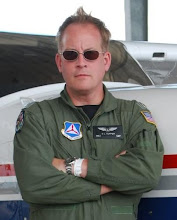

 Posts
Posts


