Monday, January 24, 2011
Flying the Black Rocket: The Northrop T-38 Talon

Monday, January 10, 2011
Still More Frame Grabs from the T-38 Ride
This is a regular blog post. If you’re looking for show notes or links to show audio or video, please check out the other entries.
After getting the Acro Camp trailer ready to show at the Great Lakes International Aviation Conference on Saturday, I sat down to really crank on the episode covering my T-38A ride with the 9th Reconnaissance Wing at Beale AFB. All of the pieces other than the voiceover material is in the can and I’m going through all of the footage again to see where voiceover is necessary in order to help explain what’s happening on screen.
And, of course, that means that I get frame grabs as I go to post here.
The lead shot is an inverted moment out in the MOA. I didn’t have a chamber card, so we had to stay below FL 180. Given the elevation of the terrain, we couldn’t really get in a full loop, but the alternative maneuver was pretty cool regardless. Imagine a slashing loop that’s canted over 45 degrees. That presents a pretty sight out the window. Especially if you roll it at strategic moments like this one.
Here’s a view of three of the cameras that I flew on the sortie. The primary camera is a GoPro HD Hero mounted on the grab handle. Behind it, clamped to the AOA indicator housing, ate two ContourHDs, one looking forward and the other looking 90 degrees left. I also flew with a hand-held ContourHD so that I could shoot footage inside the cockpit.
Like this, in fact. If you look straight down into your lap in the back of a Talon, here’s what you see. I’ve got my sectional strapped down so I can follow along for the route. I also carry a couple of sic sacs, although I’m happy to say that I didn’t need either of them on this sortie. You get a pretty good idea of the ergonomics here. The stick is right there handy. There’s a T-handle on the panel just in front of the stick that moves the pedals fore and aft to give you the best distance. Obviously, the fact that you’re sitting in an ejection seat makes it more practical for the aircraft to have movable pedals than a movable seat. You can raise and lover it within an approx. 5-inch range, but that’s about it for the seat.
Here’s one of my favorite shots. Inverted at 15,500 MSL and 280 KIAS. Clearly, this shot is post-G-ex. You can see that we’ve already pulled/pushed +4.7/-0.8. I think that the range for the whole sortie was +5.0/-1.0.

I like the color in this one. This is just after launch on the first landing – a touch-and-go. We got a total of two takeoffs and two landings and I learned a lot about the sight picture in really pointy aircraft like the T-38. Something about a 160-KIAS short final really gets your attention.
More editing to do this week. I have a couple of proposals to draft for some additional military flights and the T-38 episode is going to be a big part of those packages. I’m really pleased with the way it the footage looks and it’s a lot of fun turning this into a cogent story for you guys. Stay tuned for the full episode, coming soon to a handheld device near you!
Tuesday, September 14, 2010
T-38 Egress Training - Part 2
And now it's time for the "do" phase of the T-38 egress training at Beale AFB. I climb in, strap in, and get a chance to demonstrate what I've learned. And ask a lot more questions!
I'm planning to shoot some more commentary this weekend and then I'll have all of the elements I need to get going on the final edit. Watch for the finished episode in October.
Sunday, September 12, 2010
Raw Footage: T-38 Egress Training - Part 1b
Saturday, September 11, 2010
Raw Footage: T-38 Egress Training Part 1a
Sunday, July 18, 2010
Post-Production Begins on T-38 Episode
This is a regular blog post. Please check out the other posts if you’re looking for show notes or links to show audio or video.
The adrenaline rush from the T-38 ride at Beale has subsided just enough that I can sit down and begin to rationally inventory the content that we captured on the trip. I spent part of this afternoon going through some of Mark LaCoste’s still pictures. While Mark was primarily handling video, he also shot some really good stills.
I flew four cameras on the sortie – three mounted and one hand-held. Here, I’m mounting a couple of ContourHDs. You can see the GoPro HD Hero through the glass just opposite where my belt buckle would be if I was wearing a belt. I had given a lot of thought beforehand about where to mount the cameras, so the mounting and setting took only about five minutes. The crew chief was really helpful, too, in selecting where to put the hardware.
Here, LtCol Gary MacLeod finished checking out my harness and making sore that nothing in the back cockpit becomes FOD. (Yeah, you pay close attention that. You do engine start and taxi with the canopies open for ventilation. The intakes are just abeam the rear cockpit and anything loose in that cockpit will instantly be ingested into the engines. Which would matter greatly even if the engine weren’t 50-odd years old. And, even though they've been overhuled many times, they're - well - 50 years old.
Getting ready to go. I’m setting up the audio recorder.
I’m really excited about this episode. Can you tell? Contrary to prior practice, I think I have enough video – and it’s strong enough stuff – that I think this is going to be an all-video treatment. I’ll likely do an audio treatment as well on some of the more meta aspects of the flight, but this feels like a video thing. More soon as I get the rest of the inventory done and start writing the script and figuring out what other on-camera narrative input I need to film here in Michigan.
Vectren Dayton Airshow 2010 - Saturday
This is a regular blog post. Be sure to check out the other posts, many of which contain show notes and links to show audio and video.
I spent yesterday at the first show day of the Vectren Dayton Airshow. Probably the largest show I’ll hit this year other than Oshkosh. Really well laid out and very nice facilities for media. I’m grateful to the organizers for the access that made this a great first experience at Dayton.
As usual, I get pulled in many different directions at these things. In the best way. To a large extent, what I see from the crowd line has more to do with what other opportunities I’m covering on the field. It might take five or six shows before I get to see all of the performers that performed at any given show site. But that’s okay.
This was my first time seeing Kyle and Amanda Franklin’s wing walking act. I’ve said before that I’m not so into wing-walking. I appreciate the difficulty and skill, but – as always – my thing is chasing things that I’d like to do. I’d love to go fly that beautiful Waco JMF-7 Mystery Ship. But firmly strapped into the cockpit and cranking it around a bit.
They say that people watch NASCAR or airshows or whatever for one of two reasons: To witness the skill and performance or to see a crash or other tragedy. I’m very much about the former interest. I harbor the view that wing walking caters to the latter interest. Am I a bad airshow fan for thinking that? Am I a wuss for being conflicted about it? Would Kyle or Amanda take umbrage? (They are, by all accounts, wonderful folks and I’d sure hate to give the least offense.)
And there’s beauty in that solitary figure on top of the wing challenging the wind blast. I know it’s a team (somebody has to fly the airplane), but the image that gets me is the strange combination of vulnerability and strength in that image. I rarely blow up images that I take at airshows and hang them up in my office. But one of the images for which I’ve done that is a shot of Theresa Stokes atop Gene Soucy’s Show Cat from Selfridge three years ago. It’s really dramatic in a way that doesn’t happen with other acts. Maybe it’s that you can see the performer from head to toe. The performer is not the airplane, as is the case with the other aerobatic acts. Maybe that’s why I like Greg Koontz’s act so much. In the Clem Cleaver act, you get to see Greg out there with the airplane and he flies low with the door off, so you actually get a sense of the man as well as the machine.
Anyway, above is the best of the images of Kyle and Amanda that I was able to capture. I’m not the guy with the long lens (I shoot with a Costco special from Nikon that came with a reasonably capable 200mm zoom), so there’s a fair amount of cropping involved, but I’m pleased with this one. And it evokes that vulnerable, yet defiant thing.
Capt Ryan Corrigan of the Viper East Demo Team put the F-16 through its paces. Really nice display. And the humidity was just about right so that it wasn’t too hazy to shoot, yet the aircraft created excellent vapor on the wings when pulling Gs (which was most of the time).
The show hosted two B-17s. This is the Commemorative Air Force’s B-17F, Sentimental Journey. She has been everything from a bomber in the Pacific theatre to a photo reconnaissance platform to a fire fighting platform. The CAF Arizona Wing acquired the aircraft in 1979 and has been operating it since then.
What’s better than a C-130? An aerobatic C-130 flown by steely-eyed and slightly crazy Marines. The days of JATO launches are over, but I can’t seem to get bothered by that. It’s just stinking majestic to see this bird fly and be as nimble as it is, notwithstanding its 76,000-lb (empty) weight. Plus, a Fat Albert pass is an opportunity for us guys with the shorter lenses to actually get a better shot than the long-lensed shooters. Although I was kind of jealous of one guy who actually got the face of the rider up in the dome on top of the aircraft.
This is also the first time in years that I was close enough to the Blues to be able to see them step. In a very real sense, the demo begins a good 15 minutes prior to takeoff. They do the precision step even though 99% of the crowd can’t see it, and even when they stage across the field and almost no one can see it.
I often talk about stomping the ramp or doing the Haka prior to a flight. The Haka part is mainly in jest. (But only mainly.) But a preflight routine of almost any kind focuses you and serves as the thing that separates two-dimensional activities from the impending three-dimensional activities. And that’s a good thing. You’re about to go do something completely divergent from what our species is used to. You’re about to go and fly on behalf of those homo sapiens who lived during the 200,000 years prior to aviation. It’s serious business and it sends a chill up my spine every time. Maybe the Haka isn’t such a bad idea. Say on the ramp at KBAK for NESA MAS next year?
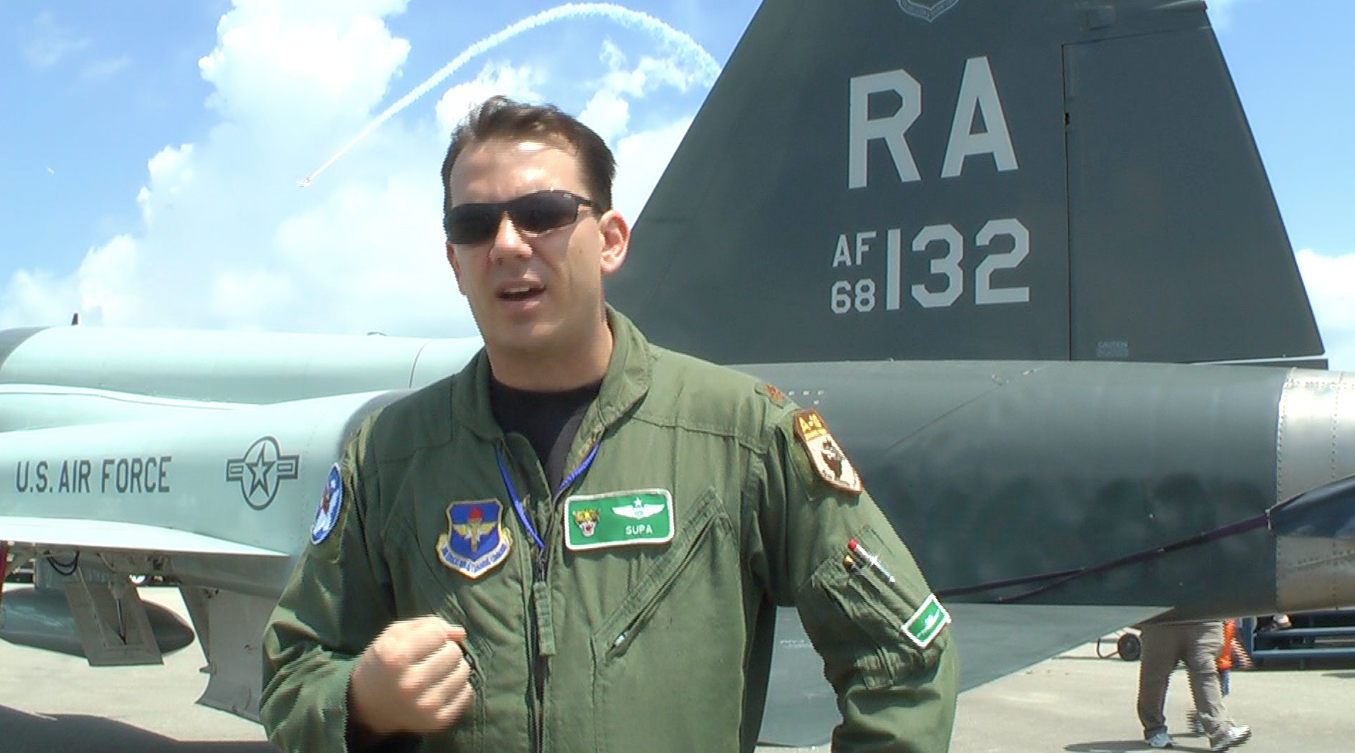
I also interviewed Maj Luke “Supa” Fricke, a T-38 IP from the 560th Flying Training Sqn, 12th Flying Training Wing at Randolph AFB near San Antonio, Texas. He’s an IP in the T-38C who makes other IPs for a living. He started out in the T-37 Tweet and then moved to the T-38 for advanced training. He then did a stint as a T-38 first-assignment instructor pilot (“FAIP”) before going on to fly the A-10 Thunderbolt II (the iconic “Warthog”) for 13 years before heading to Randolph to train instructors in the T-38C.
I’m going to use the footage to supplement the T-38 ride footage from the Beale AFB flight last week. We weren’t able to do a planeside interview at Beale because of the amount of noise on the ramp (not a bad thing, mind you – I adore that kind of noise). So the planeside footage of Maj Fricke will go nicely with the episode. I also got some beauty shots of the airframe to drop into the episode at strategic moments.
Maj Fricke did a great job in the interview. He was nearly perfect at working each question into his answer so none of my voice had to be in the interview. He also did a great job of stopping and restarting at logical points when the AeroShell T-6s drowned him out momentarily. (Note the T-6 smoke arc behind him in this frame grab, which was unplanned but kind of cool.) I’m guessing that he’s done this before. I hope his PAO knows what a great ambassador he or she has in Supa.
So now it’s back to the grindstone for a week and a half until Oshkosh. I’m planning to leave southeast Michigan at oh-dark-thirty the morning of Wednesday 28 July and hit the American Champion factory on the way to OSH. FOD and I should make it there late afternoon and then be on the grounds through Saturday mid-day. I’ll tweet the lat-long for Firebase Airspeed as soon as we get settled in. See you there!
Friday, July 16, 2010
Vectren Dayton Airshow 2010 - Media Day

This is a regular blog post. If you’re looking for show notes or links to show audio, they’re here on the site, just in the other posts.
I spent the day at the Vectren Dayton Airshow here in Dayton, Ohio, where, in addition to hitting the show, I’m visiting my college roommate, Jim Davis.
This is my first year hitting Dayton. I can tell you already that I like the layout and the media situation and I’m looking forward to getting out on the grounds tomorrow to see the show in full swing. The Blue Angels are headlining and I got to see the team’s practice demo. It seems to be a little longer than I remember and it has several elements that are different from last year.

I spend the early afternoon getting a ride in Flagship Detroit, the oldest fully-restored DC-3 flying today (SN 45, delivered to American Airlines in 1937.). This ‘three is owned and operated by the Flagship Detroit Foundation.

Lewis Drake and John Thatcher took Jim, me, and about a dozen other media reps out for about 0.6 to demonstrate the airplane. I flew a couple of video cameras, but the footage didn’t work very well. I mounted the Hero up on the top rear of the cockpit and a ContourHD on the flight engineer’s table. As I sat in the back looking up into the cockpit, I realized that that placement wasn’t working well, largely because the guy at the flight engineer’s seat kept lifting his still camera up directly in front of the Hero and shooting. And there was the parade of other media folks in front of the camera.
No biggie, though. I got several sequences that I’ll likely be able to use in a later episode. And I plugged in the audio recorder and captured the intercom and ATC chatter. I haven’t had the opportunity yet to listen to the audio. But I explained to Lewis what the audio recorder was as I was de-installing it from the rear headset jack. And he said something to the effect of “Oh! Did you get the landing?” Which leads me to believe that there might be some fun stuff on the tape, both there and elsewhere. Lewis was enthusiastic and fun to be around. I can’t wait to audition that audio. I might do it on the drive home.
I’m always conflicted about riding in a DC-3 or a C-47. Clearly, I love the airframe or I wouldn’t have gone all the way to Griffin and done a type rating training course in it. But I got the type rating to fly it, after all. I think I was a good passenger despite myself. As often as I make the joke about the pilots having the fish and being called upon to dash to the cockpit to land the airplane, this is one airliner that I know I can actually land. And that makes it weird somehow.
Dan Gryder’s Herpa DC-3 was perfectly serviceable and hat its own gritty freight-dog appeal. I heard Dan say in an interview once on the 25 Zulu Show that N143D greasy and oily and he kept trying to talk people out of coming to train in it, but that they kept showing up to fly it. Yeah, I’m one of those guys. And I’m (and many others are) good with that.
Flagship Detroit, on the other hand is pristine. The cockpit is clean and shiny. New(er) gages and dials and a clean panel. The Spirit harkens to a different line of history that the same airframe serves. This is the airplane that made air travel more common, even if not commonplace. It’s a different vibe. Neither better nor worse. Just different. And, for the record, I’d happily fly either of them tomorrow. Or right now, for that matter. Heck, I’m tailwheel current . . .

Randolph AFB sent a couple of T-38Cs to the show and they were flying earlier in the day. There are a couple of Vipers on the ramp, too. I met the pilots. And, of course, there’s a T-6A.
Airshows are becoming reunions of my dreams. Nodes of convergence by the gossamer functions that are these aircraft – these things that I first grew to love here on the tarmac and then pursued. Perhaps you’ve heard the line about the dog that chases cars and about what a dog like that would do if he actually caught one. In some sense, I’m that dog. And I’ve caught a few cars.
Walking around the ramp on a day like today is an opportunity to reflect on how fortunate I’ve been to experience these aircraft, how hard I need to work to come up with a great episode for the T-38 ride to justify the trust that the Air Force placed in me, and the vast chasm between my abilities and the abilities of those pilots who regularly fly these aircraft.

I mentioned at the beginning of this post that I’m visiting Jim (“Gumby”) Davis, who’s a senior desk editor at the Troy Daily News. Gumby and I roomed together for the last two and a half years that I went to Albion College. We were on 2nd East Seaton 1986-87 and then roommates in the Delt Sig house 1987-88. We spent many a sleepless night studying (or not) and once came within two hours of breaking the Delt Sig stay-awake record of 70 straight hours. Many an excellent memory is being re-lived and the deepest, darkest corners of my iPod are being plumbed for obscure stuff that I couldn’t fathom why was there until a few hours ago.
We’re hitting the show again tomorrow to see what we can see. In the meantime, though, we’re heading out for some food and a beer or three.
Wednesday, July 14, 2010
Firebase Airspeed - Beale AFB Style
There are the show notes to an audio episode. You can listen to the show audio by clicking here: http://traffic.libsyn.com/airspeed/AirspeedFirebaseBeale.mp3. Better yet, subscribe to Airspeed through iTunes or your other favorite podcatcher. It’s all free!
Jo Hunter (www.futurshox.net) and Mark LaCoste (www.twitter.com/stdntpilotmark) joined me at Beale to shoot stills and video, respectively. And, as is the custom of merry bands of new-media producers, we gathered around an MP3 recorder to talk about the experience and get some content out into the podsphere.
This session happened in the VOQ at Beale Air Force Base about 45 minutes north of Sacramento, California on the morning of my T-38 ride.
We’re compiling the video, audio, and stills and I should have content get into the feed soon!
First Frame Grabs from the T-38 Talon Ride

Tuesday, July 13, 2010
On the Eve of the Talon Ride

This is a regular blog entry. If you’re looking for show notes or liks to show audio or video, please check out the other entries.
Many thanks to Jo Hunter (www.futurshox.net) for shooting the stills in this entry and to Mark LaCoste for shooting video and providing really valuable Air Force background and commentary from his experiences as an F-15 Eagle maintainer.
Okay, I’m going on radar. (It seems as though I’ve been using that line frequently lately!)
I’ve been here at Beale AFB, about 45 minutes north of Sacramento, since Sunday afternoon. This morning, I completed my flight physical. That’s the last hurdle over which I have any control and thus the event after which I go on radar with you guys. So I can tell you that I’m on the verge of completing the trifecta: Completing demo rides in examples of aircraft from each phase of the fighter-bomber track.
As most of you know, I have logged time in the T-6A and the F-16. That leaves only the Phase 3 aircraft – In this case, the mighty T-38 Talon. I’ve been working with the 9th Reconnaissance Wing for a few months to get things lined up and now it’s scheduled to happen tomorrow. I show at 1345 local and step at 1530 local for an approx. 1.5-hour flight.
Today was mostly preliminaries. I got the flight physical done and then did a base tour. After lunch, it was time for the egress training, parachute training, survival kit orientation, and local survival training.

The egress training is always the most interesting of the pre-flight activities. You have a training cockpit and you learn how to get in, strap in, get the canopy closed, and be ready to fly. Then it’s all about emergency procedures. You learn how to egress (get the hell out of the airplane on the ground in case of fire or other danger) and how to eject.
Capt Gorman walked me through the egress training first, and then I climbed in and demonstrated my understanding. It takes doing it two or three times to figure out what you’re doing, but it comes pretty quickly if you’ve paid attention.

Then it’s all about the parachute. We walked through what to expect in an ejection and how to recognize and troubleshoot parachute malfunctions. Probably the most interesting part came with the personal lowering device (or “PLD”). The idea is that you might make it from 15,000 ft. AGL to 50 AGL just fine, but be hung up in a tree and need to get yourself the rest of the way down unassisted. With the PLD, you can do just that but connecting it to a tree branch or (if your parachute is firmly lodged in the tree) the parachute itself and then pulling the harness releases and lowering yourself with a breaker bar.
I actually got to perform the whole procedure suspended from the ceiling. For the record, it was pretty straightforward and I think I accomplished it with aplomb. One demonstrated parachute landing fall later, I was signed off and the pre-flight training was complete.
Next was life support for the G-suit, helmet, and mask. This is my third time getting fitted for this equipment. Although the fittings have been roughly a year apart, I’m pleased to report that it seems that I remember perfectly well how to don and doff a G-suit. And a helmet and mask. And check out the breathing apparatus at the test station. Not that I’m anywhere close to being a fighter jock. But it gets the heart beating a little quicker when you walk into a place like the base life support room and it turns out that you know what to do.

So, in the quiet and dark of yet another locker at yet another Air Force base, there sits another G-suit, helmet, and mask. And they have my name associated with them. Tomorrow I again get to taste a little bit of that fleeting dream that began in 1971 with a book about Joe McConnell, Jr. and the F-86 Sabre. Tomorrow I step to complete the trifecta. And maybe I get a little closer to understanding what lives inside every pilot and aviation enthusiast.
And, most of all, I hope that I again feel that spark that will keep me up at night for the next couple of months composing, editing, writing, and bringing you guys another account from the edge of the envelope.
G’night for now. Sleep if you can. I’m going to go toss and turn for awhile. Wouldn’t you?
Invertor et vomens! Smoke on!