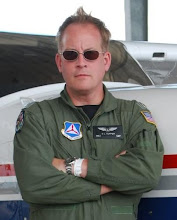
Monday, September 24, 2007

Why I Fly


Subscribe to Airspeed through iTunes or your favorite other podcatcher, listen to audio at http://airspeed.libsyn.com/, or download directly at http://media.libsyn.com/media/airspeed/AirspeedWhyIFly.mp3.

Flying has to be about the most expensive, demanding, and exasperating thing that I’ve ever loved. In fact, many of those qualities are at the core of the reason that I love it. Sometimes that’s counterintuitive to non-aviators. They wonder why I and my fellows do as we do. So I thought about it for awhile.

On a recent Sunday afternoon, I took my five-year-old son, Cole, to an FBO at the airport. He sat and watched his Speed Racer DVD on the portable player with headphones while I flew practice approaches and holds on a simulator in preparation for an instrument stage check.

The FBO with the simulators is near the southeast corner of the airport and just a few hundred feet south down Airport Road from the fence where you can stand in the parking lot of an avionics shop and watch the airplanes landing on 27L and 27R. It was a beautiful afternoon, so I grabbed the radio out of my flight bag, tuned in the tower, and walked with Cole up to the fence. Not much going on, but I did hear one twin Cessna out at ERNST get clearance to shoot the backcourse for 27L. I explained to Cole where to look for the twin and we watched it come in and grease the landing.

Not much else going on and we were just getting ready to walk back to the car when a Jeep pulled in off of Airport Road and stopped in the little parking lot. A guy in his forties or fifties got out.

“Are you a pilot?” the guy said.

It’s a post-911 world, and the thought occurred to me that this might be the airport manager or someone similar who was uncomfortable about a guy with a radio standing by the fence. I explained that I was, indeed, a pilot and that I was an instrument student in a Part 141 program kitty-corner across the field, taking care to use as many code words as possible to convey to the guy that I belonged there and that I posed no threat.

I needn’t have worried. “Oh, that’s great!” he said. “I saw you and your boy there watching the planes and was going to stop and offer you a ride in an airplane. I have a light twin here at the airport.”

We talked some more. Turns out that he’s a Northwest 757 captain who flew Phantoms for the Marine Corps before joining the airlines. I expressed the requisite awe (mainly because I genuinely felt it) and he shook it off diplomatically.

We exchanged business cards and shot the bull for a few more minutes and then he was off with a smile and a wave.

What a cool thing. I belong to a group that includes this guy. A guy who regularly flies more than 200 people 2,500 miles at Mach-point-eight and who used to fire guided munitions inverted and under spleen-crushing gee-loads with his hair on fire – all before lunch. He sees a suburban schlub and his five-year-old with their noses pressed against the fence at the airport on a Sunday afternoon and his heart’s fondest desire is to load them into his airplane and show them the place where they were standing from a thousand feet up.

And, as cool as that was and is, it gets better. It would not surprise me if Cole and I were just two of dozens, if not hundreds, of people that got offers just like that one along airport fences all over the country and all over the world that day and other days like it.

I fly because I am honored to count myself in the fellowship that includes that guy.

Robert A. Heinlein wrote that “[a] human being should be able to change a diaper, plan an invasion, butcher a hog, conn a ship, design a building, write a sonnet, balance accounts, build a wall, set a bone, comfort the dying, take orders, give orders, cooperate, act alone, solve equations, analyze a new problem, pitch manure, program a computer, cook a tasty meal, fight efficiently, die gallantly. Specialization is for insects.”

It is a proper thing for free men and women to be jacks of as many trades as they can practice.

I fly because it is part of the renaissance that many take for granted.

Many, if not most, pilots fly better than I do. But it is within my comprehension, skills, and will, to fly competently and safely.

If flying were easy, everyone would do it. In some ways, flying is the hardest thing I’ve ever done. Flight is singular in providing a challenge by which to measure one’s self.

I fly because it’s hard.

The other 98% of the American public – and even greater proportions of humanity elsewhere in the world – lives out lifetime after lifetime not knowing of a genuine third dimension that unfolds as little as five hundred feet above its collective head.

Timothy Ferris wrote in his book about astronomy, Seeing in the Dark, that most people, when asked to extend an arm up and point to a right ascension halfway between the horizon and the local zenith, choose an angle that’s a good 10 to 20 degrees low. That’s because most people literally don’t think of the sky as including anything that they don’t normally see from under their own eyebrows. The 40 degrees or so of sky directly above – 20 degrees each side of vertical – just doesn’t exist for most people. Who can blame them when most live in urban areas where the sky glows with a dimly yellow sodium iridescence from sundown to sunup and all but the brightest stars and planets are obscured?

But just a little way up, there’s a different world. Even VFR, you see things from the cockpit of a general aviation aircraft that others just don’t see. The sun reflected on a frozen lake. Freeway traffic moving or not moving, according to the time of day. Crops being sown and harvested.

And IFR is yet another story. There’s nothing like climbing up from the solid gray world as it gets brighter and then more ragged and varied, and then you finally climb into the sun. If you’re really lucky, ATC assigns an altitude that lets you just drag your wheels in the clouds and stir the hillocks and mounds of piled cotton with your wingtip vortices.

Many fly commercially and that does count for something. But the view out the side window of a human mailing tube simply cannot compare to the view out the front window. Meeting an aircraft-carrier-sized cumulous cloud head-on and broadside five thousand feet up in a painfully blue summer sky – That’s what I’m taking about.

I fly because I never, ever get tired of that.

All of the eggs of my species are in one basket. Every aspiration, dream, or idea – Every song, novel, poem, speech, or thought of homo sapiens has occurred within about 250,000 miles of the surface of this planet. The overwhelming majority within 100 feet of it.

It is likely that there exist one or more asteroids or comets between the sun and the Oort Cloud that has our planet’s name on it. It is all but certain that a cataclysmic impact has radically changed our planet’s climate and habitability at least once in the last 65 million years. If you think of thing in terms of the right timeframe, it is almost certain that this will happen again. The time frame in which I am thinking includes the time when humankind will still be in existence.

I am as subject to the rhetoric of exploration and adventure as anyone. From Buzz Aldrin to Jack Schmidt to thousands of others before and since, I believe in the human need to explore.

But even if I didn’t, it is a matter of survival of the species that we develop the technology, practices, personnel, and political will to place some seed of our species in another place. That we allocate our eggs to more than one basket.

I fly because it gives me a broader understanding of the technical and emotional challenges associated with aerospace and grand missions such as outboud colonization and because, in some small way, it gives me the credibility as an advocate and teacher who can explain this imperative to others.

I was cruising the web the other day and I came across one of the most intriguing airplanes I’ve ever seen.

At a small airport in western Pennsylvania lives a Cessna 150, tail number N66089. It’s like many other Cessna 150s of its vintage – except that it is painted in the blue and gold livery of the United States Navy Blue Angels. A Cessna 150 has about 100 horsepower under the cowling, cruises at 90 to 100 knots, and climbs at about 600 feet per minute on a good day. The Blues haven’t flown aircraft since 1949 that wouldn’t stall at the Cessna’s cruise speed. Yet there exists a humble Cessna 150 that bears the blue and the gold.

I fly because someone in Pennsylvania painted a humble Cessna 150 in the livery of the Blue Angels, probably has a ball flying it, and probably doesn’t give a tinker’s damn what anyone thinks about it.

In many ways, I am 089. And so are you. And neither you nor I give a tinker’s damn who might have a problem with that.

I once saw an IMAX movie about the Space Transportation System (some call it the Space Shuttle). It was telephoto footage of the system about 30 seconds after launch. It’s a little hazy because the camera is looking through so much atmosphere and because it’s humid there in Florida. It adds a dreamlike quality. You can see the orbiter’s engine bell. It’s spitting exhaust and going like a bat out of hell. You can see the engine bell vibrating – flopping around a little. Then they throttle up and the bell just snaps to. No more visible vibration. Rock solid. Holding the strain in perfect balance. Taut. Going flat out at 110% or more of rated power.

I fly because humans can make machines like that that can bear them off of the world of their birth. I fly because the best and highest energies of humankind have, at every point since 1903, been best demonstrated by the then-current aircraft and spacecraft.

One of the most inspiring sights I’ve ever seen is a flight of the Grumman Cats. It was at the Kalamazoo Air Show in 1992 or so. The museum maintained an F4F Wildcat, an F6F Hellcat, F7F Tigercat, an F8F Bearcat, and an F9F Panther. The Navy supplied an F-14 Tomcat for the formation. The formation had to be very carefully executed because the Wildcat’s top speed is just about the same as the Tomcat’s stall speed.

On the last pass, the formation flew the Missing Man. All you hear as the formation comes in are rotary engines. Then, just before the formation overflies the crowd, the Tomcat lights up the afterburners and pulls up to the near vertical and all you hear is the thunder of the twin Pratt & Whitneys as the Tomcat heads up into the blue.

I challenge you to experience that and not get severely choked up. If you can, we can’t be friends.

I fly because there are men and women who bridge time and space by restoring, maintaining, and flying these aircraft and I want to be at least a little like them.

Flying – at least flying of the kind most worth doing – requires courage. It’s not courageous to do a thing that holds no challenge for you. It is also not courageous to do a thing in which you’re incapable of recognizing the risks. The former is overconfidence and the latter is stupidity. For me, having flown is having met the enemy – certain of my insecurities – in the sky where they were familiar and I was not. Continuing to fly is to continue to subject myself to an environment that requires commitment, training, skill, and nerve.

I fly because it is courageous to do so.

Ever see a jet demonstration team perform a high show? About halfway through the show, they do the sneak pass. I saw it one particular time during the Blue Angels’ show at Selfridge ANGB in May of 2005.

You’ve just watched the diamond go by and you haven’t quite thought about where the solos are. Then they’re right on top of you. Two McDonnell Douglas F/A-18 Hornets from behind at more than 500 knots and less than 1,000 feet off the deck. They make a sound like someone is unzipping the very sky. Tens of thousands of people freeze simultaneously. No one even has the presence of mind to look up. There’s no time. It’s suddenly just there. It grabs you in the small of the back, runs up your spine, and grabs you again at the back of your neck and just shakes you.

I was there. I was in full military battle dress uniform. I was a number-one badass in my narrow shades and my shiny boots. And I heard that. I was rooted to the spot. Everything else was silent. It seemed to last for minutes. And I realized that my face was wet. And I didn’t care who saw.

I fly because I want to be a part of that. No matter how small the part, I want to be a part of something like that.

Lastly, have you noticed that all of the best dreams are about flying? All of them. Sure, there’s music and there are various reasons for the flying from love to victory to every other happy thing. But it remains that there’s always flying. Even those who have never flown in an aircraft of any kind fly in their dreams. It is natural and instinctive in the human psyche that flight necessarily accompanies love and victory and the fondest desires of the heart and mind.

Play double basses and mandolins, write novels, heal the sick, coax sustenance from the ground, launch rockets, and fly jets. These are things that humans do. Because, if we work long enough and hard enough – and if we are lucky enough – we can do these things. Just us. With our opposable thumbs and out oversized braincases and our boundless curiosity.

I fly because to do so is to be one with the highest aspirations of my species. To daily demonstrate that homo sapiens is no longer earthbound. To taste some small piece of what it will be like when we take our first real steps into the cosmos.

That’s why I fly.

__________________________

Music: Jon Schmidt, Prelude - from the Podsafe Music Network. Check it out at music.podshow.com or see Jon's website at http://www.jonschnidt.com/.

Monday, September 17, 2007

Stage Check Almost Complete


I'd consider throwing all of my approach plates in the lake at this point, but I fear that, even with dual VORs, IFR-certified GPS, and vectors, I'd have trouble finding the lake.

I had my final stage check this afternoon - well, most of it. 2.1 under the hood with rapid-fire changes of clearance, two holds (one VOR and one at an airway waypoint), a DME arc, unusual attitude recoveries (both full and partial panel), compass turns, approach and departure stalls under the hood, and a takeoff under the hood. That's f%&$ing work! I was a noodle by the end.

My check pilot (the senior training pilot at Tradewinds) had a headset malfunction when the portion near the plug separated and made it tough for him to hear. So we shouted at each other for most of the maneuvers (par for the course on some of my flights, even when the instructor's headset is fully funcitonal) and packed it in at the end.

We'll do the approaches and clean up the other stuff soon. Gotta go fly some sim between now and then, especially partial-panel approaches.

Here's N916TA, a Cessna 172R in which I've probably logged 20-30 hours. It and its sister aircraft, N920TA, have two-axis autopilots and an audio Aux input (great for iPod addition to your avionics). 16 and 20 are contemporaries of N918TA, the subject of the So Long, One-Eight! episode. Nice aircraft and none older than 2002. N915TA is a glass-panel (Garmin G-1000) is also on the line, but I'm going to finish up the rating with the steam gages and then maybe transition.


Wonder why I like Tradewinds? Here's my walk from the lobby to the Pilot Center flight line. Right past the King Airs and the Hawkers. Got to like that. And look at the floor! Could you eat off of that or what?

Last thing: I'm the guest on Episode 3 of The Pilot's Flight PodLog, which you'll recall is Will Hawkins' new podcast. Check it out and subscribe to Will's new podcast at iTunes or your favorite other podcatcher or listen online at http://media.libsyn.com/media/pilotwill/pilots_flight_podcast_3.mp3.

Sunday, September 16, 2007

Paul Stambaugh's Hangar Party at KARB


This is a regular blog post. If you're looking for the current show notes, please check the entries below this one.

Nothing quite like a hangar party on a nearly perfect September day! Paul Stambaugh (whom you'll remember from the Airspeed episode "Lunch with Aerobatic Pilot Paul Stambaugh" (listen at http://media.libsyn.com/media/airspeed/AirspeedStambaughLong.mp3) and another hangar renter at Ann Arbor Municipal Airport (KARB) again hosted their "Fly "em If You Got 'Em" hangar party on September 15. I took Cole and Ella to the last one two years ago and brought them again this time.

Paul got out his Pitts "Psycho Therapy" and, together with another gentleman who brough along a WWII Navy trainer named California Girl (the designation of which escapes me - If you recognize it, please e-mail me at steve@airspeedonline.com), treated us to a couple of cool passes. The hangar is located at the departure end of Runway 24 (3,500' x 75' asphalt) so we could see departures and arrivals at the end of the hangar row. Last time, Runway 6 was active so we saw climbouts.

This shot is of Paul's high-speed pass.

Here's California Girl during one of two formation passes that the two aircraft did. She led the formation.

The first of two shots of one of the formation passes. Although Paul in the Pitts was well behind California Girl and there's some forced perspective here, the size difference is reasonably well portrayed.

My favorite shot ot the day. This was just after the previous picture when Paul in the Pitts had just settled into train with California Girl. Nice clouds and the lighting from in front of the aircraft here really worked well.

Wednesday, September 12, 2007

Cirrus G3 Part 2 - Alan Klapmeier

Subscribe to Airspeed through iTunes or your favorite other podcatcher, listen to audio at http://airspeed.libsyn.com/, or download directly at http://media.libsyn.com/media/airspeed/AirspeedCirrusG3Part2.mp3.

In this episode, we follow up the Cirrus SR22 GTS Turbo demo ride with a conversation with Alan Klapmeier, co-founder, chairman, and CEO of Cirrus Design. We talk about the Cirrus philosophy and the third-generation Cirrus aircraft, as well as Cirrus' entry into both the jet and light sport markets.

See the show notes below for more information about the ride in the GTS and how to get a ride yourself!

Cirrus Contact Information

Cirrus Design:
http://www.cirrusdesign.com/
http://www.cirrusdesign.com/contact/
info@cirrusdesign.com

Friday, August 31, 2007

Cirrus G3 Part 1 - Test Flying the Cirrus SR22 GTS Turbo


Subscribe to Airspeed through iTunes or your favorite other podcatcher, listen to audio at http://airspeed.libsyn.com/, or download directly at http://media.libsyn.com/media/airspeed/AirspeedCirrusG3Part1.mp3.

Another installment of flying OPA (other people's airplanes)! I took a ride in the Cirrus SR22 GTS Turbo pictured here. Cirrus Design and AirShares Elite attended the annual open house a few weeks ago at my home airport, the Oakland County International Airport (called "Pontiac") (KPTK) and brought along three gorgeous Cirrus SR22s, all with the third-generation technology recently introduced by Cirrus.

I've see the Cirrus display at Pontiac several times, but have always been on duty with the Civil Air Patrol and unable to go try to get a demo flight. But with Cirrus's introduction of the G3 line this year, I decided to make a special effort and drop in on the Friday prior to the open house for a demo ride.

I went with high expectations and I was not disappointed.

You're going to have to listen to the audio of this ride to get the full effect. (See above for the direct link to the audio). It's much easier to listen in to the cockpit conversation and you get a better feel for the experience. That said, here are some highlights.


It's a gorgeous aircraft and it flies like . . . What the hell does it fly like? How do you explain doing 1.3 Vso banked over 45 degrees and still feeling effective aileron control? Climbing at nearly 1,400 FPM on a warm day with three guys in the aircraft? It's just wonderful.


Am I a Cirrus fanboy? Maybe. I'm a C-172 jockey and don't fly a lot of high-performance aircraft. So, in fairness, it's possible that I would have been just as wowed by any high-performance aircraft and that Cirrus has no special sauce. But I think not. The handling, intuitive controls, and responsiveness sure felt special. The airplane just obeyed. Know what I mean?


I concluded long ago that it was unlikely that I would ever launch single-pilot IFR into anything hairier than a 200-foot broken layer. But I could really imagine the SR22 being a genuine go-places airplane that could be a fully-adequate platform for single-pilot IFR, even by a relatively low-time pilot like me. Sure, I'd want to train up and become thoroughly familiar with the systems and maintain currency and proficiency. But the point is that this aircraft made me seriously re-think the idea of single-pilot IFR in the first place. It's that capable and robust. It made me re-think the potential missions that my instrument ticket would open up to me.


Here's the aircraft from the front. Those gull-wing doors are more than just pretty. They allow the back seat passengers to step from the wing into the rear footwells while still standing up. They need then only sit down and buckle in. No crawling onto the aircraft all bent-over.


And the three-bladed composite prop grabs air in front of you and turns it into air behind you efficiently and effectively.


Gorgeous interior. All white leather. This shot shows the Avidyne glass panels and other avionics. Radios and autopilot are on the center post. Throttle and mix on down by your leg. Side-stick controls are completely intuitive for the yoke-jockey and I can't imagine that stick-and-rudder flyers would have much trouble transitioning.


The flight displays, coupled with the side-stick controls, make the frontal presentation elegant and intuitive. It's like flying your living room. Only the inertial forces are cooler. And the PFD is actually better than my TV.


These show notes just scratch the surface. Make sure that you listen to the audio.

In addition to this audio, Part 2 will feature an interview with Cirrus co-founder, chairman, and CEO Alan Klapmeier. Look for the episode in a couple of weeks.


Specs (from Cirrus)

Dimensions
Length 26 ft
Height 8 ft 9 in
Wingspan 38 ft 4 in
Cabin Length 130 in
Cabin Width 49 in
Cabin Height 50 in

Design Weights & Loading*
Maximum Gross Weight 3,400 lbs
Standard Empty Weight 2,330 lbs
Useful Load 1,070 lbs
Usable Fuel Capacity 92 gal/552 lbs

* Weights and loading based on base model SR22 Turbo configuration. Actual Useful Loads and individual aircraft weights will vary depending on options installed on aircraft. Always consult specific aircraft weight and balance data for flight planning.

Performance
Takeoff 1,028 ft
Takeoff Over 50 ft Object 1,594 ft
Climb Rate 1,400 ft/min
Max Operating Altitude FL250 (25,000 ft)
Stall Speed with Flaps 60 KCAS
Max Cruise Speed 219 KTAS
Cruise Range w/Reserve (75% pwr) 925 nm
Maximum Range w/Reserve (55% pwr) 1,000 nm
Landing Ground Roll 1,141 ft
Landing Over 50 ft Object 2,344 ft

Engine
Manufacturer Continental
Model IO-550-N
Turbo-normalizing System Tornado Alley
Horsepower 310


Contact Information

Cirrus Design
http://www.cirrusdesign.com/
http://www.cirrusdesign.com/contact/
info@cirrusdesign.com

AirShares Elite
Creig M. Kelley - Regional Director
6230 North Service Road
Waterford, Michigan 48327
Office 248-666-5646
Mobile 989-859-7650
Fax 248-666-5647
ckelley@airshareselite.com
http://www.airshareselite.com/

Tuesday, August 21, 2007

The Airspeed Pilot Shop is Open for Business

This is a regular blog post. If you're looking for show notes from an episode, please see below.

The Airspeed Pilot Shop is now open for business at Cafe Press. Get your favorite aviation podcaster's noggin on T-shirts, barbecue-wear, baseball shirts, and mugs - along with witty, profound, and even inspiring commentary. All net proceeds go into producing and hosting the show. (And, believe me, they're very "net" to make the stuff affordable for you. We know that every one of your dollars has to compete with your avgas pusher.)

So get your Airspeed gear today at www.cafepress.com/airspeedonline.


Great rags. Great podcast. What's not to like?

(No, thongs are not available. Sorry!)

Pilot Will Hawkins Starts Next Podcast

This is a regular blog post. Looking for show notes? See below.

Will Hawkins of The Student Pilot Flight PodLog is starting his next venture in the Podsphere!

Will has already posted Episode 0 of The Pilot's Flight PodLog. See http://pilotwill.libsyn.com/ and subscrbe through iTunes or your favorite other podcatcher. Will will swap stories of his aviation exploits with guests and feature yet other accounts by listeners and other contributors. Look for the first full episode soon, which is slated to feature hangar-flying with Pilot Kent of The Pilotcast. Yours truly will also join as soon as Will and I can both carve out some time.

Now if only Will could operate Skype! (And then teach me!)

Wednesday, August 08, 2007

Aerobatic Ride with Michael Mancuso in the Extra 300L


Subscribe to Airspeed through iTunes or your favorite other podcatcher, listen to audio at http://airspeed.libsyn.com/, or download directly at http://media.libsyn.com/media/airspeed/MancusoRide1.mp3.

The second of my 2007 aerobatic rides!

The show starts out with an update on my instrument training, including cockpit audio. Then we get into the ride, complete with audio from the MicroTrack 96/24 plugged into the Extra's intercom.

Michael Mancuso is in his 10th year doing shows. He has 7,000 hours total time and commercial and instructor certificates. He started flying gliders at age 11 and soloed for the first time when he was 13. He and his family own Mid Island Air Service on Long Island in New York and Michael started Gyroscopic Obsessions in 1995 to teach aerobatics. He competed in IAC aerobatics from 1992 to 1997 and then spent from 1998 to 2000 with the Northern Lights.

Michael flies the Extra 300L. The 300L is about 23 feet long and nine feet tall at the tail, and has a wingspan of about 25 feet. It’s powered by a Textron Lycoming AEIO 540-L1B5 300 horsepower engine connected to an MT three-blade prop that pulls the aircraft through the air at 170 knots when cruising at 75% power. It’ll get off the pavement in 315 feet, climb at more than 3,000 feet per minute, pull plus and minus 10 g’s, and do all kinds of crowd-pleasing gyrations between its 55-knot stall speed and Vne of 220 knots. The aircraft is built in Germany and certified in the United States.


The Extra on the ramp when I arrived. Taking on fuel and getting ready for a morning of flying media riders. How nice is Mike? And I'll bet you that going that Extra mile (pun intended) gets really valuable exposure for his sponsors that they wouldn't otherwise receive. All this and flying two demos a day at the actual show? That's hard work.

The guy scheduled to go after me cancelled when he got his signals uncrossed and figured out that this was an aerobatic flight and not a balloon ride. Gotta pay attention to who's in town, my friend! This is Michael Mancuso we're talking about! Anyway, since when does a balloon ride start at 9:00 a.m.? Not with any balloon pilot with whom I'd ride.

This is throw-the-airplane-ass-over-tea-kettle-high-over-Gull-Lake time!


Arriving back after the ride. My glasses came off as I took off the headset and - "sproing!" went flying into Michael's lap. That's alright. A ride like that and I'm set for the week.


Last shot on the ramp for the day. Then it's time to go sit in the Meijer parking lot and let my vestibular system reset while awaiting the Blue Angels' arrival a few hours later and the rendezvous with photographer par excellence Dan McNew for the interview with Craig Olson.

Great interview with a great naval aviator, but the ride makes Michael the Airspeed MVP for this trip to BTL!

Here's the maneuver I discuss in the audio. Michael performs barrel rolls around an inverted Matt Chapman's track on Sunday. You need to be on the ground and at the fence to really appreciate this. Precision in all three axes and power management to boot. Unreal. I hope the non-pilots in the audience recognize the difficulty of this thing that Michael makes look so easy.

Contact Information for Michael:

Michael Mancuso Airshows
Brookhaven Airport
139 Dawn Drive
Shirley, New York 11967
Phone: 516-359-9948
e-mail: michael_mancuso@mmairshows.com or nlight4@aol.com.

Tuesday, August 07, 2007

2.5 with VOR 27 FNT with Published Miss, RNAV 18 FNT, ILS 27 FNT, VOR 18 FNT, LOC B/C 27L PTK

This is a regular blog post. If you're looking for show notes, please see below.

Can anyone think of a better way to spend a Monday morning than weaving up and down through a 500-700 foot thick overcast layer shooting instrument approaches? So can I, but Winona Ryder was unavailable.


Nailed five of them (summarized in the title to this post). Flew it mostly with the hood up because I like to have two fully-functional pilots in the cockpit when I'm in actual. Plus, even the cockpit of a C-172 seems a lot bigger without the hood on.


That's Steve Roemer, CFII extraordinaire. Former air cav pilot in Viet Nam. Sometimes I think that I'd have to be inverted before he'd intervene, but I'll flatter myself and believe that his calm disposition is a result of my nailing the approaches. (Wait 'till we get out there VFR and he can fail by vacuum gages - Then we'll see who's nailing what!)


My eminently-organized kneeboard. ATIS and clearances on the left. Approach briefing cheat sheet at the top right of the pad. Climb, cruise, descent, and pre-landing checklist usually on top on the right followed by other approach plates, the IFR low-altitude en route charts, spare taxi diagrams, then my leg. Energency checklist dangles on the side to my left in the third panel of the kneeboard. Don't know how I'm ever going to fly center stick because I really like this kneeboard configuration. At least I can still keep the pen Velcro-ed to my noggin.


The multimedia capture area (sometime known as the back seat). M-Audio MicroTrack 96/24 on the right to capture audio. Old Sony Handicam with analog video input in the center. Battery pack for the bullet cam next to the Sony. Bullet cam is mounted with Velcro to the top of the mag compass in front. No apparent adverse effect on the mag compass.

Wish I had remembered to hit REC once I confirmed that I had signal! Anyway, I'll get some video on the next appropriate flight.

Friday, August 03, 2007

"Hey, Don!" and Oshkosh 2007 Wrap-Up

Subscribe to Airspeed through iTunes or your favorite other podcatcher, listen to audio at http://airspeed.libsyn.com/, or download directly at http://media.libsyn.com/media/airspeed/AirspeedHeyDon.mp3.

As promised, the NSFW version is at http://media.libsyn.com/media/airspeed/FirstSoloHeyDon.mp3.

We're back from AirVenture Oshkosh 2007 and beginning the decompression process. For this episode, I'm hauling out a song I recorded about my first solo a few months after it happened.

Many of you have heard the podcast episode about my first solo (the show notes for which are here), but there's a funny side, too. I loaded all of the angst and energy into a song called First Solo and recorded it and gave a copy to Don Fuller, the CFI who soloed me. I don't know why it hasn't occurred to me before now to include the song in an episode of the podcast, but I thought about it on the drive home and decided to do it.

It's way too long, contains too many details, and isn't the best sound-engineering job I've ever done (I did all of the engineering in addition to performing all of the instrumental parts and all of the vocals except for two of the radio voices without much help in setting the levels, etc.) but it's a fun tune and you guys might appreciate it. So I post it now for what it's worth.

Thanks to John Crowe and Doug Parker for playing the parts of YIP tower and Don Fuller respectively.