Saturday, November 18, 2006

Aerial Photography with Dave Higdon


Subscribe to Airspeed through iTunes, through your other favorite podcatcher using the feed http://airspeed.libsyn.com/rss, or listen online at http://airspeed.libsyn.com.

We all love those gorgeous air-to-air photos of aircraft that grace the covers and the insides of our favorite flight magazines. We even like the ones in the ads. Sometimes especially the ads. Ever wonder who shoots those pictures or how they do it?

Enter ace aviation photographer Dave Higdon.

Dave has been a working journalist for more than 25 years and currently freelances for a number of media outlets. His magazine work lands his images on several covers each year and on ever more advertising pages. He is an accomplished pilot with almost 5,000 hours flown in a variety of aircraft, including hang gliders, ultralights, and light-sport aircraft, as well as general aviation aircraft ranging from piston singles to light business jets.

He is the president and creative director of PhotoProse Productions in Withita, Kansas. He is also a regular part of the panel on Uncontrolled Airspace, a relatively new entry to the podsphere that just hit its sixth episode and is one of the best hangar-flying shows out there.

[Interview audio.]


Thanks to Dave Higdon for taking time to talk to us.

We’ve covered some ground here about techniques, planning, and other aspects of flight and about aerial photography. As ever, nothing you hear on Airspeed is flight instruction or any recommendation with regard to the operation of an aircraft. Consult a certified flight instructor and otherwise get the proper training from qualified personnel before you consider doing anything you hear about here on Airspeed. The Airspeed legal staff thanks you – and maybe now they’ll let me take my thumbs out of this vice.

_________________________________

Dave's Website: http://www.davehigdon.com

Uncontrolled Airspace podcast: http://www.uncontrolledairspace.com

Avweb: www.avweb.com

Sunday, November 05, 2006

Balloon Flight with Dave Emmert

Subscribe to Airspeed through iTunes or listen to the audio at http://airspeed.libsyn.com.

You’re already familiar with Airspeed’s dogged pursuit of things that tear up the atmosphere and get from point A to point B as fast as possible – With sonic booms if at all possible.

Today we stretch those horizons a little and talk about tearing up the air a little less. In fact, we’re talking about floating along suspended under about 80,000 cubit feet of air that’s a little warmer than the surrounding atmosphere. We’re going up in a hot air balloon.

You’ll recall that we spent a few days in July at the Battle Creek Balloon Championships and Field of Flight Airshow in Battle Creek, Michigan. We went primarily for the noise and excitement of the Thunderbirds and the Snowbirds, but the fact remains that hot-air ballooning is has always been a big part of the show. Dr. Bob Kinsinger of Battle Creek played a key role in bringing the World Hot Air Balloon Championship to Battle Creek and his legacy remains. Dr. Kinsinger lived down the street from where I grew up and I still remember the hot air balloon that he painted on his mailbox.

Tim Reed and I made it a point to be at the field by 5:30 a.m. each day, primarily because we wanted the opportunity to do the dawn patrol and be as close to the airplanes as possible without all the crowds around to disturb the deep thoughts that we came to think. The festival opens that early for the media primarily because the balloon pilots are there getting their briefings for the morning flight. As long as we were there, each morning and each evening we put in our names on the chance that one of the balloon pilots might take one or both of us up. A few launches either didn’t happen or happened without a pilot having a spot for us but, on Sunday evening, they called my name.

A few minutes later, I was in the van with Dave Emmert and his family driving to the nearby town of Climax for my first balloon ride.

02

A couple of notes here. Most peoples’ paradigm of hot air balloon flight is silently floating over the countryside. That’s most of it, but that quiet is frequently broken by the fury of the propane burner that produces more than 40 million BTUs of heat from 200 PSI of propane tank pressure. Here’s what it sounds like.

[Burn audio.]

03

As you’ll soon hear, Dave is a soft-spoken guy. Nothing wrong with that, but it’s virtually impossible to engineer the recording levels on a handheld MP3 player to capture Dave’s voice while not slamming the meters ever time Dave lights up the burner. In order to capture the conversations, I edited out most or all of the burns. You may hear some clipped sentences (Dave doesn’t structure his comments around burns but, rather, talks right through them) and you may hear shifting audio levels and the general effect of the audio in the basket will be a lot more serene than it actually was. But the authenticity and pragmatism in Dave’s voice more than makes up for the loss of authenticity caused by editing out the burns.

We went up in Dave’s balloon, Cloud Nine. Cloud Nine is a Firefly 7-15 registered as N1515E. The part of the balloon that most people think of as the balloon itself is called the “envelope.” Cloud None’s envelope is 57 feet across, 47 feet tall, and has a volume of 77,000 cubic feet. The whole rig is 62 feet from the top of the envelope to the bottom of the basket. Its max gross weight is about 1,750 pounds.

Firefly balloons range from 56,000 cubit feet and 1,200 pounds gross weight to 280,000 cubic feet and 3,940 pounds gross weight.

We arrive at the appointed gathering place – A grocery store parking lot in Climax, just south and a little west of the airfield. There’s some convective weather off to the west and the organizers elected to get everybody down to Climax and make the call to launch as close to the scheduled launch time as possible.

We walk a hundred yards or so to the briefing just in time to hear the organizers announce that we were go to launch.

The walk back is the first chance I have to really talk to Dave.

[Audio – Dave 1]

04

As we return from the briefing, we stop to talk to one of Dave’s acquaintances. Dave’s friend reaches inside the trailer and blows up a little black party balloon from a helium tank. Moments later, while a small knot of balloonists watches, he lets the balloon go.

The little black balloon is what balloonists call a “pieball.” As it rises through the air, they observe it to try to determine the wind direction and speed at various altitudes. Dave’s friend sights the pieball through something he’s holding up to his eye. It could be an inclinometer or a compass or something else.

As we’re standing there, my MP3 recorder draws some attention. [Audio – Dave 2]

______________________________________________ 05

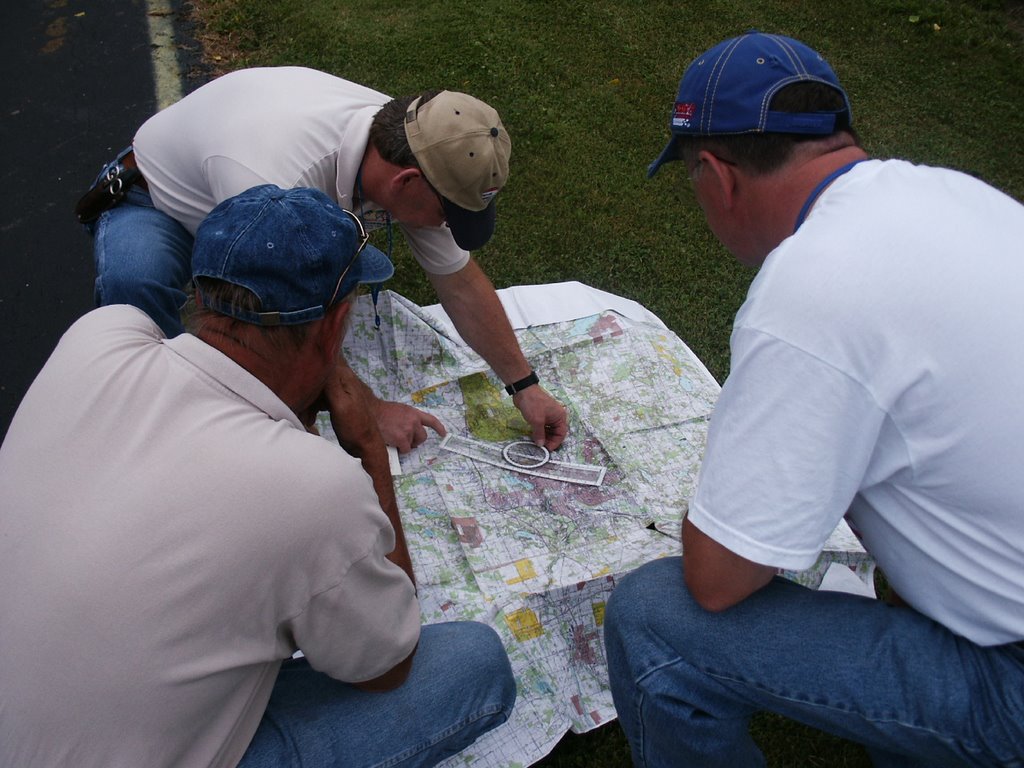
At balloon competitions, you basically “fly in” or you “fly out.” “Flying in” is setting up somewhere upwind of the drop zone and trying to bring the balloon in directly over the target. “Flying out” is setting up on the field at what would otherwise be the drop zone and flying out to some other place downwind. This allows the audience at the airfield to see one of the two more dramatic phases of ballooning on each flight: The launch and the approach to the target. We’re obviously flying in on this one. Based on the wind direction and speed, we now have to go find a place to launch from which the available winds will take us over the big white “X” on the airport in front of the crowd. Dave lives nearby and knows the area well. Looking at the map and considering the wind direction, Dave and his friend decide to head for a nearby subdivision to see if they can find a place to launch. Toward the back of the subdivision, we find an empty lot. Balloon crews are not an uncommon sight around Battle Creek, but they still draw interest. The people in the home next door were out in their front yard. Dave asked whether they’d mind if we launched a couple of balloons from the lot. They weren’t the owners of the lot, but they allowed as how they themselves didn’t have a problem with it.


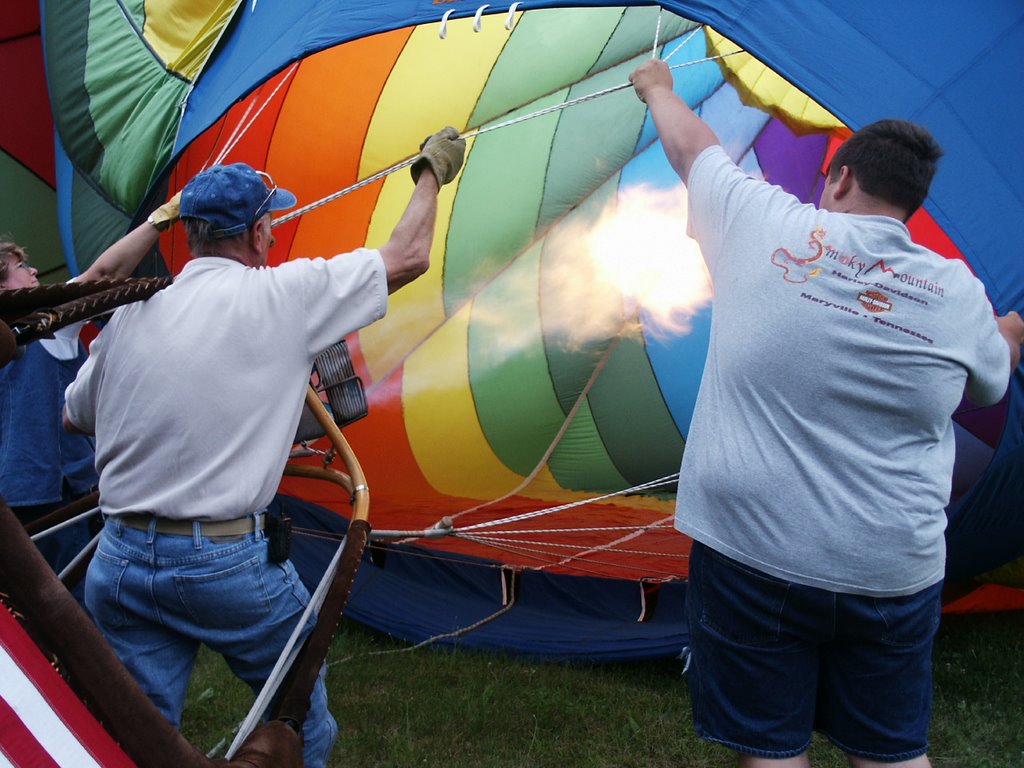
Dave and his friend each set up on the lot and started the gasoline-engine-powered fans that inflate the balloons with ambient air before firing up the burners.

[Audio – Dave 4]

06

Okay, it’s time to man the basket. Dave has been firing the burner on and off for a few minutes and the balloon has stood up enough to climb into the basket. The basket itself is tied to the bumper of the van with a quick-release knot that Dave could pull to release the balloon. I make sure that my camera is snugly in the case and that the MP3 recorder is at the ready and they wave me over. Here we go.

[Audio – Dave 5]


07

We cleared the trees on the north side of the lot easily and then floated out over a corn field with railroad tracks running through it. Dave stayed on the burner pretty frequently to get us to around 1,000 feet.

A few impressions here.

There is no apparent wind in the basket of a balloon. You are essentially within the air mass and a part of the air mass. Other than in the case of shear where air masses meet or when you ascend or descend through a shear zone, there's no wind.

Another odd thing is that you can actually see the cross-section of the wind currents by using a very sophisticated and high-tech procedure. You spit. As the spit recedes, you can see it shear this way and that for a good hundred or more feet.

There’s also the way you experience the altitude. Altitude in an airplane is your friend. It’s time and options and, to a great extent, that’s also true in a balloon. But your position in an airplane is such that you don’t really get to look straight down. You’re usually looking at least 20 degrees or so off to the side. Not so in a balloon. You look over the edge of the basket and you’re looking straight down.

I was uncomfortable, but not overly so. I found a place in the corner of the basket where I could hook an arm around the frame and I felt a lot better.

You navigate a balloon by making use of wind direction at different altitudes. While you're confined to a general direction of flight, you can tweak that direction by ascending or descending to where the wind will take you in the right direction.

On the flight with Dave, is became pretty apparent that the wind up at a few thousand feet would take us about 30 degrees to the right of the target. But the wind below us was a little quicker and from right to left. So the drill on this flight would be to remain high and drift until some distance before the target and then descend at such a time and at such a rate so that we swoop down and to the left directly over the target.

Here’s the conversation.

[Audio 6]
_________________________________________________________


08

Dave notices how I’m hugging the strut and wants to make sure that I’m comfortable. Then we talk a little bout his ballooning experience and some of the instrumentation in the basket.

[Audio 7]

09

Pretty soon, we’re just about over the field and Dave talks about what we’re about to try to do.

[Audio 8]


10

Closer and closer. A balloon ahead of us has hooked right into the target and its crew is getting ready to drop its marker.

[Audio 9]
____________________________________________________________

11

The task for today is to drop a weighted streamer as close to the center of the big white “X” as possible. According to the Balloon Federation of America’s competition rules, a weighted streamer is supplied by the organizer for each given task. The marker's streamer must be unfurled before release. A marker's total weight is 70 grams (2.5 oz.). The marker's tail width is 10 centimeters (3.9 in.) and its total length of 170 centimeters (66 in.). Some competitions require that you hold the marker by the tail and drop it without imparting any lateral velocity to it. You can throw the markers in this competition, but you can’t throw a marker sideways very far even if you try because it’s too light to go very far.

We’re at least a couple of hundred feet from the target and Dave considers not throwing the marker at all, but he eventually decides to toss it. He’s hot and heavy on the burner as we maneuver and then go to climb out from the target area.

[Audio 10]


12

Some of the balloons are oblong and look like rugby balls standing on end.

Looking behind us, there's a parade of balloons. Different types at different altitudes at different positions near the target area.

Dave says that, by going early, we've given up a bit of an advantage in that the other contestants can gage their approached by looking at what happened to us with our approach profile.

Looking back, there's a rugby-ball-shaped balloon hovering over the target. Maybe 30 feet off the ground. I can see a person leaning out and it's pretty apparent that this toss is going to be within a few feet of dead center. It's going to be close enough that even the bounce is going to be material.

Off to our right, one of the rugby-ball-style balloons is landing in a field behind a school. It looks like they’re breaking up a soccer game, but none of the players seem to mind.

[Audio 11]


13

Drifting clear of the airfield, we begin to think about places to land. By now, I’m a lot more comfortable in the basket. I still have an elbow hooked around the strut, but I no longer have the death grip. I tell Dave about that.

[Audio 12]

14

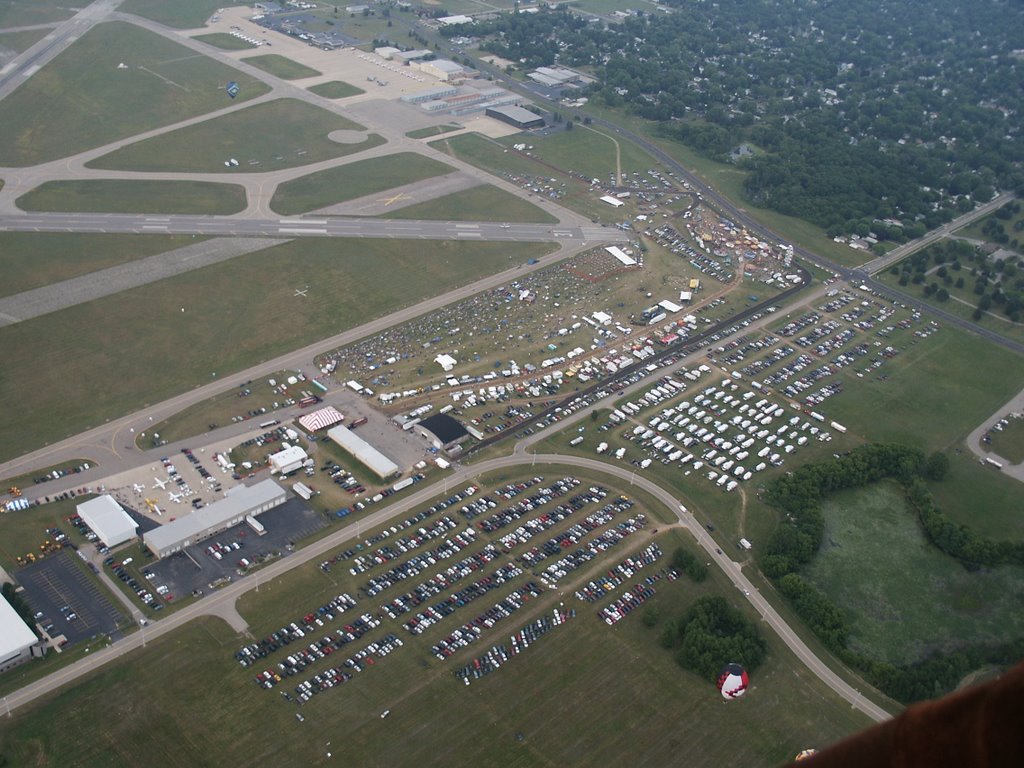
Another observation. Ballooning is the ultimate in low and slow. You have a lot more opportunity to look at things on the ground and you notice a lot more. Like an enormous outdoor lot with thousands of something line up in it.
_________________________________________________________

[Audio 13]

15

As we drift past the developed area around the airport and over the railroad tracks toward the northern suburbs, I ask Dave about his training and experience.

[Audio 14]

16

Now well past the airfield, the terrain is a lot more wooded, punctuated only infrequently by small clearings and residential subdivisions.

Observation: You can hear an amazing amount of what’s going on the ground. It makes sense, actually. Sound generated on the ground only has an average of 180 vertical degrees within which to propagate. In other words, a lot more of it goes up than down. You can hear a conversation from 100 feet away. It’s easy to say hello to people on the ground and they can talk to you without even raising their voices. The person in the balloon has to talk a little louder because the sound he or she makes has a full 360 degrees in which to propagate. But it’s still a lot more social between the ground and the air than it is with airplanes.

I actually proved this point by telling a knock-knock joke to a little girl in a subdivision as we glided overhead. Dave was adjusting our altitude and was on the burner enough to make the audio unusable, but the fact remains that two-way communication is possible without a radio.

[Audio 16]

17

By now, Dave is actively looking for a place to land. He tells me that he knows of lots of places up ahead. That’s good, because all I can see is trees.

[Audio 15]
_________________________________________________________

18

A good landing place is open, flat, away from trees antenna farms, and electrical wires, and close to a road so that the chase vehicle can get to you. Dave has humped Cloud Nine from the landing zone out to a road a few times, but not often. Worst case, he can pull the propane tanks out of the basket and then no individual part would weigh more than one or two people can carry.

Up ahead is a small clearing. The trees are bout 40 feet high all around. There’s a mobile home at the far side and a dog tied up near the mobile home. We’re hooking in more or less directly toward the center of the clearing. Dave is about to get on the burner and pass up this opportunity, but it’s hooking in so nicely that he reconsiders. A guy about 30 years old has just stepped outside of the mobile home. He doesn’t see us right away, but looks up when Dave asks permission to land.

[Audio 17]

19

There’s a flap of fabric in the top of the balloon called the “parachute.” You can pull on a line connected to the parachute and release some or all of the hot air in the envelope. It does for balloons what flaps do for airplanes by letting you descend more quickly in a stabilized way. But, unlike flaps, you can really haul on the parachute line and deflate the envelope to take it down and pack it up. Try that with a Being 727.

As we come in over the trees, Dave gets on the parachute line. I look up and see the parachute flap moving and letting a measured amount of air out of the envelope. Our rate of descent increases and we descend into the clearing. Going about two feet per second, we settle onto the grass. Dave warns me to expect a gentle bounce, and then we come to rest.

[Audio 18]

20

For whatever reason, I have this initial urge to get out of the basket. But I think better of it. If I get out, two hundred pounds of podcaster and podcaster gear would become suddenly unavailable as ballast and the balloon would likely try to ascend again. So I stay put.

Once we’re down, the occupants of the mobile home come out to meet us. The guy’s wife and their toddler have joined him and they come out to examine this colorful monstrosity that has just occupied the clearing. The kid’s eyes have grown huge. Clearly, this is not something that happens every day.

[Audio 19]


21

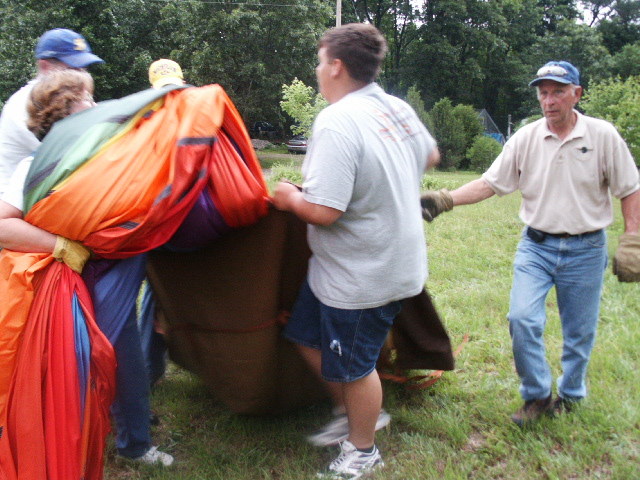
Dave gets on the phone and tells the chase crew where to find us. It’s about ten minutes before they show up. Dave keeps the envelope heated just enough to keep it standing up until the crew can help him take it down. Dave spies a moth flying around in the lower reaches of the envelope and, in a moment of unexpected whimsy, he kills some time by going after the moth with the burner. The moth evades the flame ably, possibly because of the turbulence of the burner output itself. If he got it, I didn’t see it happen.

The chase crew arrives a few minutes later. Pack-up takes all of 15 minutes. Everyone seems to know his or her job and falls to it immediately and efficiently.

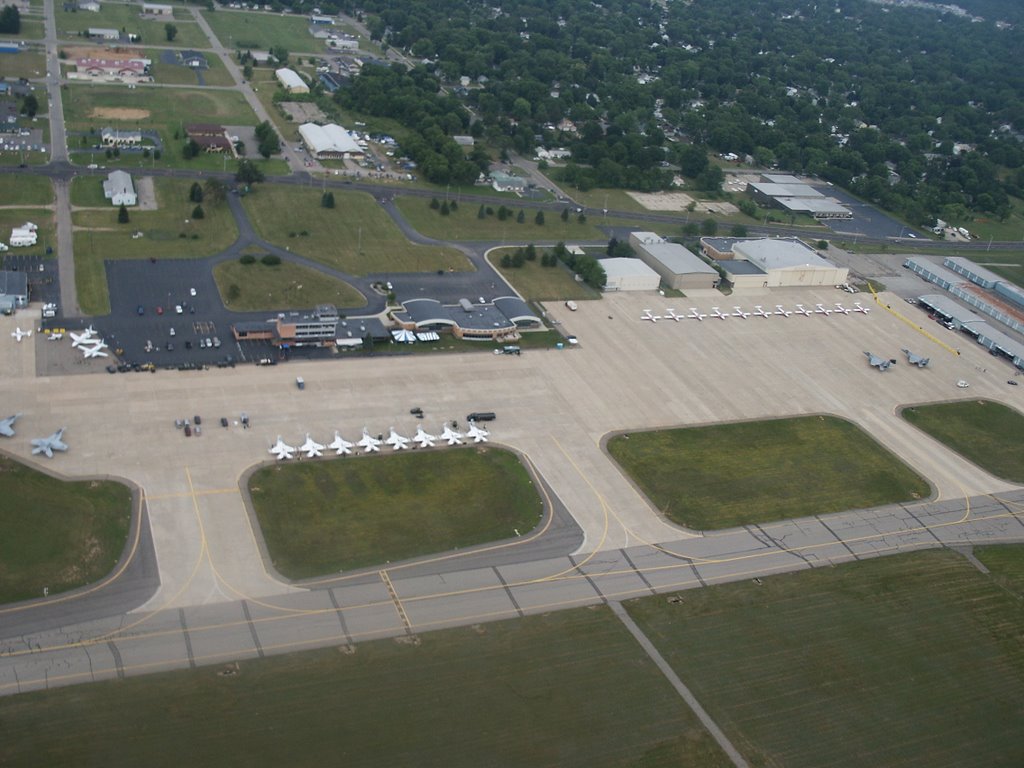
I slide into the van and we head back to the airport. It’s getting dark off to the west and thunderstorms are moving in. We head to the Air National Guard side of the field and everyone but Dave gets out. Dave is cleared onto the base to go refill his propane tanks. We hang out under a tarp with the friendly but heavily armed guardsmen until Dave comes back, picks us up and swings back around to the other side of the airport where I’m parked.

The crowds are arriving for the fireworks show as I pull out and head for the highway. The more mundane demands of my work and family life await my return 140 miles or so to the east. The drive gives me a chance to reflect on the really singular experience I’ve just had. It’s not the same as the coast down off the adrenaline peak of an airplane media ride. It’s much more reflective.

For all the bombast and fire of the jet demonstrations earlier in the day, this experience stood out for its own reasons. Ballooning is perhaps the first means by which men slipped the surly bounds of earth and got a taste of what was to come in aviation. It demands competencies that are unique among the modes of aviation. Perhaps more than any other form of aviation, it is dependent upon weather and other uncontrollable variables. Success in competition demands humility, keen observation, and a sixth sense about the atmosphere.

Dave Emmert is much like his balloon. Even-tempered, steady, and deliberative. Soft-spoken for the most part. Sharing the skies in easy and close proximity with his fellow enthusiasts.

He is an approachable emissary for his sport. Dave frequently takes up media people and others in Cloud Nine. On the flight that morning, Dave had taken up Maj. Steve Horton, the Thunderbirds’ slot pilot who flies the No. 4 jet. Although I have no real way of knowing, I suspect that Dave gave me, as a mere podcaster and flight enthusiast, the same treatment, consideration, and experience that he have a Thunderbird. It was a privilege to fly with him

Many thanks to Dave Emmert and to the Cloud Nine chase crew.

_______________________________________

Battle Creek Balloon Festival and Field of Flight Airshow: www.bcballoons.com

Firefly Balloons: www.fireflyballoons.net

Monday, October 23, 2006

First Solo


Subscribe to Airspeed through iTunes or your favorite other podcatcher, listen to audio at http://airspeed.libsyn.com/, or download directly at http://media.libsyn.com/media/airspeed/AirspeedFirstSolo.mp3.

We’re going to talk about the first solo.

I can’t think of a sharper divide to have to cross. There are no half-measures here. Either the instructor is in the plane with you or he or she isn’t. Unless you’re going to try to solo a Predator APV, there’s no radio control unit that the instructor can sit there on the ground with and help you out if you run into a problem. You are completely and absolutely alone and on your own.

And that, in large part, is what aviation is all about. Self-sufficiency, courage, and skill – all in one of the most objective tests you’ll find anywhere.

There are as many stories of first solos as there are pilots. This one is mine.

Flight did not come easily to me. I didn’t really get the bug until seeing the Tom Hanks-produced minisieries From the Earth to the Moon. It’s a little odd, I know, because there’s only one sequence in the series that contains any general aviation. But the series rekindled the wonderment I felt as a kid and I resolved that I’d pursue the experiences that were as close as I could get to mankind’s exploration of space.

My first few flights were not what I thought they’d be. Everything was strange, the airplane didn’t want to listen to me, and – to top it all off – I got pretty green around the gills. This was disappointing, especially because I had spent hours and hours on Microsoft Flight Simulator and with all of the books I could find on the subject and had arrived the first night of ground school prepared to teach the class if need be. At least inasmuch as you could teach a ground school class based solely on what you can read.

It got better after that, but I still got the sense that this was something that I would have picked up a lot easier had I started earlier in life. You can teach an old dog new tricks – and I’m not even that old – but it was clear to me that I didn’t have the kinesthetic learning ability that I’d had in my twenties. I suspected then that the instrument rating was actually going to be easier for me than the private ticket because it’s more cerebral and less kinesthetic and my instrument training so far has proven that out.

Another thing was that I went it mostly alone. Many student pilots come up in a community of pilots. For some, it's a mother, father, uncle, or some other person that introduces them to flight and coaches them along. For others, it's the students and the certificated pilots and the instructors who hang around at the flight school trading stories and experiences.

I was among those without an immediate circle of pilots. I was on good terms with the other members of my ground school class and we headed out to the bar a few times. I even sat right seat on a flight to Oshkosh with a guy I met in class. But the demands of a law practice and a new family and the thousand other things that happen while you're making other plans happened to me. I saw people as I came through the pilot's lounge on the way to and from the flight line for a lesson, but that's about it.

A community of pilots is an important thing to any student. You get to see and hear other approaches to aviation. You get to benefit from war stories and near-misses and the mistakes of others. And you get the camaraderie that comes from being part of a demographic that makes up only a half of one percent of the US population.

Lastly, I was more than a little conflicted about flying in the first place. Flight is not without risk. Most of you have seen the poster in your local pilot’s lounge showing a picture of an airplane hung up in a tree and containing the immortal quote from the World War II advisory: “Aviation in itself is not inherently dangerous. But to an even greater degree than the sea, it is terribly unforgiving of any carelessness, incapacity, or neglect.”

Getting hurt or killed would be bad. But what would be worse would be the effect of a flying-related casualty on my ability to meet my other responsibilities. I had been married for almost ten years by then and I had a son on the way. I had a mortgage, a car loan, student loans, and other obligations. My wife was not crazy about the idea of me flying, especially at this stage in our little odyssey, but she saw that I had a fire in my belly about it and let me make the decision.

And even if general aviation is as safe as we know how to make it, it is a substantial departure from the average person's mostly two-dimensional life. From mixing it up on the ground with business jets to talking to ATC to coming to grips with that dangly feeling that comes with the nose-high attitude and mushy controls in slow flight. It all takes getting used to.

It all piled up and began to take on the mantle of self-doubt. Nobody likes to talk about anxiety associated with flight. From the Wright Brothers to the barnstormers to the Mercury Seven to now, pilots are supposed to be steely-eyed missile men oblivious to danger and fear. Anxiety is communicable by words and actions. And I think that pilots often try to be firewalls by judiciously avoiding words or actions that might spread it to other pilots. I did my part on that score, but that means storing up the anxiety and letting it feed on itself.

There’s a level of anxiety at which you’re not fit to fly. It can be strong enough to become a basis for denial of an airman medical certificate or, at a lesser level, it can cause your instructor to stay in the plane or to ground you. I wonder if there’s some way which we as pilots couldn’t talk a little more freely about whatever anxieties we have and use it as a tool to defeat the anxiety in the first place, rather than internalizing it and inviting the feedback loop that could cause otherwise capable student pilots to hang up their headsets. Flight instructor and aviation comedian Rod Machado is just about the only widely-heard voice in this wilderness and his articles in AOPA Flight Training and on his website are great.

So I drove back and forth to the airport with my little bag of conflicts and anxieties and did the best I could to become the best pilot I could.

My first lesson was in February of 2001 at Oakland County International Airport near Pontiac, Michigan. I flew with a guy named Josh, who was a CFI and CFII and the instructor who taught the ground school. The weather conspired to keep us on the ground on all but the two of our scheduled times at Pontiac, but at least I was settling into the routine there.

Then, after the ground school finished, Josh moved to a school at the Ann Arbor Municipal Airport about 40 miles away. I trusted Josh and they had good aircraft at Ann Arbor, so I uprooted and started driving to Ann Arbor for instruction.

In the course of all this, I went in for my aviation medical exam. I called the AME’s office that morning and asked whether I needed to fast. The receptionist said that I could eat whatever I wanted, whereupon I ate a bagel with jelly on the way to the AME’s office. I turned something the wrong color and the AME promptly deferred my file to Oklahoma City. He also apparently closed his practice and retired the week after that. So I got with my family physician and went about rebutting the bagel-induced results.

When the Michigan winter began loose its hold on the landscape, I booked every Saturday and Sunday morning from 8:00 to 10:00 and began training up to three and a half hours a week with Josh in a Piper Warrior II. I was, of course, waiting on my medical, so we went out and did a lot of high airwork and even flew a cross-country to Lansing.

The Tuesday before Father’s day, I got a call from Josh. One of his other students, who was solo-rated, had just purchased an experimental Mustang II in Caro. The Mustang was a taildragger kit plane with side-my-side seating, max gross weight of 1.350 pounds, a nine-gee-rated airframe, a 180 degree-per-second roll rate, a 160 or 180 hp engine, and a wood prop. Josh wanted to know whether I would give up my reservation on Saturday for the Warrior so that he and his student could go pick up the Mustang. As compensation, Josh offered me the right seat for the ferry flight while his other student flew the Warrior back.

I had long ago set a personal limit for myself under which I would only fly non-experimental aircraft. There’s nothing inherently wrong with experimental aircraft. But, as a class, they don’t fit my current risk profile. Besides, Josh had only been tailwheel-rated for two weeks and I wasn’t comfortable going up in that hot of a plane on the pilot’s first flight of that particular aircraft. I told Josh that he could have the Warrior and that I’d just see him on Sunday.

I had a chance to sit in the Mustang on Sunday before Josh and I took the Warrior up. Josh’s student had apparently told Josh to fly the airplane and get comfortable with it, after which Josh would instruct him in it. Josh was excited about flying the Mustang.

A little later, we were up in the Warrior. There was a stern crosswind from the north when we took off on Runway 24. With the Father’s Day fly-in and pancake breakfast going on, the pattern at Ann Arbor was getting full, so we headed to Willow Run about 10 miles to the east.

By this time, I had 20 or 30 hours in the plane. I had received a provisional letter from the FAA Flight Surgeon, but not the actual medical certificate. Nevertheless, I had made good use of the time since leaving Pontiac and was getting a lot more comfortable in the airplane. My high airwork and ground reference were good, most of my landings were salvageable, and I had apparently made points with Josh by not being afraid to go around if I didn’t like an approach.

I put it down unassisted two or three times on Runway 32, where the wind was more or less right down the centerline. I dropped it on the mains pretty hard, but I got it down safely each time. At one point, Josh turned to me and said, "You got your medical yet?" My heart leaped into my throat. I showed him the provisional letter that I had received from the FAA, but he shook his head and handed it back to me.

We departed Willow Run on the downwind and pointed her back at Ann Arbor. The crosswind was still howling along, but I managed to put her down pretty well twice, despite the crosswind. Josh was pleasantly surprised. After we put the plane back in the hangar, we strolled out onto the ramp to see the aircraft that had flown in for the pancake breakfast. Josh introduced me to a Stearman pilot as one of his students and said, "He's coming along fine, except that he needs at least a seven-knot crosswind to land."

Josh went off into the crowd and I headed for my car.

Josh's life had four days left in it.

___________________________

From NTSB accident report NTSB CHI01LA181


On June 21, 2001, at 1405 eastern daylight time, an amateur-built Masko Mustang MII, N24898, piloted by a commercial pilot, was destroyed when it impacted terrain following a loss of control while maneuvering in the traffic pattern at the Ann Arbor Municipal Airport (ARB), Ann Arbor, Michigan. The aircraft had just completed a touch and go and was turning from the upwind to the crosswind leg of the traffic pattern for runway 06 (3,500 feet by 75 feet, concrete). The local flight was being operated under the provisions of 14 CFR Part 91 and was not on a flight plan. Visual meteorological conditions prevailed at the time of the accident. The pilot and the pilot rated passenger received fatal injuries. The flight originated from ARB at 1353. Witnesses to the accident saw the airplane make a steep right turn prior to spiraling to the ground. A postaccident examination of the airplane revealed no anomalies that could be associated with a pre-impact condition.

The pilot held commercial and certified flight instructor certificates with airplane single engine land and instrument airplane ratings. The pilot also held a ground instructor certificate with advanced and instrument ratings. According to Federal Aviation Administration records, the pilot reported having 398 hours of flight time as of March 15, 2001. The pilot's logbook was not recovered.

The pilot rated passenger held a commercial pilot certificate with airplane single engine land and instrument airplane ratings. He held a certified flight instructor certificate with an airplane single engine land rating. The pilot rated passenger also held a ground instructor certificate with an advanced rating. According to Federal Aviation Administration records, the pilot rated passenger reported having 307 hours of flight time as of May 10, 2001. The pilot rated passenger's logbook was not recovered.

Toxicology tests performed on the pilot and pilot rated passenger were negative for all tests performed. Autopsies were performed on the pilot and pilot rated passenger by Washtenaw County on June 22, 2001.

It was reported that the airplane was purchased on June 16, 2001. The pilot was the flight instructor of the new owner. The owner was not aboard the airplane when the accident occurred.

___________________________

I was driving home from work when I heard the report on the radio that a small plane had crashed in Ann Arbor. I fished out my mobile phone and dialed the number to the flight school. When the office manager answered, I told her that I had heard about the accident. "Anybody we know?" I asked.

"Steve, it was Josh."

After the homeowner's association meeting that night, I went home and had to tell my wife, "Hon, I have to go to the airport. Josh got killed. I'll be back late."

I drove to the airport. Josh’s car was there. The Mustang has apparently come down on the airport perimeter fence just in front of the EAA hangar near the departure end of Runway 6. They had cleared away the airplane and done what they could to repair the ground around the impact site. I actually had a hard time finding the site even though it was right next to the road. I drove back home flipping radio stations and listening to the accounts of the crash, few of which got the story right.

I don't want anyone to think that the accident had more of a role than it did. I wouldn't have done what Josh did, if only in that I don't fly that type of aircraft. This accident didn't fall within the envelope of risks that I had set for myself as acceptable. It's apples and oranges, really.

But it was another stumbling block. I lost a friend and I had an object demonstration of the potential dangers of flight. And I had to switch schools again because Ann Arbor was suddenly short of instructors.

It's hard enough to do a thing when you can just go do it and have done with it. Like a bungee jump or something. It's another thing entirely when circumstance walks alongside you and keeps giving you opportunities to blink. I still carries my little bag of anxieties to the airport and back. I took it to work. I took it into the shower. I took it into my dreams.

I resolved that this was a horse that I would have to stay on or I might never go further. It was crunch time.

I got my medical certificate shortly after that and, after the weekend, I started calling flight schools. Nobody flew Warriors, but there was a school over at Willow Run called Air One Aviation that had an Arrow and I could transition to it if I flew Cessna 152s for awhile first.

The day I showed up for my first lesson at Air One, I ran into one of Josh’s other former students. Apparently, there had been a steady stream of us coming through the office in the preceding few days.

The 152 was a lot smaller and a lot more susceptible to the turbulence caused by the convection of the summer heat. Don, my new instructor, was a recently-laid-off cargo pilot who was instructing to make ends meet until be got called back. The airplane obeyed Don and he promised that it would soon obey me.

The first flight, we went out and did the high airwork. Where the Warrior had stalled like a sea turtle, the 152 wanted to spin. Slow flight was a pendulous dance on the rudder pedals. The 35-knot stall speed in the 152 meant that slow flight involved puttering along at about that speed. You could get a backward ground track if the wind was just right and that decreased sense of forward motion was enough to really give you the sense of just being suspended up there in space.

And to top it all off, Don decided to show me a couple of spins. One to the left and one to the right. Lots of chlorophyll in the windshield. Rotating chlorophyll. He said that he spun all of his new students and that those whom it gave the willies were probably better off finding that out early on. I wasn’t a guy who needed to be told about the willies, but I kept that to myself.

We did one other flight to get me familiar with the low airwork and spent a good chunk of that flight in the pattern. If I had problems with the 152 in the stall and the other high airwork, I made friends with the airplane on final. It landed beautifully. In ground effect, the plane wouldn’t stall until it hit something like 25 or 30 knots. You could almost get out of the plane and run alongside to help it down. One of the first solid moments of confidence that I had was on short final to Runway 23. Perfectly stabilized in the approach, I knew that I could get her down on the centerline and stopped before the VASI lights.

The bag of anxieties still sat right behind my seat. I knew that the time was coming when Don would get out of the plane. He said at one point that four was the magic number. When a student pilot can put together four consecutive good landings and shows that he or she is not afraid to go around if need be, the student pilot is ready to solo.

July 14, 2001 dawned warm and a little hazy. I drove the 45 minutes to Willow Run with a knot in my stomach. I had greased almost every landing the last weekend, and I would be an idiot if I thought that the time to solo wasn’t coming. In fact, I would be an idiot if I didn’t think that the solo was going to happen today. The anxiety bag on the passenger seat of the car shifted around a little and gave off a threatening vibe. Baby on the way in December. Student loans. Mortgage. Wife I love. Old dog trying new tricks. Is the dream worth it? What if? What if? What if?

We did 11 trips around the patch (yeah, 11) before he got out of the plane. The last four or five were with different flap settings and the last one before the solo was a short approach with a simulated engine failure and no flaps.

After the last one, Don said, “Let’s taxi back so you can solo.”

I was numb and only taxiing the aircraft out of reflex. “You sure about that?” I said.

“Steve, I’m convinced that you won’t bend the airplane or yourself. You’re ready. I wouldn’t solo you if I didn’t think that you were ready.”

We taxied back to the ramp. On the way, Don called the tower and let the controller know that he was about to have a student solo in the pattern. We shut down the plane. Don signed my logbook and the fuel truck topped off the tanks.

After I got back into the plane, Don leaned in and said two things.

He said, “Steve, you have a full load of fuel. You don’t have to land for four hours. Pick approaches you like and go around if you don’t like what you see. "

Then he said, “You’ve got my checklist there. Don’t augur in. I’d hate to lose that checklist.”

“Fuck you, Don, and get away from my airplane,” I said, or words to that effect.

I started up the plane, got the ATIS, called ground, and taxied out to the threshold of Runway 5L. Once there, I turned the plane into the wind and did a full runup. All the while, I tried not to look at the now-empty right seat. But I could still back out. As long as I didn’t call the tower.

I keyed the mic and called the tower. I was surprised at how confident I sounded. Not quite a West Virginia drawl, but calm and collected.

“Tower, Cessna 94891, student pilot, holding short Runway 5L with Whiskey, would like to take off, remaining in the pattern.”

“Cessna 891, cleared for takeoff, make left closed traffic, wind 340 at five.”

“891 is cleared for takeoff, Runway 5L, will make left closed traffic.”

I inched out and centered the airplane on the centerline. 7,700 feet of runway stretched out in front of me. All of Willow Run Airport was mine if only I had the guts to take it. I could still back out. I could call the tower and claim an alternator undervolt or any of a thousand other things.

I spoke over the intercom. “What do you believe about yourself? Heels on the floor. Let’s go.”

I firewalled the throttle. This is it. If I rotate, there’s no turning back. The idea of not going through with it washed away in the time it took to reach 50 knots. The yoke grew stiffer in my hands. The vibration from the nosewheel through the pedals gave way to the feel of the rudder behind me. 50 knots. Now or never.

The airplane rose readily into the air, apparently happy to find itself 170 pounds lighter. I held a death grip on the yoke at 65 knots. 800 feet. 900 feet. 1,000 feet. 1,100 feet. Time to start the crosswind.

The airplane tried to turn for me. She passed through 20 degreed of bank and then 30 degrees. My hands were so sweaty that I was afraid that my left hand was going to slip off the yoke as I fought the overbanking. I added my right hand to the yoke and then leveled out on the crosswind.

Climbing like a homesick angel, I was practically at pattern altitude by the time I started the turn to downwind. I relaxed a little once established on downwind. The runway was right there to my left. I had done this 11 times in the last hour and a half. I wanted to nail this one.

Abeam the numbers. Carb heat. Throttle to 1,500. Trim. White arc. First notch of flaps. Trim.

“891, cleared for the option Runway 5L.” came the call.

I heard myself say, “891 is cleared for the option Runway 5L.”

70 knots. Second notch of flaps. Trim. Start the base turn. Descending.

Roll out on the centerline. 60 knots. Left aileron for the centerline. Right rudder to point her down the runway. The sight picture that I had first seen the week before came rushing back.

Just over the ditch short of the threshold with the runway made, last notch of flaps. Flare. Keep her straight. Try to keep it flying. Try to keep it flying. What do you believe about yourself?

The mains touched down, followed by the nose gear. Without waiting, I pulled up the flap lever, firewalled the throttle again, and again headed down the runway.

I got two more trips around the patch and then taxied back.

“Congratulations on your first solo, 891,” came the call from the tower. I babbled something in reply and turned onto the ramp.

Don met me on the ramp and congratulated me. We filled out the logbook for the flight. A quick picture next to the plane and then it was over. I packed up and headed for the parking lot. Then the parking lot and the airport grew small in my rearview mirror.

The bag of anxieties was still there with me in the car, but it was a lot less noisy and seemed a little lighter.


On June 21, 2002, I walked through the dewy grass next to State Street up to the new fence off the departure end of Runway 6 at Ann Arbor. I pulled out a copy of the page in my logbook showing the entry for my first solo and clipped it to the fence.

Work and a new son and lots of other things intervened, but, on June 21, 2004, I made that same walk and, this time, I clipped a copy of my new private pilot certificate to the fence. With each, I included a quote from French poet Guillaume Apollinaire:

Come to the edge, he said.
They said: We are afraid.
Come to the edge, he said.
They came.
He pushed them.
And they flew.

Again, it's not that Josh's accident loomed larger than it actually did. I would have duct-taped that stuff to the numbers at the approach end of 5L at Willow Run if I could have, but the fence was the best place available. So it became my touchpoint.

I still have that bag of anxieties. I still carry it around and can’t seem to be entirely rid of it. It moves around a little there in the backseat of the Cessna 172s that I fly now and makes burbling noises and smells slightly reptilian. But it is no longer the millstone that I carried heavy on my heart in the days before my first solo. It is no longer the Wednesday anxiousness or Thursday loathing or Friday dread that it used to be. It could have been debilitating and ended my flight training and the Big Dream right there at the hold short line of Runway 5L. Facing that challenge is one of the hardest things I’ve ever done, but in that is the source of the pride I feel at having done it.

I’m sure that hundreds of others around the world soloed for the first time that day and I’m sure that some got over obstacles even bigger than mine. But none of them was in my airplane with me. We each face our own little bags of anxieties in our own ways, picking our own battles.

I have learned that the figurative little bag of anxieties is a part of my flight gear just like my tangible flight bag. Perhaps even more so, because, although it’s bothersome sometimes, if mostly just reminds me that aviation in itself is not inherently dangerous, but, to an even greater degree than the sea, it is terribly unforgiving of any carelessness, incapacity, or neglect. And that’s a reminder that every pilot can use now and then.

I have a colleague where I work named Brendan. We were having lunch one day and talking about flight when he said, “You know, there are pilots and then there are guys who have pilot’s licenses.”

There isn’t a malicious bone in Brendan’s body. He’s a good Joe. But he doesn’t get it. I don’t hold it against him, but the fact remains that he doesn’t get it.

I say that anyone who sits all alone in an airplane at the end of the runway, firewalls the throttle, and rotates is a pilot.

I’m not Scott Crossfield or Marsha Ivens and neither are you. I’m not going to the moon and I’ll probably never even fly a turbine aircraft. But I’m a pilot. Because of what I did. Even if I hadn’t gone on to get my private pilot certificate, or even gone back to the airport at all. By every measure that really matters, I’d be a pilot.

The aircraft left the ramp with one guy in it. It made three trips around the pattern and returned to the ramp with one guy in it. That guy was me. Res ipsa loquitor. The thing speaks for itself. On July 14, 2001, I joined the community of pilots.

I am not the same person I was before I soloed. Maybe it’s a small difference between old me and new me. But pre-solo me didn’t know whether he had it in him to get it up and get it down all alone. Pilot me knows about the reserve that he has within him and that it’ll open up and carry him through if only he’ll call on it and believe things about himself that we wants more than anything to know are true. There is no courage without fear.

Ladies and gentlemen, I’m Superman and Harry Potter and Fletcher Seagull, all in good measure. I’m a pilot. The rest is gravy.

To hell with the credits. Call in sick tomorrow and go to the airport or wherever else you think your soul will have room to unfold so you can have a good look at it.

You can choose the battlefield, but you can’t avoid the battle. Go pick a fight with your limitations and transcend them.

Have a nice day.

______________________________

NTSB accident report for N24898:

http://www.ntsb.gov/ntsb/brief.asp?ev_id=20010627X01269&key=1

Information about Josh and the scholarship that bears his name:

Joshua Esch Mitchell Aviation Scholarship
For students pursuing studies in the field of professional pilot with an emphasis on general aviation, flight engineer, or airway science.
Eligibility: US citizens enrolled in a full or part-time program at a college or university in the US providing an accredited flight science curriculum. All applicants must have a minimum cumulative grade point of 2.75 and be entering the second year (or above) in college. For further details visit online at: www.grfoundation.org.
Contact: 161 Ottawa Ave NW Suite 209-C, Grand Rapids MI 49503-2757
Phone: 616 454-1751 x 103
E-mail: rbishop@grfoundtion
Cash award: $500-$2000
More information: www.grfoundation.org

Music:

Theme from Milliways (Go for TMI) by Steve Tupper
Steve Tupper: 12-string guitar, mandolin, and violin
From the perpetually in-process album Songs from the Rodger Young: The First Folk Music of the Journey to Mars and Back
(c) 1998-2006 by Steve Tupper


Pilot voices:

Various pilots whom I accosted with an MPe recorder, including those at Tradewinds Aviation and Flight 101 at PTK, various senior members of the Oakland Composite Squadron (GLR-MI-238) of the Civil Air Patrol (USAF Auxiliary), and two of my neighbors.


Sunday, October 15, 2006

Motion Sickness and AFTE with Dr. Particia S. Cowings of NASA Ames Research Center


Subscribe to Airspeed through iTunes or listen to the audio directly at http://airspeed.libsyn.com.

Argue with the worms, barf, bark at the ants, bile geyser, blow groceries, call Huey on the big white telephone, the call of the walrus, chorkle, drive the porcelain bus, flash the hash, heave, honk, hoark, hurl, liquid burp, look for aardvarks, spew, spit the furry lifesaver, park a tiger, puke, ralph, roop, sell Buicks, shout at your shoes, technicolor yawn, toss your cookies, unswallow, upchuck, vurp, woof cookies, yack, yark, yodel.

There are many ways to say it. There are many ways to do it. It’s funny and it’s not funny. But it’s a part of almost everyone’s life and Airspeed isn’t about to let this stone go unturned.

We’re talking about hurling and we’re talking about motion sickness in particular.

It has its funny side. But it also has a serious side. We may never know how many people have decided not to explore aviation because of this strange artifact of human evolution. We may also never know how many current pilots and student pilots have this extra burden on the road to the big dream.

Pilots don’t like to talk about motion sickness. It somehow makes us less Scott Crossfield-like or less Patty Wagstaff-like to admit that we get a little green around the gills. But motion sickness, in addition to being inconvenient and embarrassing, can be a safety issue. Some studies show that being motion-sick can reduce your effectiveness below that of someone who is legally drunk.

I had problems with motion sickness issues on each of my first two flights and I worried about it recurring for many flights after that. In fact, after experiencing a vurp (that’s where you do a little burp that’s more than just a burp but doesn’t quite make it out of your mouth) on my second flight, I resolved that I was going to stick it out for a total of five flights and, if I felt sick after that, I was going to hang it up.

Fortunately for me, flight number three was good and I haven’t been green around the gills since except for some extended sessions of stall training and a few sessions of unusual attitude training under the hood. All completely natural.

I went to ground school with a guy who has become a good friend over the years. He’s a very good pilot and we flew to Oshkosh together in 2002. I admire him because it took him a lot longer time than it did me to get over his motion sickness. Our mutual flight instructor nicknamed him “Cool Hand” because he was fine when his hand was on the yoke but, as soon as he gave the controls to someone else, he got sick. And our mutual flight instructor admitted to being a sympathetic puker, so he let Cool Hand have the controls as often as possible.

The point is that everyone either deals with motion sickness or knows someone who does. It’s a near-universal issue that bears on the enjoyment and safety of flight, but that gets short shrift in the aviation media. In other words, it’s a perfect topic for Airspeed.

The FAA’s Pilot’s Handbook of Aeronautical Knowledge doesn’t have much to say about motion sickness. It states, in relevant part, as follows. “[A]void lessons in turbulent conditions until becoming more comfortable in the airplane, or start with shorter flights and graduate to longer instruction periods. If symptoms of motion sickness are experienced during a lesson, opening fresh air vents, focusing on objects outside the airplane, and avoiding unnecessary head movements may help alleviate some of the discomfort.”

Good advice, to be sure, but we had heard about training and exercise regimes that directly address motion sickness and provide better tools with which to combat it.

So we went directly to one of the world’s foremost experts on motion sickness, Dr. Patricia S. Cowings. Dr. Cowings is a research psychologist with the Human Factors Research and Technology Division and Human Information Processing Research Branch of NASA-Ames Research Center near San Francisco, California. She is the inventor of the autogenic-feedback training exercise (AFTE) method and system and is the inventor of that method as stated in US Patent no. 5,694,939 issued in 1997.

Dr. Cowings was the first female scientist trained as an astronaut. She was a backup payload specialist for Spacelab Mission Development 3, the first simulation of a life-sciences-dedicated space shuttle mission. Her experiments have flown on STS 51-B and STS 51-C in 1984 and Spacelab-J in 1992. She continues to do and administer human factors research.

We caught up with Dr. Cowings by phone at her office at NASA-Ames office.

[Audio]

If you’re interested in AFTE, you can contact Dr. Cowings or BioSentient, Inc. Dr. Cowings’ e-mail address is patricia.s.cowings@nasa.gov and you can reach BioSentient at info@biosentient.com or http://www.biosentient.com/. There’s more complete contact information in the show notes at http://www.airspeedonline.blogspot.com/.

As always, nothing you hear here on Airspeed is flight instruction, legal advice, or medical advice. You should consult a certified flight instructor or a qualified physician or both before acting on anything you hear on Airspeed.

Note that certain kinds or intensities of motion sickness could be disqualifying for an airman medical certificate and I can tell you from personal but unrelated experience that some aviation medical examiners are more involved and collaborative than others. If you have real trouble with motion sickness but still want to be a pilot, you might want to consult your personal physician or other qualified and licensed medical or phychological professional before applying for an airman medical certificate. Get any issues identified and taken care of before you apply for an airman medical certificate so you can check all the right boxes with a smile on your face. Remember that most AME's are great guys and gals, but they're the FAA's doctor, not yours.
And, as ever, if you're going to fly, be safe and comply with the regs.

Last and unrelated disclaimer: Although Dr. Cowings very kindly appeared on Airspeed, Airspeed is not endorsed or recommended by NASA or any related person or agency. They didn't ask me to say that. I just throught it might be courteous to say it.

______________________________________________________

Contact Information and Links

Patricia S. Cowings, PH.D
NASA Ames Research Center
Moffett Field, California 94035
Phone: (650) 604-5000
Patricia.S.Cowings@NASA.gov

Psychophisiology Lab – Nasa Ames Research Center
http://human-factors.arc.nasa.gov/ihh/psychophysio/

BioSentient, Inc.
http://www.biosentient.com/
info@biosentient.com

Astronaut Dr. Mae Jemison
http://quest.nasa.gov/women/TODTWD/jemison.bio.html

Monday, October 09, 2006

So Long, One-Eight!


Subscribe to Airspeed using iTunes, visit us at http://airspeed.libsyn.com, or use the following RSS feed. http://airspeed.libsyn.com/rss.

Nearly everybody says goodbye to an old friend at one time or another and pilots are no different. But it's particularly tough when a pilot has to say goodbye to an airplane.
You may have heard me on this program shooting instrument approaches or doing parts of the show from Cessna 918TA, known locally at Oakland County International Airport in southeast Michigan as Tradewinds 18. Well, today I bid a fond farewell to 18. She met her end in the grass next to runway 27R after a bad landing on July 13.

The pilot is fine. He walked away uninjured. But 18 is a twisted mess. Let's read the NTSB accident report. (http://www.ntsb.gov/ntsb/brief.asp?ev_id=20060908X01323&key=1)

________________________________

[NTSB Identification: CHI06CA189. The docket is stored in the Docket Management System (DMS). Please contact Records Management Division 14 CFR Part 91: General AviationAccident occurred Thursday, July 13, 2006 in Waterford, MIAircraft: Cessna 172R, registration: N918TAInjuries: 1 Uninjured.]

On July 13, 2006, at 1106 eastern daylight time, a Cessna 172R, N918TA, operated by Tradewinds Aviation Inc. as an instructional airplane, impacted terrain during landing on runway 27R (5,000 feet by 100 feet, asphalt/porous friction courses) at Oakland County International Airport (PTK), Waterford, Michigan. Visual meteorological conditions prevailed at the time of the accident. The 14 CFR Part 91 student solo instructional flight was not operating on a flight plan. The student pilot was uninjured. The local flight originated from PTK about 1030.The student pilot stated that he arrived at Tradewinds Aviation Inc. for flight training at 0830.

The student pilot and his certified flight instructor (CFI) departed from runway 27L, remained in the airport traffic pattern, and performed 5 landings. The CFI then exited the airplane, and the student pilot departed and performed two solo take off and landings from runway 27L. The student pilot then departed from runway 27R and was instructed by air traffic control to land on runway 27R. The student pilot stated that he performed a go-around since he "felt a slight crosswind" and "could not get the airplane on centerline." He then entered the traffic pattern for runway 27R for another landing attempt. He stated that on final, the descent was "fine" and the airspeed was "good." The student pilot stated that as he began to level off, he held left aileron into the wind. The student pilot stated that the nose yawed to the left when he reduced power and "felt" ground effect. He stated that during landing, the airplane was "somewhat" crabbed and began to turn left. He stated that he tried to correct by applying the left rudder pedal, but the airplane went into the grass and flipped.

The PTK Automated Surface Observing System recorded winds for the following times:

0853: 000 at 0 knots
0953: 170 degrees at 7 knots
1111: variable at 4 knots
1153: 170 degrees at 8 knots
________________________________

I saw 18 in the hangar. Prop bent and scored. Right wing twisted. Firewall caved in.

There's a picture of 18 in the show notes at http://www.airspeedonline.blogspot.com. A fellow Civil Air Patrol officer who also flies at my school snapped the picture a little while before I saw her. I know that it was before I saw her because, in the picture, there are no lip marks in the dirt on the spinner. That's right. I planted a big wet one right on her nose, Michigan clay soil, grass stains, and all.

A man doesn't kiss his airplane has issues showing emotion and needs to spend more time on the ramp.

18 was one of a few aircraft that are very special to me. One is Cherokee 47656, a PA-28-160 in which I did most of my pre-solo training at Ann Arbor Municipal Airport. Another is Cessna 94891, the Cessna 152 in which I did my first solo training out of Willow Run Airport (and which, by the way, got bent by a student pilot long before I flew her, but came out of the shop as good as new).

18 was special to me because she got me through the final push for my private pilot certificate. I flew her with flight instructor excraordinaire and now King Air captain Eamon Burgess in late 2003, got re-soloed in November of that year, did my long cross-country with her in January of 2004, and took and passed my checkride with Mary Carpenter in February of 2004.

The most beautiful VFR flight I've ever made was my long solo in 18. Well below freezing that January day, but severe clear. I could see 60 miles or more from up there at five thousand feet.
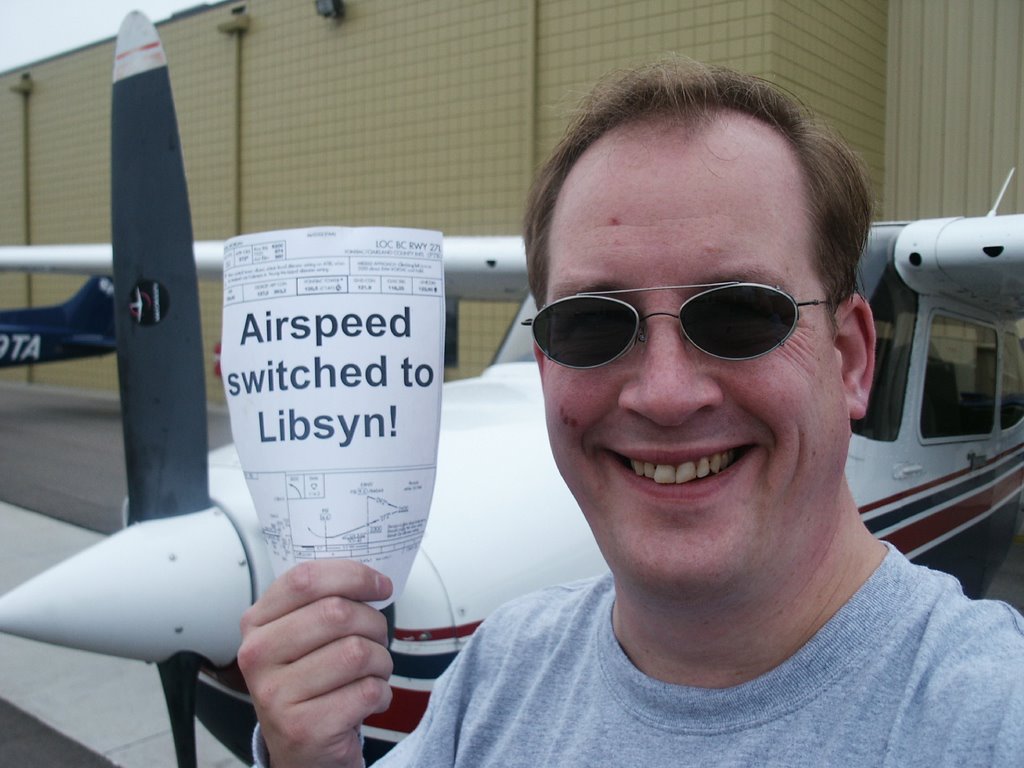
In fact, the picture I use of myself for the podcast was taken on that flight as I headed back for Pontiac on the last leg of the flight.

I've reacted in a few ways in particular to 18's demise.

I pay more attention now to my landings. Which is to say that I start the process well out there on approach, getting stabilized in my pitch attitude, power, airspeed, and ground track. I don't settle for anything less than the exact centerline and a precisely parallel lateral orientation with any crosswind.

I also lost another notch of respect for mainstream media. Now you guys know that it's not in my nature to badmouth anyone. Even when I took the media to task this year about not understanding what an aerodynamic stall is or completely misunderstanding the national security threat posed by general aviation, I tried to make it an educational and collaborative thing. But ignorance and rudeness are two different things. So let me rant a little here.

A local TV reporter reported from a helicopter taking telephoto shots of the inverted 18. Here's a clip from the report. Listen to this guy's closing comment.

[News audio.]

What a jerk! No, not any landing you walk away from is a good one. My favorite airplane lay there on her back with her wheels pointed skyward and an earnest student pilot with lofty goals had just had the crap scared out of him.

A good landing brings the airplane back to the ramp in good shape in time for the next student to do his preflight. A good landing sometimes even gets praise from the tower. Hundreds of good and graceful landings happen every day at Pontiac and tens of thousands of them take place every day throughout the world.

And this guy - a guy in a helicopter no less - makes a comment like that. I hope the chopper pilot treated him to a no-warning autorotation on the way home.

I know that most reporters try to do a competent job and don't intentionally say insensitive stuff like this, but, by golly, when you start circling my favorite aircraft at my favorite airfield, you better bring your A-game with something intelligent to say or just shut off your mic.

And what does the public see and hear? Not the hundreds or thousands of safe and even graceful landings that happened that day in southeast Michigan. They get a knucklehead who gives the impression that every flight is a dance with death and it's a miracle that we aviators don't rain down fuselage parts on innocent people every day.

We're never going to be able to adequately educate the media about general aviation. We can't count on these people to know what they're seeing or hearing or even to try to find out.
The best thing that the general aviation community can do is to renew and improve its commitment to training and safety so that we give the media as little bad news to cover as possible.

Okay. End of rant.

Lastly, I'm just plain going to miss that aircraft. She was rigged right and she flew well. But that they say that about me when I'm gone.

She had an audio jack for a CD player or iPod and she sang to me over the lonely winter landscapes of southeast and central Michigan. She stalled like a sea turtle and gave me plenty of opportunity to recover. I fly at a school that has five nearly-identical Cessna 172Rs on the ramp and I can get by with any of them. But any pilot will tell you that no two aircraft fly exactly the same. Each aircraft has its own shuck and jive - its own little dance into the flare - its own little burble in the stall. I'll miss 18 because I always felt more like a pilot when I flew her.

But there are other airplanes. And the accident pilot is fine. He got back in the saddle the next day. In fact, I saw him taxiing back to the ramp a couple of weeks ago with his instructor.

I'll finish the instrument rating in 16 or 20 and it'll be fine, but it'll be different. Maybe friends and things really do come in and out of our lives like busboys in a restaurant. But that doesn't mean that we don't notice when they do. Maybe I'll use her tail number someday on the CTAF at a deserted little untowered field, just for old time's sake.

So long, 18. You've been a good friend and true.

In other news, there’s a new podcast in town. It’s called Uncontrolled Airspace and it’s hosted by Aviation Safety editor-in-chief and Avweb contributing editor Jeb Burnside, aviation photographer and journalist Dave Higdon, and web developer, technology consultant, marketing communications advisor, and freelance writer Jack Hodgson. I listen to a fair number of podcasts and Uncontrolled Airspace is the best hangar-flying-format podcast I’ve heard so far. All three of the hosts are expert in their fields and you’ll find lots of authority and grizzled pragmatism in the show (although they might argue among themselves about who’s more grizzled and who’s more pragmatic). You can subscribe to Uncontrolled Airspace through iTunes or your favorites podcast aggregator or visit the podcast’s website at http://www.uncontrolledairspace.com/. No affiliation yet with Airspeed, but I dropped them a line right after their second episode and they were kind enough to give me a mention on their show.

Saturday, September 23, 2006

C-5A Galaxy and a Talk with TSgt Brandon Ives

Subscribe to Airspeed at iTunes or by using the RSS feed: http://airspeed.libsyn.com/rss. Listen online at www.airspeed.libsyn.com.


We’re going large this time on Airspeed. Large as in the Lockheed C-5 Galaxy, the largest aircraft currently in use by the Air Force’s Air Mobility Command.

It’s 247 feet long, 223 feet wingtip to wingtip, and 65 feet tall at the tail. Its cargo compartment is 13.5 feet tall, 19 feet wide, and 144 feet long. It’ll haul 270,000 pounds of cargo and get it all off the ground in only 8,300 feet of runway. And if you think that’s quick, try the 4,900-foot landing distance at that same weight.

The C-5 is powered by four TF39 turbofan engines that produce 43,000 pounds thrust each. The air intake diameter of each engine is more than 8.5 feet. Each engine pod is nearly 27 feet long.

The landing gear consist of a total of 28 wheels and the landing gear will “kneel” to adjust the cargo deck to allow loading and unloading at various heights off of the ground.

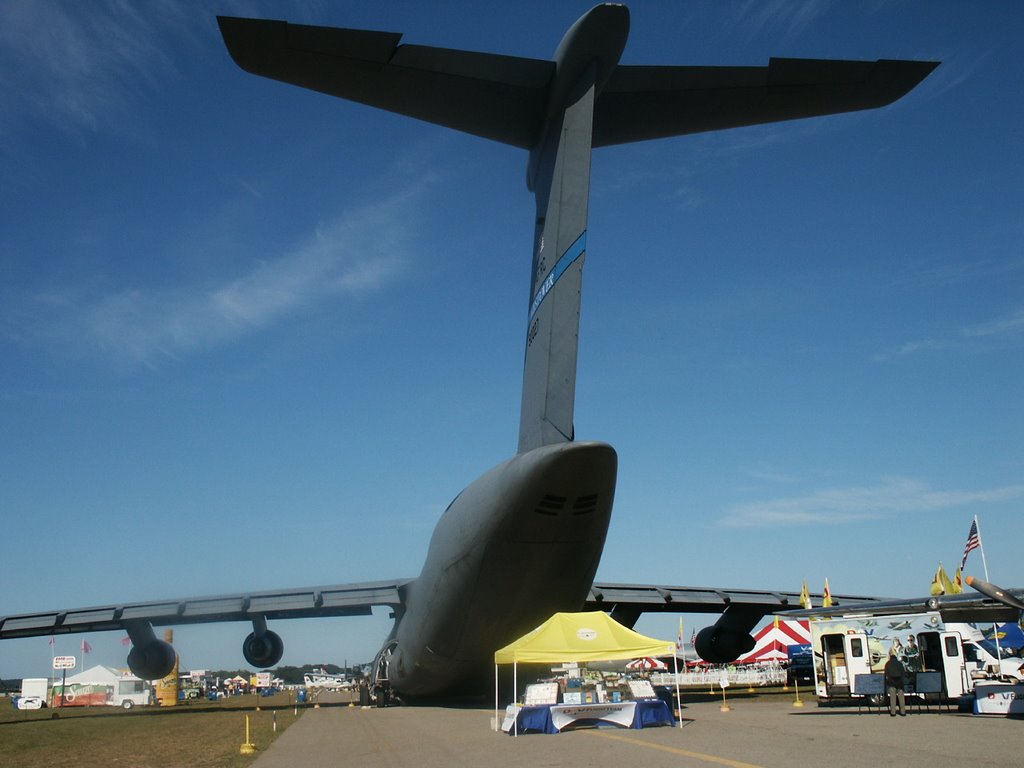
You just don’t get a sense of the size of the C5 until you walk up to it. For starters, you can see it as you drive up to the airport. Then you get out of the car and walk toward it and you get the sense that you’re not getting any closer to it. By the time you get close enough to really get a sense of its size, it fills your entire field of view. So much so that it’s hard to get a picture of the aircraft that conveys a sense of its size. Too close, and you’re just shooting pictures of parts of the aircraft. So you walk a few hundred feet away, but by then the objects to which to compare the C-5A are too small to be good comparisons.

I got up close and personal with a C-5A this summer at the Muskegon Air Fair in Muskegon, Michigan. Toward the end of the day, they actually set up a band and all of its equipment in the back of the cargo compartment and had room to spare.

Anyway, it’s a technically complex and interesting aircraft and we talked to USAF TSgt Brandon Ives about it. Sgt. Ives is a crew chief with the 439th AMXS – 439th Air Wing – Westover Air Reserve Base in Massachusetts.

[Audio]

Thank you TSgt Brandon Ives and thanks also to the 439th Air Wing in Westover Air Reserve Base in Massachusetts. We really enjoyed having your C-5A in Michigan for the weekend and we hope that you’ll send it back again next year!

USAF Fact Sheet on the C-5: http://www.af.mil/factsheets/factsheet.asp?fsID=84

Westover Air Reserve Base: http://www.westover.afrc.af.mil/

Hear the audio at http://airspeed.libsyn.com

Saturday, September 16, 2006

Yankee Air Force Boeing B-17G Flying Fortress "Yankee Lady"

Subscribe to Airspeed using iTunes, visit us at http://airspeed.libsyn.com, or use the following RSS feed. http://airspeed.libsyn.com/rss.


A few weeks ago, I was on duty with the Civil Air Patrol at the Oakland County International airport for its annual open house. Lots of great aircraft, including an F-16 from 127th Fighter Wing at Selfridge Air National Guard Base and an A-10 Warthog from the 110th Fighter Wing at Battle Creek Air National Guard Base.

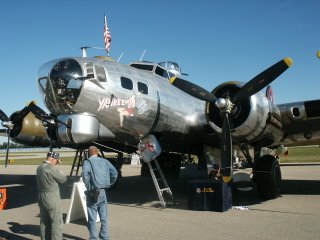
Parked just down the flight line from the CAP communications trailer was the Boeing B-17G Flying Fortress “Yankee Lady” from the Yankee air Museum at Willow Run Airport in Ypsilanti, Michigan, about 25 miles away as the bomber flies.

The Boeing B-17G is 74 feet long, has a wingspan of 104 feet, and stands 19 feet tall at the tail. It weighs about 36,000 pounds empty and has a max gross takeoff weight of nearly 66,000 pounds, leaving a lot of room for crew, fuel, and munitions. The crew included two pilots, a bombardier, a radio operator, and five gunners: One in the nose, two at the waist, one in the ball turret, and one in the tail. The aircraft carried 11 to 13 machine guns and up to 9,600 pounds of bombs.

It’s powered by four Wright R-1820-97 engines, each developing about 1,200 horsepower. It has a range of about 2,000 miles, cruises at about 130 knots, and is can do a maximum of 249 knots.

Boeing built a total of 6,981 B-17s in various models, and Douglas and Lockheed collaborated to built another 5,745.

Yankee Lady is a beautiful aircraft. She’s polished silver and makes beautiful noise when she has all four bird shredders turning. She’s a tail dragger, which makes her look like a fighter from a distance. But when you get up close, you see how massive its wings and other superstructure are. The leading edges of the wings are amazingly thick and the wings are really broad. It’s a muscular-looking aircraft.

Yankee Lady is a movie star, too. She was used in the movie Tora! Tora! Tora!

On a break in the action, I had a chance to talk to Paul Scholl, who flew Yankee Lady in for the show.

[Interview Audio.]

You heard us mention the fire. On October 9, 2004, the hangar that housed the museum caught fire and burned to the ground. All of the flyable aircraft made it out but the museum did lose virtually all of the tooling, equipment, and spare parts for all of the aircraft plus all of the office and display fixtures.

You can visit the Yankee Air Museum’s web page at http://www.yankeeairmuseum.org/ and find out about visiting the museum and donating to help fund recovery after the fire.

To see a list of needs and to find out how to donate to the museum, visit http://yankeeairmuseum.org/donations.shtml.

You can also donate directly to the Yankee Air Museum's recovery fund at https://www.paypal.com/cgi-bin/webscr.

More information about the 127th Fighter Wing at Selfridge Air National Guard Base: http://www.miself.ang.af.mil/

More information about the 110th Fighter Wing at Battle Creek Air National Guard Base: http://www.mibatt.ang.af.mil/battlecreek/index.htm

Saturday, September 09, 2006

Snowbirds: The CT-114 and No.3 Pilot Maj. Cory Blakely

Listen to the audio and subscribe to the podcast at http://airspeed.libsyn.com or subscribe to the podcast using our RSS feed: http://airspeed.linsyn.com/rss.


[Check-in audio]

You may remember that check-in from our coverage of the Canadian Forces Snowbirds on an episode earlier this year as part of our survey of the premier jet demonstration teams so that you’d be prepared as airshow season started later in the year. Lest anyone think that we at Airspeed are all talk, we braved menacing cloud cover and horrible road coffee to go and stalk the Snowbirds in their native setting – The airshow.

In this show, we’re going to do two things. First off, I don’t think that many people understand how special the Snowbirds’ aircraft are, so we’re going to go a little more in depth on the CT-114 Tutor. Second, and by no means less important, we’re going to actually talk to Maj. Cory Blakely, who flies the No. 3 aircraft in the inner left wing position.

So let’s get going. The Snowbirds are the Canadian Forces 431 Air Demonstration Squadron, based in Moosejaw, Saskatchewan, Canada. They train primarily in Saskatchewan and do their pre-season training over different terrain in British Columbia, then thrill audiences all over North America over the course of one of the longest demonstration seasons undertaken by any jet team.

The Snowbirds fly the Canadair CT-114 Tudor and have done so since 1971. A predecessor team, the Golden Centennaries, flew the Tudor beginning in 1967. Canadian-designed and built and claiming a heritage that goes back to preliminary design in 1955, the Tutor was the primary Canadian Forces military jet trainer up until 2000. 22 Tutors continue to fly for the Canadian government and they’re divided between the Snowbirds and the Aerospace Engineering Test Establishment.

The Tutor weighs in at about 7,150 pounds and its J-85 engine produces about 2,700 pounds of thrust. It’ll do more than 400 knots, even with the smoke tanks attached. It’s 32 feet nose to tail, about 36 feet from wingtip to wingtip, and about nine feet tall at the tail. It’s pressurized and air-conditioned and has a service ceiling of 38,000 feet.

The Snowbirds’ Tutors were among 50 that received updates under a Depot Level Inspection and Repair (DLIR) program and an Avionic Update program that rewired the aircraft and installed a DC starting system, among other things Those updates were to extend the rated life of the aircraft to 2015, but the Canadian Airworthiness Review Board never formally ruled on the program.

In addition to routine maintenance, the aircraft require a consolidated inspection package every 400 hours and the engines are rated for 1,600 hours TBO. As of the Tutor’s retirement by the Canadian Forces in 2000, the fleet aircraft had averaged almost 8,000 hours with a low of about 5,400 hours and a high of 12,300 hours.

It seats two side-by-side. I don’t know what training is like in tandem aircraft, but I can’t help but believe that the side-by-side configuration is much better for training. . . . Although it does make it easier for the instructor to whack you in the head if you line it up on the hangars on an ILS. But it’s primarily radio and new media hosts that do that, right? In any case, it’s a nice-looking cockpit.

The No. 1 jet, and possibly others, have convex rear-view mirrors across the top of the cockpit frame. I had often wondered whether the boss gets lonely not being able to see the other aircraft in the formation, but it’s got to be pretty cool to see up to eight other aircraft in your upper peripheral vision. That’s a lot of red in the rearview and it all hangs on with beautiful precision.

The Tudor is a great training aircraft. It’s very stable and very maneuverable, which gives students the opportunity to experience a broad envelope of flight characteristics. Unlike many other jets, the Tutor actually glides pretty well. Those who have flown it say that it “scales” well, which is to say that it models very well at its size the performance and handling characteristics of the larger and more powerful military aircraft to which Canadian military pilots transitioned from the Tutor.

There are apparently many other Tutors in civilian hands and a little searching on the net will bring up several forums for discussions by those rebuilding them. It’s really worth the time to read a couple of those boards. The posters are amazingly knowledgeable and are really passionate about their restorations and about flying the aircraft. There’s one registered in the US on Mercer Island in Washington State under an experimental type certificate. I checked the registration database of Transport Canada to try to determine how many were registered in Canada, but found none. It may be that civilian-owned Tutors in Canada either don’t have to be registered in that database or are registered under some designation other than C-114.

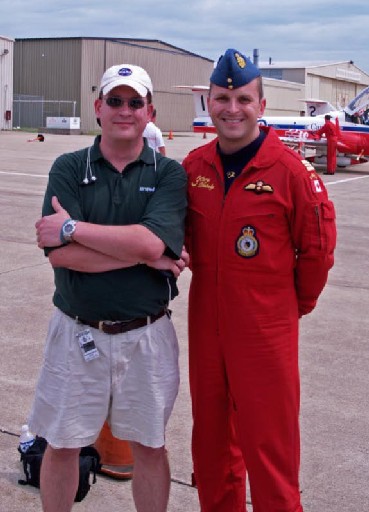
So on to the interview. We caught up with the Snowbirds at the Battle Creek International Balloon Festival and Field of Flight Air Show in July on the day they arrived. It took only a few minutes with public affairs officer Navy Lieutenant Petra Smith before we met Maj. Cory Blakely.

The major is 38 and flies the No. 3 jet in the formation. That’s the inner left wing of the formation. The No. 3 pilot flies to the left of, and a little behind, the lead jet in many of the team’s formations. As such, much of the left half of the formation lines up on his aircraft and depends on his consistency and skill for its integrity and safety.

He’s in his third year with the squadron. Prior to joining the Snowbirds, he was stationed at “The Big 2,” the 2 Canadian Forces Flying School in Moose Jaw, Saskatchewan, instructing in the CT-156 Harvard II, a turboprop trainer that offers an initial climb rate in excess of 3,300 feet per minute and handles sustained 2G turns at 25,000 feet. The Big 2 trains more than 150 pilots every year through the NATO Flying Training in Canada program. The Big 2 is also home to the Flying Instruction and Standards Section, the unit responsible for training military flying instructors.

Prior to that, he served with the RCAF 434 Squadron in Stan Rogers country – Greenwood, Nova Scotia. The 434 squadron, nicknamed the Bluenose after the schooner by that name that you can see on the back of Canadian dimes, has been formed and disbanded several times between its initial formation during World War II and the present day. It was most recently disbanded with the retirement of the CT-133 Silver Star (which Maj. Cory flew) and CE/CP-144 Challengers. I mention this bit of history because, in spite of meticulous research, I managed to miss the retirement of the Silver Star, but mentioned it in the interview.

Let’s talk to Maj. Blakely.

[Interview audio]

Libsyn Transition Complete!


The transition to Libsyn is pretty much complete! The new rss feed is:

http://airespeed.libsyn.com/rss

We moved all of the files over to Libsyn last weekend and, as nearly as we can tell, we didn't lose anyone in the transition. We're going to submit the above picture in case Libsyn will take a "celebrity endorsement" from good ol' Capt. Force.

Please let us know if you've had any difficulty making the jump. steve@airspeedonline.com.

Thanks!

Sunday, September 03, 2006

Yet More Transitions: Airspeed Moves to Libsyn!

I hope you're not here because you're having trouble with our feed. In fact, it'd be great if you're here because you're thrilled about the speed, efficiency, and reliability of the feed!

In any case, here's the skinny.

I finally got (1) fed up with the existing RSS manager for the podcast (2) fed up with the file host that I had been using for some of the episodes (1&1's front end and just about every other element of its services are constantly broken and I'm tired of talking to tech support! Net Voce, (www.netvoce.com) and Daniel McNew on the other hand, rock!), and (3) enough time to fully migrate the podcast to another RSS provider!

So here's what is supposed to happen. 22 episodes are already migrated over to Libsyn. I have another five episodes that 1&1 lost that I need to find on my local hard drive and make available using Libsyn. Then I'll have all of the Airspeed and Airspeed in Brief episodes (almost 30!) available in one RSS feed and from one website!

Note that I'm not posting the two Airspeed in Brief episodes that were merely parts of the full Airspeed episodes. But all other episodes will be available.

Once I get the remaining five episodes transitioned, I'm going to put a redirect in the old feed. My present RSS provider says that "Enabling redirection will cause the [current-RSS-manager-who-will-not-be-named] server to return a 301 error and redirect to the new location when receiving a request for the old feed. Doing so will cause both the iTunes Music Store and the iTunes clients that have subscribed to your podcast to pick up the new feed URL."

If the redirect works (and I have grave doubts about whether it will), you should be transitioned over to the Libsyn feed automatically without any action on your part.

If it doesn't work, you will need to update the RSS feed that you use for Airspeed to:

airspeed.libsyn.com/rss

I apologize in advance for any inconvenience. Please e-mail me at steve@airspeedonline.com with any questions or if I can be of assistance. Even if we only successfully transition the iTunes users, that will still give us an 83% transition rate automatically. I apologize to users of other podcatchers if we lose them. Please find us and re-subscribe if we lose you!

The transition should allow us to deliver the podcast more reliably and also provide a means of accessing the entire Airspeed library from one convenient feed and web location. Additionally, the transition should give us better metrics so that we can show sponsors and potential providers of orientation flights the reach of the podcast. That should come around to benefit you, the listeners, as we obtain better and better opportunities to bring you cooler and cooler content.

Thanks in advance for your patience!

- Steve