Saturday, September 23, 2006

C-5A Galaxy and a Talk with TSgt Brandon Ives

Subscribe to Airspeed at iTunes or by using the RSS feed: http://airspeed.libsyn.com/rss. Listen online at www.airspeed.libsyn.com.


We’re going large this time on Airspeed. Large as in the Lockheed C-5 Galaxy, the largest aircraft currently in use by the Air Force’s Air Mobility Command.

It’s 247 feet long, 223 feet wingtip to wingtip, and 65 feet tall at the tail. Its cargo compartment is 13.5 feet tall, 19 feet wide, and 144 feet long. It’ll haul 270,000 pounds of cargo and get it all off the ground in only 8,300 feet of runway. And if you think that’s quick, try the 4,900-foot landing distance at that same weight.

The C-5 is powered by four TF39 turbofan engines that produce 43,000 pounds thrust each. The air intake diameter of each engine is more than 8.5 feet. Each engine pod is nearly 27 feet long.

The landing gear consist of a total of 28 wheels and the landing gear will “kneel” to adjust the cargo deck to allow loading and unloading at various heights off of the ground.

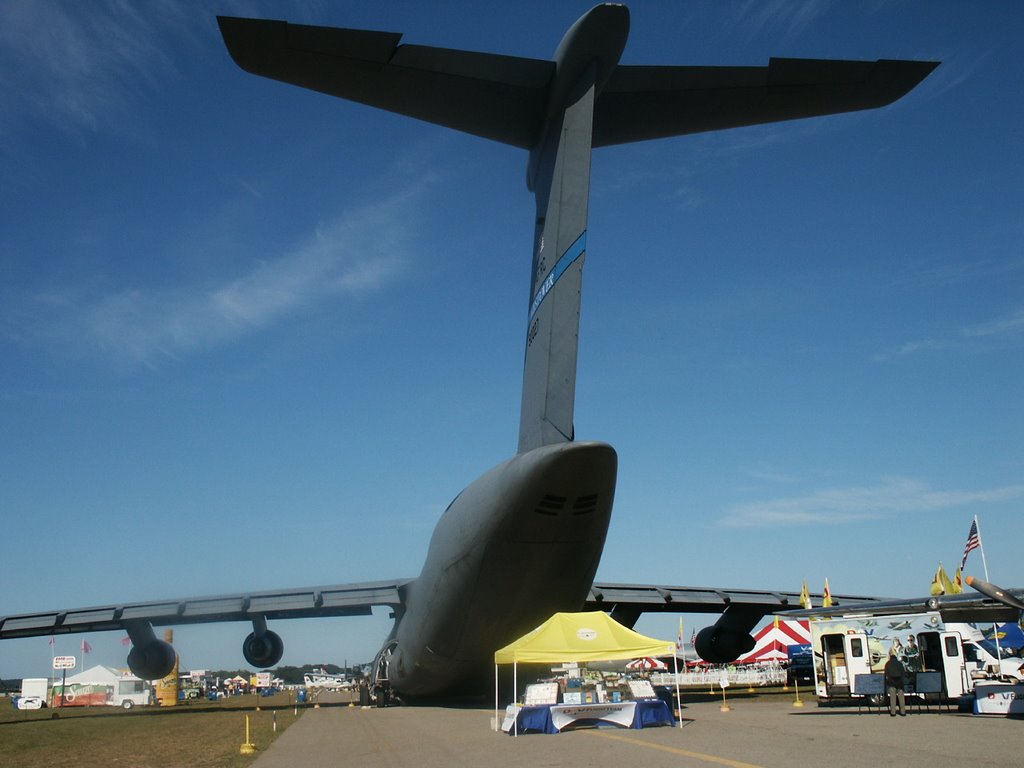
You just don’t get a sense of the size of the C5 until you walk up to it. For starters, you can see it as you drive up to the airport. Then you get out of the car and walk toward it and you get the sense that you’re not getting any closer to it. By the time you get close enough to really get a sense of its size, it fills your entire field of view. So much so that it’s hard to get a picture of the aircraft that conveys a sense of its size. Too close, and you’re just shooting pictures of parts of the aircraft. So you walk a few hundred feet away, but by then the objects to which to compare the C-5A are too small to be good comparisons.

I got up close and personal with a C-5A this summer at the Muskegon Air Fair in Muskegon, Michigan. Toward the end of the day, they actually set up a band and all of its equipment in the back of the cargo compartment and had room to spare.

Anyway, it’s a technically complex and interesting aircraft and we talked to USAF TSgt Brandon Ives about it. Sgt. Ives is a crew chief with the 439th AMXS – 439th Air Wing – Westover Air Reserve Base in Massachusetts.

[Audio]

Thank you TSgt Brandon Ives and thanks also to the 439th Air Wing in Westover Air Reserve Base in Massachusetts. We really enjoyed having your C-5A in Michigan for the weekend and we hope that you’ll send it back again next year!

USAF Fact Sheet on the C-5: http://www.af.mil/factsheets/factsheet.asp?fsID=84

Westover Air Reserve Base: http://www.westover.afrc.af.mil/

Hear the audio at http://airspeed.libsyn.com

Saturday, September 16, 2006

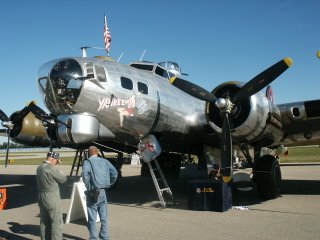
Yankee Air Force Boeing B-17G Flying Fortress "Yankee Lady"

Subscribe to Airspeed using iTunes, visit us at http://airspeed.libsyn.com, or use the following RSS feed. http://airspeed.libsyn.com/rss.


A few weeks ago, I was on duty with the Civil Air Patrol at the Oakland County International airport for its annual open house. Lots of great aircraft, including an F-16 from 127th Fighter Wing at Selfridge Air National Guard Base and an A-10 Warthog from the 110th Fighter Wing at Battle Creek Air National Guard Base.

Parked just down the flight line from the CAP communications trailer was the Boeing B-17G Flying Fortress “Yankee Lady” from the Yankee air Museum at Willow Run Airport in Ypsilanti, Michigan, about 25 miles away as the bomber flies.

The Boeing B-17G is 74 feet long, has a wingspan of 104 feet, and stands 19 feet tall at the tail. It weighs about 36,000 pounds empty and has a max gross takeoff weight of nearly 66,000 pounds, leaving a lot of room for crew, fuel, and munitions. The crew included two pilots, a bombardier, a radio operator, and five gunners: One in the nose, two at the waist, one in the ball turret, and one in the tail. The aircraft carried 11 to 13 machine guns and up to 9,600 pounds of bombs.

It’s powered by four Wright R-1820-97 engines, each developing about 1,200 horsepower. It has a range of about 2,000 miles, cruises at about 130 knots, and is can do a maximum of 249 knots.

Boeing built a total of 6,981 B-17s in various models, and Douglas and Lockheed collaborated to built another 5,745.

Yankee Lady is a beautiful aircraft. She’s polished silver and makes beautiful noise when she has all four bird shredders turning. She’s a tail dragger, which makes her look like a fighter from a distance. But when you get up close, you see how massive its wings and other superstructure are. The leading edges of the wings are amazingly thick and the wings are really broad. It’s a muscular-looking aircraft.

Yankee Lady is a movie star, too. She was used in the movie Tora! Tora! Tora!

On a break in the action, I had a chance to talk to Paul Scholl, who flew Yankee Lady in for the show.

[Interview Audio.]

You heard us mention the fire. On October 9, 2004, the hangar that housed the museum caught fire and burned to the ground. All of the flyable aircraft made it out but the museum did lose virtually all of the tooling, equipment, and spare parts for all of the aircraft plus all of the office and display fixtures.

You can visit the Yankee Air Museum’s web page at http://www.yankeeairmuseum.org/ and find out about visiting the museum and donating to help fund recovery after the fire.

To see a list of needs and to find out how to donate to the museum, visit http://yankeeairmuseum.org/donations.shtml.

You can also donate directly to the Yankee Air Museum's recovery fund at https://www.paypal.com/cgi-bin/webscr.

More information about the 127th Fighter Wing at Selfridge Air National Guard Base: http://www.miself.ang.af.mil/

More information about the 110th Fighter Wing at Battle Creek Air National Guard Base: http://www.mibatt.ang.af.mil/battlecreek/index.htm

Saturday, September 09, 2006

Snowbirds: The CT-114 and No.3 Pilot Maj. Cory Blakely

Listen to the audio and subscribe to the podcast at http://airspeed.libsyn.com or subscribe to the podcast using our RSS feed: http://airspeed.linsyn.com/rss.


[Check-in audio]

You may remember that check-in from our coverage of the Canadian Forces Snowbirds on an episode earlier this year as part of our survey of the premier jet demonstration teams so that you’d be prepared as airshow season started later in the year. Lest anyone think that we at Airspeed are all talk, we braved menacing cloud cover and horrible road coffee to go and stalk the Snowbirds in their native setting – The airshow.

In this show, we’re going to do two things. First off, I don’t think that many people understand how special the Snowbirds’ aircraft are, so we’re going to go a little more in depth on the CT-114 Tutor. Second, and by no means less important, we’re going to actually talk to Maj. Cory Blakely, who flies the No. 3 aircraft in the inner left wing position.

So let’s get going. The Snowbirds are the Canadian Forces 431 Air Demonstration Squadron, based in Moosejaw, Saskatchewan, Canada. They train primarily in Saskatchewan and do their pre-season training over different terrain in British Columbia, then thrill audiences all over North America over the course of one of the longest demonstration seasons undertaken by any jet team.

The Snowbirds fly the Canadair CT-114 Tudor and have done so since 1971. A predecessor team, the Golden Centennaries, flew the Tudor beginning in 1967. Canadian-designed and built and claiming a heritage that goes back to preliminary design in 1955, the Tutor was the primary Canadian Forces military jet trainer up until 2000. 22 Tutors continue to fly for the Canadian government and they’re divided between the Snowbirds and the Aerospace Engineering Test Establishment.

The Tutor weighs in at about 7,150 pounds and its J-85 engine produces about 2,700 pounds of thrust. It’ll do more than 400 knots, even with the smoke tanks attached. It’s 32 feet nose to tail, about 36 feet from wingtip to wingtip, and about nine feet tall at the tail. It’s pressurized and air-conditioned and has a service ceiling of 38,000 feet.

The Snowbirds’ Tutors were among 50 that received updates under a Depot Level Inspection and Repair (DLIR) program and an Avionic Update program that rewired the aircraft and installed a DC starting system, among other things Those updates were to extend the rated life of the aircraft to 2015, but the Canadian Airworthiness Review Board never formally ruled on the program.

In addition to routine maintenance, the aircraft require a consolidated inspection package every 400 hours and the engines are rated for 1,600 hours TBO. As of the Tutor’s retirement by the Canadian Forces in 2000, the fleet aircraft had averaged almost 8,000 hours with a low of about 5,400 hours and a high of 12,300 hours.

It seats two side-by-side. I don’t know what training is like in tandem aircraft, but I can’t help but believe that the side-by-side configuration is much better for training. . . . Although it does make it easier for the instructor to whack you in the head if you line it up on the hangars on an ILS. But it’s primarily radio and new media hosts that do that, right? In any case, it’s a nice-looking cockpit.

The No. 1 jet, and possibly others, have convex rear-view mirrors across the top of the cockpit frame. I had often wondered whether the boss gets lonely not being able to see the other aircraft in the formation, but it’s got to be pretty cool to see up to eight other aircraft in your upper peripheral vision. That’s a lot of red in the rearview and it all hangs on with beautiful precision.

The Tudor is a great training aircraft. It’s very stable and very maneuverable, which gives students the opportunity to experience a broad envelope of flight characteristics. Unlike many other jets, the Tutor actually glides pretty well. Those who have flown it say that it “scales” well, which is to say that it models very well at its size the performance and handling characteristics of the larger and more powerful military aircraft to which Canadian military pilots transitioned from the Tutor.

There are apparently many other Tutors in civilian hands and a little searching on the net will bring up several forums for discussions by those rebuilding them. It’s really worth the time to read a couple of those boards. The posters are amazingly knowledgeable and are really passionate about their restorations and about flying the aircraft. There’s one registered in the US on Mercer Island in Washington State under an experimental type certificate. I checked the registration database of Transport Canada to try to determine how many were registered in Canada, but found none. It may be that civilian-owned Tutors in Canada either don’t have to be registered in that database or are registered under some designation other than C-114.

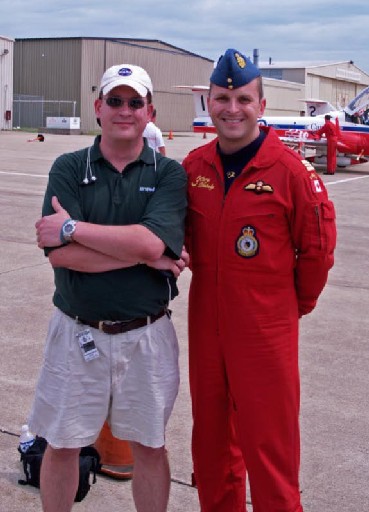
So on to the interview. We caught up with the Snowbirds at the Battle Creek International Balloon Festival and Field of Flight Air Show in July on the day they arrived. It took only a few minutes with public affairs officer Navy Lieutenant Petra Smith before we met Maj. Cory Blakely.

The major is 38 and flies the No. 3 jet in the formation. That’s the inner left wing of the formation. The No. 3 pilot flies to the left of, and a little behind, the lead jet in many of the team’s formations. As such, much of the left half of the formation lines up on his aircraft and depends on his consistency and skill for its integrity and safety.

He’s in his third year with the squadron. Prior to joining the Snowbirds, he was stationed at “The Big 2,” the 2 Canadian Forces Flying School in Moose Jaw, Saskatchewan, instructing in the CT-156 Harvard II, a turboprop trainer that offers an initial climb rate in excess of 3,300 feet per minute and handles sustained 2G turns at 25,000 feet. The Big 2 trains more than 150 pilots every year through the NATO Flying Training in Canada program. The Big 2 is also home to the Flying Instruction and Standards Section, the unit responsible for training military flying instructors.

Prior to that, he served with the RCAF 434 Squadron in Stan Rogers country – Greenwood, Nova Scotia. The 434 squadron, nicknamed the Bluenose after the schooner by that name that you can see on the back of Canadian dimes, has been formed and disbanded several times between its initial formation during World War II and the present day. It was most recently disbanded with the retirement of the CT-133 Silver Star (which Maj. Cory flew) and CE/CP-144 Challengers. I mention this bit of history because, in spite of meticulous research, I managed to miss the retirement of the Silver Star, but mentioned it in the interview.

Let’s talk to Maj. Blakely.

[Interview audio]

Libsyn Transition Complete!


The transition to Libsyn is pretty much complete! The new rss feed is:

http://airespeed.libsyn.com/rss

We moved all of the files over to Libsyn last weekend and, as nearly as we can tell, we didn't lose anyone in the transition. We're going to submit the above picture in case Libsyn will take a "celebrity endorsement" from good ol' Capt. Force.

Please let us know if you've had any difficulty making the jump. steve@airspeedonline.com.

Thanks!

Sunday, September 03, 2006

Yet More Transitions: Airspeed Moves to Libsyn!

I hope you're not here because you're having trouble with our feed. In fact, it'd be great if you're here because you're thrilled about the speed, efficiency, and reliability of the feed!

In any case, here's the skinny.

I finally got (1) fed up with the existing RSS manager for the podcast (2) fed up with the file host that I had been using for some of the episodes (1&1's front end and just about every other element of its services are constantly broken and I'm tired of talking to tech support! Net Voce, (www.netvoce.com) and Daniel McNew on the other hand, rock!), and (3) enough time to fully migrate the podcast to another RSS provider!

So here's what is supposed to happen. 22 episodes are already migrated over to Libsyn. I have another five episodes that 1&1 lost that I need to find on my local hard drive and make available using Libsyn. Then I'll have all of the Airspeed and Airspeed in Brief episodes (almost 30!) available in one RSS feed and from one website!

Note that I'm not posting the two Airspeed in Brief episodes that were merely parts of the full Airspeed episodes. But all other episodes will be available.

Once I get the remaining five episodes transitioned, I'm going to put a redirect in the old feed. My present RSS provider says that "Enabling redirection will cause the [current-RSS-manager-who-will-not-be-named] server to return a 301 error and redirect to the new location when receiving a request for the old feed. Doing so will cause both the iTunes Music Store and the iTunes clients that have subscribed to your podcast to pick up the new feed URL."

If the redirect works (and I have grave doubts about whether it will), you should be transitioned over to the Libsyn feed automatically without any action on your part.

If it doesn't work, you will need to update the RSS feed that you use for Airspeed to:

airspeed.libsyn.com/rss

I apologize in advance for any inconvenience. Please e-mail me at steve@airspeedonline.com with any questions or if I can be of assistance. Even if we only successfully transition the iTunes users, that will still give us an 83% transition rate automatically. I apologize to users of other podcatchers if we lose them. Please find us and re-subscribe if we lose you!

The transition should allow us to deliver the podcast more reliably and also provide a means of accessing the entire Airspeed library from one convenient feed and web location. Additionally, the transition should give us better metrics so that we can show sponsors and potential providers of orientation flights the reach of the podcast. That should come around to benefit you, the listeners, as we obtain better and better opportunities to bring you cooler and cooler content.

Thanks in advance for your patience!

- Steve

Tuesday, August 22, 2006

Dave Schwartz: Skydiving Yoda

Just got off the phone with Dave Schwartz, who produces Skydive Radio, a free podcast for advanced skydivers. More info at www.skydiveradio.com.

Dave is a commercial pilot who is a longtime skydiver (or is he a longtime skydiver who is a commercial pilot?). He started jumping in 1990 and has 2,500 jumps under his belt. He's a tandem instructor, static line instructor, and freefall photographer and holds a professional exhibition rating. Naturally, he flies jump aircraft as well.

Dave was kind enough to spend a big chunk of his Tuesday evening recording an interview for an upcoming episode of Airspeed. I became aware of Dave and his show when he wrote to augment my understanding of skydiving after the Golden Knights episode. He was authoritative and diplomatic and really made me want to learn more.

Anyway, after subscribing to his show and listening to a couple of episodes, I asked him to appear on Airspeed. He agreed and, despite a longish day at work, he leaned into every question and called them as he saw them.

Dave's experiences both as a pilot and a skydiver made this a really good interview. Normally, I do a boatload of research and rarely ask a question to which I don't already know the answer. But I went out on a limb this time and decided to risk asking the dumbass question here and there in order to get the real skinny on skydiving. I figure that I have a lot of the same conceptions and misconceptions as many pilots and, to the extent that I need to be disabused of the misconceptions, I'd be your proxy and ask the questions that are probably on your minds.

It worked, at least to my way of thinking. I learned a lot and I'm tickled pink about how it came off. Dave's perspective as a pilot really added to the value of the content. Makes me want to get the episode out as soon as I can so that GA pilots have benefit of his perspectives before the skydiving season ends here in the northern latitudes.

Dave is an excellent emmissary for his sport. I'm not about to jump out of an airplane. My shoulder dislocates when I assume the proper freefall position and any backward force is exerted on my arm. Even on the ground. And I am also quite chicken. But that doesn't mean that Dave won't be my skydiving Yoda.

Look for the episode in a few weeks after Part 2 of the KC-135 series and possibly one other show. I want to edit this one right.

Thanks, Dave!

Tuesday, August 01, 2006

A Ride in the Golden Knights' Jump Aircraft


Subscribe to Airspeed using iTunes, visit us at http://airspeed.libsyn.com, or use the following RSS feed. http://airspeed.libsyn.com/rss.

Listen to the audio episode by clicking: http://media.libsyn.com/media/airspeed/AirspeedGoldenKnights.mp3.

When Airspeed covers guys who go up in airplanes, it's usually covering guys who stay in those airplanes - at least until the airplanes land. I personally prefer to stay in perfectly good airplanes while they're aloft and it'd take a pretty bad rash of damage before I'd exit an aircraft that wasn't parked on the ramp.

Not so for the brave and/or crazy who hurl themselves from aircraft and fall for more than a mile before deploying high-tech parachutes. And especially not so for the hands-down best parachute demonstration and competition teams of the United States Army Golden Knights.

Now stationed at the “Home of the Airborne,” Fort Bragg, North Carolina, the Golden Knights started in 1959 with the 13-man Strategic Army Air Corps Sport Parachute Team. Believe it or not, the Eastern Bloc then dominated the sport of parachuting and the US airborne infantry were having none of that. On June 1, 1961, the US Army officially recognized the team as the Army Parachute Team.

Each individual must have a minimum of 150 jumps to tryout for the team. Current members have jump numbers ranging from 250-11,000 jumps, which varies with their number of years of jumping. The team consists of 95 members, which includes pilots, demonstrators, recruiting coordinators, support staff, and others.

Golden Knights pilots average more than 5,500 flying hours and average 10 years of military experience. Many are warrant officers and some are Department of the Army civilians.

The Golden Knights competition teams have won more than 400 national championships, more than 60 world championships, and too many team championships to count. If you’re at a parachute competition where the Golden Knights are competing and you’re not a Golden Knight, get ready for a shootout for second place.

Now you could be forgiven for thinking that this episode might be a monologue. After all, there's more than enough to say about the Golden Knights. Well, Airspeed went the extra mile (actually a few hundred of them) and we’re about to take you up 12,000 feet strapped into a canvas seat just a few feet from the open doors of the Golden Knights Black Team's Fokker C-31A Friendship. No ground interviews here. We're talking to fully-suited and rigged Golden Knights just minutes before they exit the aircraft. Wind noise, near-freezing cold, and the whole ball of wax. Yeah!

A couple of notes here. The only thing harder than beating a Golden Knights competition team is getting the recording levels right. The stuff in the airplane is hard enough with the engine and wind noise. The ground briefing was tough, too. The jump aircraft was parked at the end of the runway that served as the show line. This was not the active runway, so there were no takeoff or landing operations on it, but we had lots of fly-overs and explosions from the bomber flyovers. Although I didn't record it, we had two flyovers by a Mig on full afterburners at 200 feet overhead. All of which is by way of excuse for the problems with the levels and not in any way a complaint.

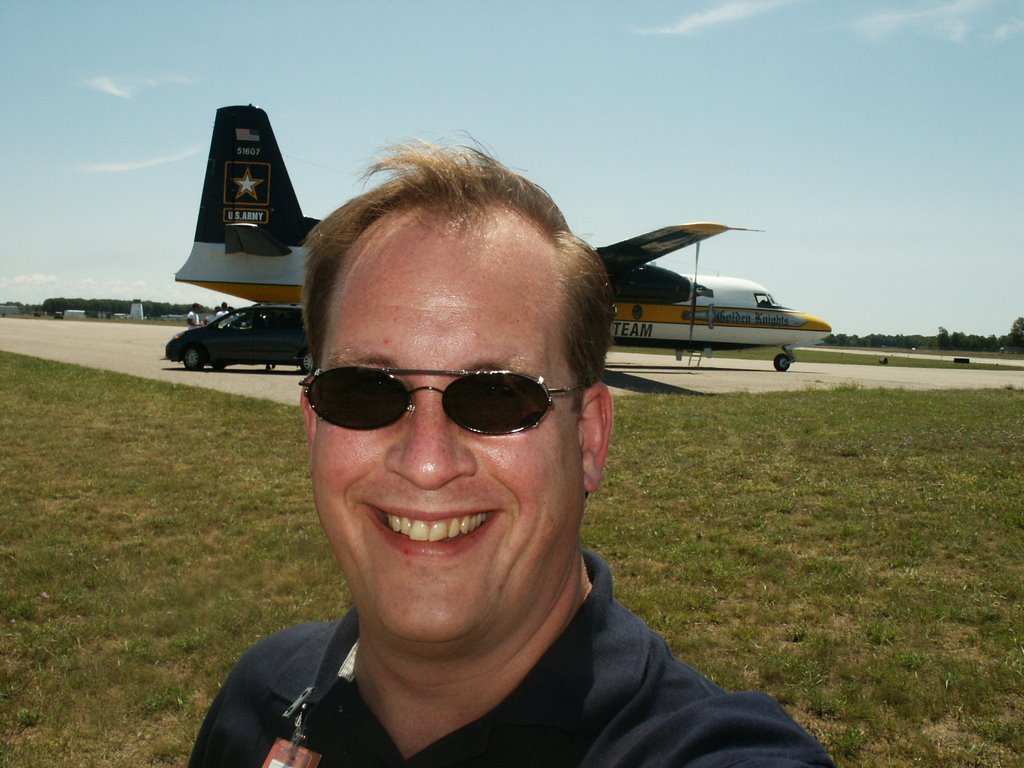
I’m going up in the team’s Fokker C-31A Friendship (the military version of the Fokker F-27). The aircraft is 77 feet long, 28 feet high at the tail, and has a wingspan of 95 feet. Power is courtesy of two 2 Rolls Royce Dart 7 Engines. It’ll do 300 miles per hour and has a maximum payload of 12,000 pounds out of its maximum rated takeoff weight of 45,000 pounds. When it’s not carrying the Golden Knights for demonstrations, the aircraft can be configured to carry 56 infantry troops, 50 fully loaded paratroopers or 24 litters. Standard crew is three personnel and it’ll go 1,500 miles before refueling. Today, the aircraft is configured with several rows of standard seating up front and then an open space for the last two thirds of the fuselage with canvas sling benches along the sides. Both doors are open from takeoff to landing.

So let's get the pre-flight briefing. At this point, I'm in the tail end of the aircraft a few feet from the open doors. This is where I'll strap in in a few minutes. The doors measure something like five feet by five feet and there are two of them - one on each side at the back end of the passenger and cargo area. The briefer is Cpl. Josh Coleman. Coleman enlisted into the Army in September 2001 and has completed one tour with the 82nd Airborne Division, Fort Bragg, N.C., with whom he deployed to Iraq for eight and a half months in support of Operation Iraqi Freedom. He’s in his second year with the Golden Knights. He has more than 890 freefall parachute jumps in his logbook.

[Audio]


I strap in and we're soon rolling. The jump team suits up in the plane and they're seated along the walls as we taxi. I take the opportunity to interview Sgt. Jared Hall, who's sitting next to me. Sgt. Hall enlisted in the Army in September 1992. He served tours of duty at Fort Campbell, Kentucky from 1992 through 2003. After completing the Golden Knights Assessment and Selection Program in the fall of 2003 he was ‘knighted’ and assigned to the Black Demonstration Team. He is in entering his second year on the team and has completed more than 1,150 freefall parachute jumps. The interview is interrupted by takeoff and we finish up during the climb.

[Audio]


Shortly after that, the knights are roaming about the plane talking about the jump and getting the plane's ground track dialed in. They toss streamers and spend a fair amount of time on hands and knees with their heads out the door looking down.

It stays noisy and gets cold. I’m wearing a fleece vest, but I’m also wearing shorts. My legs are cold, but my central body is fine. It’s my fingers that get bothersome because it’s hard to work the MP3 recorder and the camera.


Specialist Ben Borger sits down next to me and we have a chance to talk. Since joining the Army in 2001 he has earned his combat infantry badge, expert infantry badge, airborne qualification, air assault badge, and combat life saver’s badge. In 2004-2005 Borger deployed to Iraq in support of Operation Iraqi Freedom.

[Audio]

A few minutes later, we're over the target. The narrator goes first. I didn’t have the chance to ask his name on the aircraft, but I’m pretty sure that it was Sgt. John Ewald. My apologies in advance if I’ve misidentified him. Ewald is a cavalry scout in his third season with the team. He has been skydiving since May of 2000 and has 1,300 freefall parachute jumps and five military static line jumps. And lest you think that Golden Knights demonstrators jump out of airplanes because they can’t fly them, Sgt. Ewald has a degree in aviation management and is a pilot with more than 500 hours.


Ewald readies himself by the door facing forward. At the appointed moment, he side-steps out, legs straight, elbows out, and hands up. For a split second, he's there outside the door next to the airplane, hanging there Wile-E-Coyote style. And he's grinning.

Then he's gone. That fast.

The other thing that gets you about watching this is that the environment inside the plane is a lot different from outside. Yeah, it’s cold and noisy, but it’s also comparatively dark and it’s – well – inside the plane. When Ewald steps out, it’s like he’s going from the shadowy world of preparation and waiting into the bright and instantly energetic world of performance. It’s like he and his environment are instantly painted in bright colors and energized from the prop blast and more than two miles of gravitational potential energy about to be released.

That’s a lot of thought for something that lasts only a second. And I do mean a second. He’s gone immediately and you kind of find yourself looking out the trailing edge of the door. I’m glad that I was strapped in, because I really had the urge to get up and go look out the door. Not that I would have, but it’s good to be strapped in.

Then we circle around and get ready for the next run over the target. All seven remaining team members make their ways to the back of the aircraft. There are ritual shouted declarations and gestures. Not a few times, a team member stops a fellow jumper and looks over his gear. These guys are serious about safety and teamwork and nobody shows even a hint of ego about being checked over by a fellow jumper.

Then they’re formed up at the doors. This is the audio. It’s really hard to tell what’s going on, but I can tell you that being there doesn’t necessarily give you a feeling of understanding it all, either. Just like Ewald’s jump, it’s over very quickly. You’re going to hear a few shouts, then a ready, set, go! The change in the background noise for about a half second is the change in the wind dynamics resulting from seven guys diving out into the slipstream at once. Then it’s over. Seven black-clad forms are suddenly painted with bright daylight and then they’re gone.

[Audio]

Then it’s just you, the crew chief, and the pilots. The crew chief isn’t wearing a parachute, so he mostly keeps to the front of the aircraft. The pilots stay up there, too, for more obvious reasons. You descend and land about 15 minutes later.

I don’t know if the Golden Knights plan it this way, but you have time to think about what you just saw. As the air gets warmer and the houses get bigger, it dawns on you that there’s more to it than just a demonstration for an air show. The jumpers aren’t always greeted by a blast of sunlight and clean Lake Michigan air. Sometimes it’s dark. Sometimes it’s turbulent. Sometimes it’s not a festival of aviation enthusiasts waiting on the ground. Coleman, Borger, and others have done tours of duty in Iraq. Every Golden Knight is trained as airborne infantry and is on call to go into harm’s way if the country calls upon him or her. These are committed and talented individuals who put their lives on the line in more ways than one and my hat’s off to them.

Thanks to Cpl. Josh Coleman, Sgt. Jared Hall, Specialist Ben Borger, Sgt. John Ewald, and the rest of the Golden Knights’ Black Team.

Thanks also to Mike Murphy and everyone at the Muskegon air Fair at the Muskegon County air Fair in Muskegon, Michigan.

Hear the audio at http://www.airspeedonline.com/AirspeedGoldenKnights.mp3.

Sunday, July 23, 2006

Muskegon Air Show and a Ride with the Golden Knights

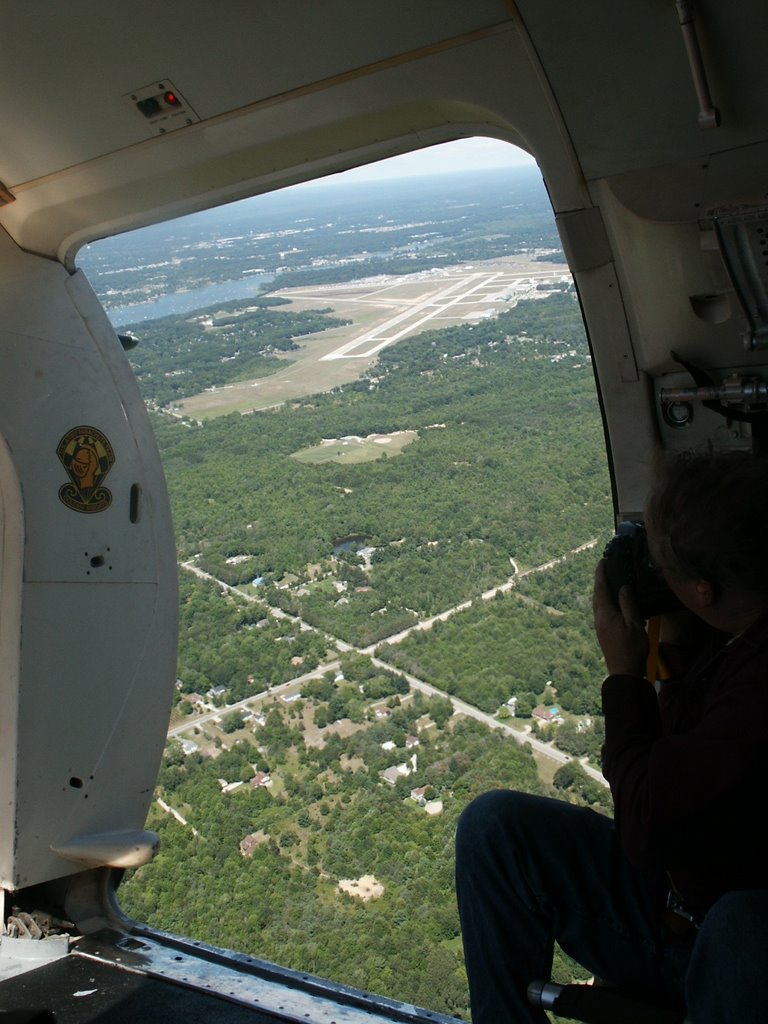
Spent the day at the Muskegon Air Fair. (www.muskegonairfair.com). Up at 5:00 and on the road by 6:00. 188 miles to Muskegon. (Planning to fly that on Tuesday for the long cross-country for the instrument rating, but that's another story).


Sublimely-run air show! Mike Murphy was an absolutely outstanding media coordinator. I pulled up to the VIP gate, they were expecting me, they showed me to the parking spot, and Mike was right there in no time with a golf cart and gave me the grant tour. Couldn't have asked for better.

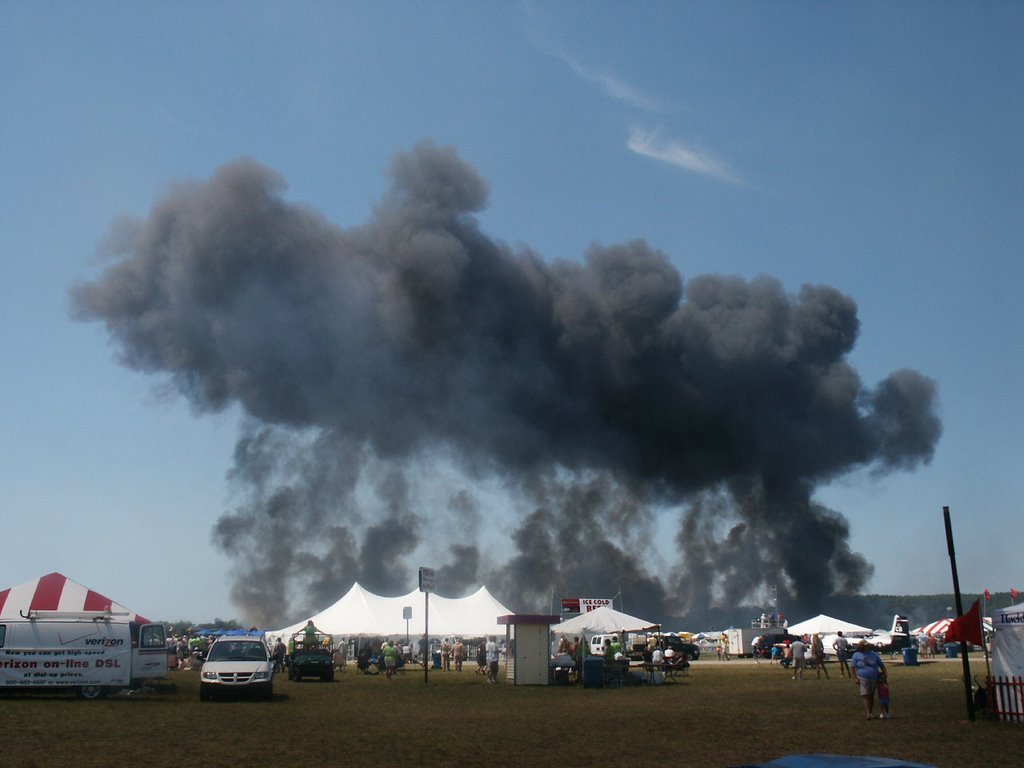
Lots of explosions and pyrotechnics during the bomber flyovers (see above). Made it hell to try to record interviews and get the levels right, but that's okay.

I ran around and interviewed anything in a Nomex jumpsuit that would hold stilllong enough for me to put a mic in its face. All of the military personnel (especially the Canadian Forces C-140 crew and the Wisconsin ANG KC-135 crew) were very forthcoming. A couple of the enlisted guys begged off on interviews, but that's perfectly fine by me. Probably instructions from their public affairs officers. But anyone with lieutenant's bars or better was all talk and they were enthusiactic about their aircraft and their roles.


Biggest thing at the show was the C5 Galaxy. I tried to take pictures of it up close, but you couldn't tell what it was. Tried to take pictures (like the one above) from further away, but you just don't get the scale of the aircraft. It's farging huge. They set up a rock band on the rear ramp toward the end of the day and still had room to play a respectable game of basketball (or golf for that matter) in the remaining volume of the aircraft. They say that it'll carry two M1A1 Abrams tanks or six helicopters and I believe them. Explains why the standard crew on the Galaxy includes three (count 'em: three) load masters.

More very soon. The highlight was a ride in the US Army Golden Knights' Fokker C-31A Friendship. Strapped in right next to the open door, we climbed to 12,500 AGL (about 13,000 MSL) and I had the best seat in the house for the jump. The team left the aircraft en masse just a few feet from me. I'm still startled by the transition from the comparative gloom and stability of the plane to the brightness and fury into which the team exploded out the door. A guy who is standing right next to me one minute is suddenly outside the plane and then he's gone. Really cool.

I was in shorts, but remembered to bring along my fleece vest. Good thing, too, because it was in the 30s Farenheit up there. They warned us once we were on the plane, but it's a little late by then. One of the guys from the local cable access show was very lightly dressed and they lent him a Golden Knights jumpsuit. His camera person got a sweatshirt. Nice guys, all of them. And laid back for a bunch of guys that are about to freefall for almost two miles.

I got two interviews on the plane, but it was noisy as hell, what with the door open and all. I'll see if I can clean up the audio with a filter.

Interview with a Thunderbird


Subscribe to Airspeed using iTunes, visit us at http://airspeed.libsyn.com, or use the following RSS feed. http://airspeed.libsyn.com/rss.

See Maj. Jeremy Sloane's bio at: http://www.nellis.af.mil/thunderbirds/06officerhtms/06officers7.htm.

If you’re been listening to Airspeed for awhile, you know that we have a Jones for the F-16 Fighting Falcon that just won’t quit. We also have a high regard for air demonstration teams.

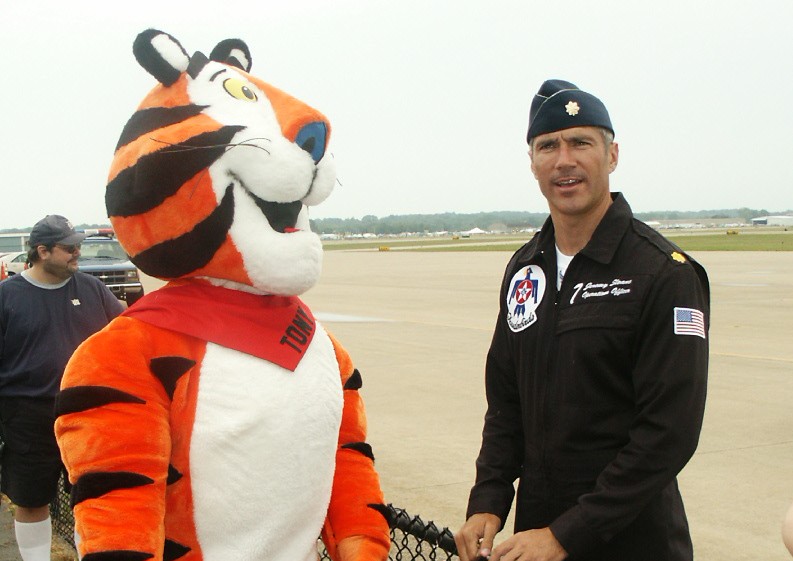
Well, get set for a treat because we went to Battle Creek, Michigan over the Independence Day weekend and entered that special confluence where the F-16 and the air demonstration team come together to produce that wonderful mix of noise, precision, and inspiration that is the United States Air Force Thunderbirds. We were fortunate enough to talk to Maj. Jeremy Sloane shortly after the team landed.

Major Sloane is the operations officer of the Thunderbirds and the squadron’s second in command. He’s in his second season with the squadron and he flies the No. 7 jet. He attended the Air Force Academy and entered the air Force in 1992. Prior to joining the Thunderbirds, Maj. Sloane was an assistant operations officer, instructor pilot, and flight examiner with the F-16C Formal Training Unit, 62nd Fighter Squadron, at Luke air Force Base in Arizona. He has more than 1,800 hours in various configurations of the F-16.

We’ve covered the general information about the Thunderbirds in past episodes, so we thought we’d get a little more in-depth on this one. Not all Thunderbirds have flown the F-16 their whole careers, so we asked about what other aircraft they’ve flown. We also noticed that the team always seems to arrive in tight formation, even on nasty days like the day that they arrived in Battle Creek, and wondered how they flew en route. We asked questions about general aviation and how it compares with military aviation. We also wanted to know how Thunderbird pilots dealt with the high g-forces associated with their demonstrations. And we got answers to all of these questions and more.

Hear the audio on the podcast! Or click here.

[A special shout out on this episode to Dan Lewis!]

Sunday, July 16, 2006

So You Want to Be an Astronaut - Part 3

Subscribe to Airspeed using iTunes, visit us at http://airspeed.libsyn.com, or use the following RSS feed. http://airspeed.libsyn.com/rss.

This is the third of the three-episode series called “So You Want to Be an Astronaut.” I’ve researched the information that NASA and others have made available about the astronaut selection process and I’m condensing it and presenting it here.

Remember through all of this that I don’t have any particular “in” with NASA. I’ve simply done a bunch of research for you and I’m presenting it to you in a mildly entertaining way. If you happen to hear something that ain’t so, please e-mail me at steve@airspeedonline.com and I’ll be happy to correct or update the information. In any case, make sure that you listen to the disclaimers in the first episode in the series.

So on to Part 3: Ruminations

Here’s where I go a little far afield and presume to offer advice on how best to present yourself. Lots of this comes directly from NASA publications, some of this comes from literature written by astronauts and professional aerospace writers, and some of it comes from distilled common sense that I think is universal, but bears repeating.

A lot of the selection process is going to be out of your hands. I’m on the recruiting committee for a nearly 400-lawyer law firm and I interview or evaluate more than a hundred candidates each year. We get more than 2,000 applications or expressions of interest every year. I know that we miss some future Clarence Darrows in the process because the process isn’t perfect. But it remains that we only need so many associates and there are always more candidates than we have slots. If I don’t recommend hiring someone because he or she had an off day or we didn’t click, I feel really bad about it, but those are the breaks. I try really hard and the candidates try really hard, but there’s noise in the system that’s unavoidable.

NASA is made up of human beings, just like my firm’s recruiting committee. I’ll bet that NASA misses some Jim Irwins and Sally Rides every time, but the fact of the matter is that there are boatloads of candidates that will make fine astronauts and, in the final analysis, NASA is splitting hairs at the very top the talent pool.

There are a few things in particular that various sources say are helpful. I tried to weed through them and I’m summarizing here the ones that I think make sense and are probably true. But take them with a grain of salt because, while some is direct from the horse’s mouth, some is ribald and smelly third-hand hearsay.

  • Become a pilot. Even if you only want to be a mission specialist. Even a garden-variety private pilot certificate will do, but the higher the certificate and the more your ratings, the better. Remember that mission specialists have to learn how to fly T-38s and you’ll already have proven the that, at the very least, you can handle a single-engine piston airplane.
  • If you’re at that age, join scouting or a similar organization. An overwhelming proportion of astronauts were scouts and lots of the males made Eagle Scout. A little editorializing here: I was an Eagle Scout and was as involved in scouting as you could be in the late 1970s and early 1980s. Camps staff, Jamboree, Philmont, you name it. I’m a captain in the Civil Air Patrol now, and I’m very, very impressed with the cadet program, at least as it’s run in my squadron. For my money, CAP is the better program. Don’t send me hate mail. I’ve seen both and, by all rights, ought to come out on the side of the Boy Scouts. But I think CAP is better. In any case, I think what matters is that, if you’re at that age, you should join a youth organization like the scouts or CAP and ascend as high as you can.
  • Keep your nose clean. Maybe it goes without saying, but I’ll say it. Everybody does stupid things when they’re young. I was surprised at how many of my law school classmates had records of stupid stuff like public urination infractions or open container violations on their records when they filled out their character and fitness questionnaires. Not that I looked. They told me. Serious guys with sterling academic credentials who had just beaten eight or more out of every ten classmates in one of the most rigorous educational processes around, yet they still had these moments of stupidity following them around. As an astronaut applicant, you’re going to be in exalted company with razor-thin margins between those who forward their mail to Houston and those who go home and stay there. You may also have to get a top secret clearance from the US government in order to handle some of the payloads or systems and criminal records are pretty touchy things when they’re thinking about handing you the keys to the room with all of the really important state secrets. Don’t let a stupid thing in college turn into a reason not to put you in a spacecraft. Drink soda pop and hold it until you can get to the rest room.
  • Don’t be extreme in your dress, mannerisms, public persona, or otherwise. Every astronaut is an ambassador of the US space program. Think of NASA as a big, conservative bureaucracy that doesn’t like surprises – and behave like NASA is watching – and you’ll probably do fine. Don’t get tattoos that show outside a tee-shirt and shorts. Better yet, don’t get tattoos at all. And if you’ve got a tongue piercing, at least don’t wear the tongue stud to the interviews. I’m belaboring the point. But put yourself in the shoes of a NASA administrator. You love science and space exploration and want to sustain a manned space program in the face of the Herculean efforts that it takes to get congressional appropriations and despite the fact that most of the public doesn’t understand science very well and is quick to criticize any real or perceived tomfoolery. Now who are you going to select as an astronaut and put out in front of the taxpayers as an example of what they get for their money?
  • We all know that grades in school aren’t fully reflective of our achievements and that “B” or “C” students often outperform “A” students in the real world. But if you were a NASA astronaut selection team member who had to find some way to cull the hundreds of applications down to a manageable number of interviewees, you could be forgiven for leaning on grades and other objective measures in order to make the paper cut a little easier. And the fact of the matter is that “A” students do outperform “B” and “C” students most of the time. Good grades are also an indicator of the ability of a person to internalize information within a set amount of time. Whether the information you internalized in school was worth internalizing or not, it’s never a bad thing to show NASA that you can internalize information. Regardless of what you learned or what value you received out of the exercise, information internalization is a skill that’s important to astronauts. If you thought that getting through the Pilot’s Operating Handbook for a Cessna 172 was a chore, imagine the number of binders of documentation that an STS orbiter has. It doesn’t matter if you’re taking three credit hours of Comparative Haiku during your last semester of your degree in particle physics. Show them the “A” in Haiku. They probably won’t ask you to compose haiku in the interviews, but you might impress someone by having proven that you have learned how to learn. Even if it involves exotic stuff.
  • Get a PhD or other advanced degree. NASA is all about hard science and the more education and training you have, the better your chances.
  • Don’t have anything done to your eyes, like RK or other surgery unless you know for sure that the surgery won’t disqualify you.
  • If NASA doesn’t offer you an astronaut candidate or astronaut slot, but offers you another job, think long and hard before you reject it. You’re probably being told that you’re just on the wrong side of the bubble and that NASA likes you well enough to keep you around in another capacity. In any case, these are smart people and they wouldn’t offer you a job if they hated you. And remember that NASA employees are disproportionately represented in the ranks of those who do get selected. There’s nothing wrong with applying again for the next round of selections and, in fact, several of today’s astronauts made it after they were unsuccessful on their first attempts. And unless your uncle is Burt Rutan, Paul Allen, or Richard Branson, NASA is probably the only game in town in terms of getting you out of the atmosphere. Consider it an inside track, work your hiney off, and keep your application updated.
That’s it for the “So You Want to Be an Astronaut” series.

If you take away one thing from this series, it should probably be this: You don’t achieve the big things without a long-range plan and a lot of hard slogging. You have to take risks and be willing to go up against seemingly impossible odds. It’s a longshot that requires a fabulous ante in terms of commitment and endurance just to get a seat at the table. But the surest way to not get selected is to not try. And even if you fall short, I’d hang out with, work with, and fly with, the people who just missed astronaut candidate selection any day of the week. You will still have made of yourself the best human being you can be and that ain’t bad.

This last comment is for anyone who’s in a position to pursue a slot as an astronaut. If you’ve got the smarts and the physical characteristics and the time to make this a possibility, consider making a commitment and going after it. I mean get out some paper and a writing utensil and make yourself a checklist. Most of the information you need is in these podcast episodes and there’s lots more information on the web, whether from NASA or other sources. Then follow the checklist. If something changes, go ahead and modify the checklist, but only if it’s necessary to get you to that goal. Make it your highest priority and do at least one specific thing each week toward the goal.

I remember working at a bank in Kalamazoo, Michigan in 1993. My friend Sam bought me a beer and explained in urgent terms that I should go become a lawyer. I really thought about it and decided that I was willing to make the sacrifices to do it. It took a relocation, a job change, five years, some all-nighters, and thousands of hours of effort, but I did it. It wouldn’t have happened unless I had committed to it and followed up tenaciously.

Same thing with becoming a pilot. I remember looking at my barber’s copy of Flying magazine about nine years ago and thinking to myself that flying was way too expensive and difficult for me to consider. Then my friend John walked into my office in 2000 and suggested that we go to flight school together and learn how to fly. Really do it. That triggered a reexamination of my situation and a realignment of priorities. We made plans and, in 2004, I got my ticket.

I’m no astronaut. I’ve got a bum shoulder and my education is all in social sciences, finance, and law. Plus I’m staring 40 in the face.

But, if you’ve got the brains and the body, I am walking into your office, or your living room, or your classroom right now, just like John did, and I’m doing the virtual equivalent of buying you a beer or your other choice of beverage just like Sam did, and I’m saying: Gee, have you ever thought of becoming an astronaut?

Make a checklist. Follow it. Check off the milestones as you achieve them. And maybe one day you’ll be able to attach that checklist to the wrist of your space suit just before you open the hatch and step out onto the surface of Mars.

And what a fine thing that would be.