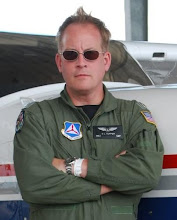
Tuesday, May 25, 2010

What I Mean by "Epic"


We sling around the word “epic” a little too freely, thinks I. And I guess that I’m more prone so say something like that after the last few days. They’ve been – well – epic.

When last I posted, I was at the hotel on Whiteman AFB in Missouri. After shutting down and clearing out, Rod Rakic and I headed out onto the base.

The first order of business was to secure breakfast. It turns out that, as the Alamo and Riverwalk are to San Antonio, the breakfast burritos at the bowling alley are to Whiteman AFB. No fewer than three people volunteered that the breakfast burritos at the bowling alley were second to none and suggested that we’d be fools not to try them out. And they were right!

Rod then dragged me to Military Clothing Sales to right a wrong that he has been seeing in my Air Force cover for months. I procured the largest one they offered (7-7/8) and it’s still a little small, but serviceable.

Then on to the good stuff. We were guests in the tower to see how operations work at the base for the B-2 Spirit stealth bomber. Everything you’d expect to see in a regular FAA tower, but about twice the personnel and A-10s, T-38s, and attack helicopters also launching regularly. And, when it came time to launch the B-2 training sorties, let’s just say that we had a unique view from close up. OPSEC suggests that I say little more, but it was a completely new experience for me.

Shortly thereafter, we got some lunch and then headed to the training center for a couple of sorties in the Level D full-motion B-2 simulator. (Yeah, I said Level D full-motion B-2 simulator!)

Side note: Please pardon the lack of pictures or other multimedia. I left the cameras and other shovels and rakes and implements of the podcaster’s craft back in the car. OPSEC is king there at Whiteman and I wanted to be a good guest. I know that I’m the guy in the new-media community who’s the first to shout at another new-media guy, “If you didn’t get audio and video, it didn’t happen!” Fair enough. The following didn’t happen.

The facility is in a vault (!) in the interior of the building with all kinds of security surrounding it. And that’s the security that we could see. I’m guessing that there were lavers upon layers of it that we couldn’t even tell were there.

I’ve never been in a sim facility before that was this sophisticated or realistic. You walk over a bridge to the sim compartment, which is itself on hydraulic supports and capable of a wide range of motion in all relevant directions and at all relevant rates. It’s a full B-2 cockpit with a wrap-around video display that cover the entire window area.

Each sortie involved a takeoff, a 30-degree turn (uncharacteristic for this aircraft that likes to stay very flat and present a very limited radar signature), a climb to a KC-135R tanker, various attempts at aerial refueling, then an ILS and landing back at Whiteman.

Rod flew the first sortie and I flew the second. The guy not flying hung out in the control room with the sim technician and watched a set of panels and a view “outside” while listening to the conversation in the cockpit.

Each sortie was about 0.7 long with the IP in the left seat and Rod or me in the right seat. You have a stick in your right hand and a fistful of throttles in your left hand. The PTT for the intercom is on the throttles. There are varying levels of automation and you engage them at various points after takeoff to assist in flying the aircraft.

Takeoff was surprisingly normal-feeling. Just a lot bigger and more protracted. Not unlike flying the DC-3 or another large aircraft that actually has vertical control surfaces to speak of. There’s a long takeoff roll and then you rotate off at well in excess of the cruising speed of most of the aircraft that I usually fly. Once established, you let the autopilot fly the climb airspeed until it’s time to pitch over for cruise.

At that point, the sim causes a KC-135R to appear magically in front of you and you climb to meet it. Boy, do I have a lot of respect for anyone who gets gas in mid-flight! I suppose I had already begun to have that respect from the sortie last summer in the KC-135R from Grissom ARB. But the process from the “get” side is awe-inspiring.

I was really saturated throughout the refueling process. But I remember stealing glances at the airspeed indicator and kicking myself for being two knots off. Two knots makes a big difference. It’s a walking pace. You can cover a lot of linear distance in ten seconds at two knots. Enough to blow right out of the top, bottom, or sides of the 2,000 or so cubic feet that I’m guessing make up the volume in which you can receive gas.

And the B-2, like any other large aircraft, reacts slowly and deliberately to control inputs. If you’re moving the controls in response to what you see out the window right now, you’re just piling up pilot-induced oscillations. What you see out the window and on the displays is the aircraft reacting to what you did three to seven seconds ago. It’s like playing guitar plugged into a long delay effect. You’re listening to what you did awhile ago, but you have to play now to make stuff happen in a few seconds or the whole thing gets downright un-musical in a hurry.

Rod and I each had boom strikes on the windshield and we caused permanent simulated psychological damage to the simulated boom operator. Neither of us actually got connected to the tanker. But neither of us killed anyone, either.

Each of us confided to the other after the experience that he was hoping like hell that the other guy wouldn’t get any gas. KMHL to KPWK is a long time to spend in a C-182T with a guy who got gas when you didn’t.

Rod got the better landing. You don’t flare the B-2. It’s a flying wing. You just point it at the touchdown zone and roll the power to idle. The airplane flares itself. I had a hard time with that and had to push a little at the IP’s call. Rod just flew the thing on. Cool on his part, but not enough to make the flight back to Chicagoland in said C-182T any worse than it needed to be.

And I guess I got the last word by remembering to bring my logbook. The IP signed it for the sortie and an already cool logbook got one notch cooler.


We got back into the minivan and headed back to Marshall (KMHL) to preflight, fuel up, and get back to Chicagoland. We launched just before sunset and air-filed back to Chicago Executive (KPWK). It was severe clear most of the way back with stars guiding the way, but the destination was iffy. A low-pressure system was dominating the whole area. KPWK was forecast to be 1,000 overcast with four miles or so of visibility and we were good to go with that. Two G1000-qualified aircrew in a good airplane with lots of alternate options.

As we neared the area, the METAR had dropped to 300 overcast with low visibility in mist. We were busting through banks of stratus and cumulus clouds, although the ride was mostly smooth. We got within 10 miles or so of the airport, snatching glances down through breaks in the clag to see the whole area around KPWK socked in.

We had briefed minima for our aircrew of 1,000 ft ceilings and three miles of visibility. There was some temptation to go down for a peek, but I’m proud to say that this aircrew planned the flight and flew the plan. Rod keyed up ATC and requested a diversion to DuPage (KDPA). We got vectors immediately and planned for the ILS.

The approach got downright interesting. We spotted the runway from two miles outside the final approach fix. About that time, KDPA tower advised us that visibility was at a half mile – minimums for this approach. We let the tower know that we could plainly see the runway. The tower allowed as how the other end of the airfield might be worse than our end of the airfield. In any case, we had both FAA minima (according to the AWOS) and out own minima (according to two installations of the Mark II Eyeball) and Rod brought her in for a good landing.

As it turns out, the other end of the field was socked in pretty well. I recall offering Rod $100 cash if he'd shut off the strobes sooner rather than later. But we made the taxi to Illinois Wing CAP headquarters without incident and buttoned up the aircraft for the night.


The next day was a training exercise for the Illinois Wing. As many of you know, I’m planning to attend Civil Air Patrol Mission Aircrew School at the National Emergency Services Academy next month and get trained to be a mission pilot. In order to do that, I need to first, among other things, become a mission scanner. I had completed all of the requirements other than a couple of technical operational items and flying on two training sorties. I’ve been slightly bunched up about the possibility of not getting the sorties in and missing the chance to go to MAS, So I lined up three opportunities in the hopes of hitting two.

The first was an Illinois Wing exercise on Saturday. Rod had arranged to let me fly on an aircrew in the exercise to known out a sortie there before driving home. The next opportunity was a Michigan Wing SAREX at KFNT the next day and, if one of those opportunities blew out, I had a self-funded unit sortie scheduled for Tuesday.

I got the Saturday sortie after the weather cleared up at KDPA. I sat front seat with Rod and we had the privilege of flying with 1Lt Tommy Whang and 1Lt Sheri Sorenson in the back. Sheri was flying a scanner sortie and the Tonny was shooting photos to maintain a qualification.


We located the target northwest of the Chicago area, did an expanding square pattern with the help of the G1000 and the GFC 700 autopilot before getting the required pictures and heading home.

I beat feet for home and arrived at KFNT early the next morning. After cooling my heels at the mission base for a few hours, Capt Norm Malek and 2Lt Dave wood arrived with the KPTK C-182T. We drew a sector search with a start at a lat-long point and a full mow of the lawn for the rest of the sector if we didn’t find anything. And there was a photo mission to boot on the way back.


We arrived at the start point and I set up the search with the G1000. The amount of time that I have in this particular airplane, together with the seven or more hours I’d spent sitting behind the G1000 over the prior few days, made setting up the search second nature and I had us in an expanding square in no time.

By the fourth leg of the square, Dave spotted a blue tarp and the letters “CAP” mowed into the grass behind a house in the search area. We radioed in to base and were instructed to photograph the find and then return to base.

Mission scanner sortie no. 2 complete! Locked and loaded for MAS and NESA 2010! And the end of an exhausting and challenging four days in a flight suit.

Which brings me back to the epic-ness of the last few days. We spend amazing amounts of time, money, and energy learning how to fly. How to make airplanes perform missions to their full potential. And, all too often, it’s simulated ersatz stuff. Hoods instead of clouds. Discussions of hypothetical weather on hypothetical trips to hypothetical places. Calculating weight and balance for people in the back seat who never actually sit there.

I’m not saying that those exercises aren’t useful. They are. But it’s not hard to arrive at a state of mind in which the hypothetical is enough. Is all you need. Is normal.

I’m here to tell you that it’s not enough and you shouldn’t let it be normal. It’s not easy to decide to launch into known weather on one of the longest trips you’ve ever flown. In strange airspace. To strange airports. With the very real challenge of thinking on your feet when things don’t go as planned. Then doing it at night in sustained actual IMC with low ceilings and wildly varying visibility. Then launching with a CAP aircrew to go find stuff on the ground that, although simulated, is real enough for you because you’re up there packing crazy amounts of workload into limited bandwidth and actually putting the words of the MART into action and objectively demonstrating skills.

None of this stuff is easy. Especially the first time. And the general aviation training culture seems pretty willing to let you keep pretending as long as you like.

But I’m here to tell you that the hard stuff is worth it. I just got a four-day immersive demonstration of that very thing. I stretched just about every limit I had and the preparation and willingness to go launch into it paid off. This is epiphany. This is discovery.

This is epic.

Friday, May 21, 2010

Channeling Dick Collins: IFR to Whiteman AFB - Almost


So Rod Rakic calls me up a few weeks ago. Seems we have an opportunity to go check out the B-2 Spirit bomber at Whiteman AFB. Cliff, a mutual friend, had kindly offered to give us a tour of the facilities and get us close to the mighty Mach 0.95, 335,500-lb. Heavy stealth bomber.

I, not being an idiot, say “Let’s go!”

To make it even more epic, Rod arranged for an Illinois wing CAP C-182T Nav III to make the trip from Chicago Executive (fka Palwaukee) (KPWK) to Whiteman.

When we got together at KPWK and sat down to brief the mission. A band of precipitation sat between us and our objective. No getting around it, really. It was all green and yellow, but non-convective as nearly as we could tell. Ceilings between 800 and 3,000 and tops between FL180 and FL250. It was clear that, if we were going to make this trip, we were going to be in the crud for a good portion of the flight.

Both Rod and I are qualified CAP pilots in the G1000-equipped bird. We’re pretty good operators – Rod perhaps more so than me. The issue now became whether to go launch into weather that we both knew that the bird could handle and for which both of us are well-trained, but that neither of us had experienced first-hand.


It was like a Dick Collins video. Planning to go launch into the soup for an extended period.

I’m a reasonably cautious guy. Old and bold pilots and all. I plan to be old. So’s Rod. I’ve talked with him about go/no-go decisions a lot in the past. We’re both conservative. But we came up with a “go” for this mission. Capable bird. Two qualified pilots. Weather thick but non-convective.

So we launched. We got into the soup well before Moline at 6,000 MSL. Then we hit the precip. Green on the XM satellite radar. Then yellow. Then green again. We gave the airplane a good bath.

And we were rewarded with a smooth flight and a beautiful phase between an undercast and an overcast. One of those great feelings you get when you train for something and then have success when you go out and actually experience it.


Then circumstance frowned upon us. We had been watching some convective activity near Whiteman, but it appeared that it would blow over by the time we got there. But the red stayed near the base. And then ATC called us up and told us that the Whiteman tower was evacuating because of a tornado in the vicinity. No good for Whiteman.

So we looked at our alternate, which was near Whiteman, but also close to the thunderboomers. With the help of the G1000, we identified Marshall Memorial Airport (KMHL) in Marshall, Missouri and shot the RVAV 18 to a smooth landing. The field was well above minimums, but it was scattered and ragged with a frond in the area and we stayed IFR through landing, then called up flight service to cancel.

As we taxied to the ramp, our eyes were greeted by the glorious sight of a CAP van parked outside the terminal building. It’s assigned to the Marshall Composite Squadron, which is based there at the field. A couple of phone calls later, we were meeting with the squadron’s commander and getting the keys to the van to drive the last 50 miles to Whiteman.

As we drove, lightning lit up the skies and low and dark clouds rolled overhead. Rail came down in varying amounts. Like all good pilots, we rehashed the flight and the decision to divert. I think we did a pretty good job of being situationally aware, being nimble and flexible to deal with the weather, and using good CRM to optimize cockpit operations.

Channeling Dick Collins for the first time. Flying through the soup and letting nature wash the airplane. This is the payoff for a lot of hard work. Now down to the hotel lobby to meet Rod and go see us some bombers!

Monday, May 03, 2010

More Acro and Camera Shakedowns


Beautiful day with 6,000 scattered and 10+ SM visibility. Yeah, I have a head cold, but cameras need testing and the acro tolerance needs extending.


So I went up with Barry for 0.9 in the Super D to fly some acro and test out the cameras. Four of them on this flight. These frame grabs are from the Panasonic placed on the left side of the dash. More on the other cameras soon!


Being a little blue about the first couple of flights of the year (10 minutes and 12 minutes of acro, respectively) and wanting to pour on the coal to build some real tolerance for an upcoming Air Force ride, I pushed it to the limit.

And then some.

Yep. Airplane hurl no. 2. (The first was in a T-6A after about 1.2 hours and the full SUPT syllabus of maneuvers.) But that's okay. I'm good with that. You don't build tolerance by pointing the airplane back at the airport as soon as you feel a little green. You tough it out. And sometime you hurl. And then you tie a knot in the little white bag, stow it someplace where it won't float the next time you go negative-G, and keep on going.

Anyway, it's off to bed. Something like eight days until principal photography kicks off for Acro Camp and there's lots to do before people start showing up.

Thursday, April 22, 2010

The Last Pure Thing on the Radio


Subscribe to Airspeed through iTunes or your favorite other podcatcher. It's all free!

These are the show notes to an audio episode. If you want to listen online, please use the direct link below.
http://media.libsyn.com/media/airspeed/AirspeedLastPureThing.mp3.

I’ve been volunteering with event-based airshow radio for three years now. I’ve really enjoyed working with guys like Dave Shallbetter of Sun ‘N Fun Radio, Fareed Guyot, Mike Morgan, and others from EAA Radio at AirVenture, Erik Utter from Arlington Fly-In Radio, and Don Costanza and others from FlightLine Radio. It’s a crew of dedicated people that really understands what the radio could be if it would dare.


And I might add that the airshow stations have been great about opening their arms to podcasters. SnF Radio not only hosts the annual Gathering of Aviation Podcasters and broadcasts a couple of Uncontrolled Airspace episodes, but puts podcasters on the air right after the airshow each evening. EAA Radio has UCAP on the radio a couple of times a week and hosts Podapalooza, now entering its fourth year. Arlington Radio has been broadcasting bits of Airspeed since 2006 or 2007. Flightline Internet Radio has put podcaster promos on the air and over the Internet for years.

So last year, just before Oshkosh, I began mucking about with a tune in tribute to airshow radio. I fleshed out the tune and actually got around to recording it a few weeks ago and it’s ready to release.


It’s called The Last Pure Thing on the Radio. I recorded the basic guitar, bass, and vocals at home and then went to The Soundscape Studio in Royal Oak, Michigan to lay down the drums. Then the whole ball of wax went to audio mastermind Scott Cannizzaro in New York for the professional treatment.

Scott not only mixed the piece wonderfully, he added some musical elements of his own. And he was able to get a college acquaintance, Chris Wormer, to play slide guitar on the track. If Chris’s sound is familiar to you, you might have heard his guitar stylings with The Charlie Daniels Band.

The artist name in the MP3 metadata is 7600, an informal band made up of music enthusiasts from around the country who collaborate remotely over the Internet. I generally release 7600 songs with the band name and then the specific folks who played or contrinbuted, so almost every 7600 song will show up as a separate artist on your player, but I think it's worth it to identify the particular humans who had a hand in the process.


I’ll post a link to an MP3 download of the song on the Airspeed website so you can download it and enjoy it for personal, non-commercial use. I hope you like it. It’s dedicated to all of the volunteers that make airshow radio happen year after year.

So, without further ado, I give you The Last Pure Thing on the Radio.

(Get your free download of The Last Pure Thing on the Radio at this link. PC users, right-click, select "save target as," pick a place for the file, download, and enjoy!)
[Lyrics]
The Last Pure Thing on the Radio
Steve Tupper

I vaguely remember FM radio in 1968
Before The Man took it over and made it all blah-blah-blah.
And I remember watching the airplanes take off and land at Battle Creek and thinking
“Man, it’s going to take a long time to get the money and the guts to do that.”

These days, I’ve got an iPod that’s connected to my head 24/7
‘Cause the radio’s still not what Mike Agranoff dreamed it could be
And it took a long, long, long time before I got the money and the guts
But I finally put together the money and the guts. (Yeah!)

And I heard somewhere that if you walk around at Oshkosh or Lakeland or Arlington
And you take along that same little transistor radio from 1968
Somewhere in the aether, there’s magic, love, and science
And some of it’ll spill into your ears if you let it.

A couple of guys are grading landings and talking trash on the afternoon show
And Dave in pre-production is working on four hours of sleep
And somebody just stuck a mic in the face of an eight-year-old kid
Who’s talking so fast about the airplanes that I’m not sure he’s breathing right

But I listen to the radio and I hear the engines roar
Washing over me again just like it did before

CHORUS
It’s the last pure thing on the radio
On the air (on the air) yeah, let the music play
It’s the last pure thing on the radio
Let the radio come carry me away


Low-power AM and FM and carrier current and whatever
And temporary antennas that they roll out once a year
Sometimes it’s not easy to get a good clean signal
‘Cause there’s a hill in the way. Or a tree. Or a gum wrapper.

But it’s the voices of people who love this stuff as much as I do
And they’ve been here since the Wednesday before the show
They get paid a campsite in a soggy corner of a field somewhere
And maybe the keys to a golf cart or a scooter someday


But from dawn patrol to signoff they lean into microphones
And spill out their hearts about whatever’s coming down the taxiway
And interview the local beauty queen and whoever else is handy
And maybe get Sean Tucker to cut a liner or two

It’s like a dream where your best friends take over the airwaves
Throw out the playlist and just put on stuff that matters
And everything stops when a fighter jet come screaming through for a low pass
And there’s even dead air just then, but everybody understands.

And they listen to the radio and hear the engines roar
Rolling down the show line just like it did before

CHORUS
It’s the last pure thing on the radio
On the air (on the air) yeah, let the music play
It’s the last pure thing on the radio
Let the radio come carry me away

BRIDGE

I like it at airshows when they have a VFR arrival window
And a lone 172 is crawling in on short final
‘Cause I like to stand up and hold my cap over my heart while that 172 touches down
And I know you do the same thing.

So I stand at the snow fence pumping my fist in the air
And shout for John Mohr as he makes the engine sputter upside down
With that little transistor radio sticking out my back pocket
Picking up dead air at all the right moments.

I listen to the radio and hear the engines roar
Washing over me again just like it did before

CHORUS
It’s the last pure thing on the radio
On the air (on the air) yeah, let the music play
It’s the last pure thing on the radio
Let the radio come carry me away

Let the radio come carry me away

Monday, April 19, 2010

Airspeed Video Episode: Don Weaver's Acro Sequence


Subscribe to Airspeed through iTunes or your favorite other podcatcher. It's all free!

These are the show notes to a video episode. If you want to watch online, please use the Vimeo viewer above or download directly from:
http://media.libsyn.com/media/airspeed/AirspeedDonAcro01.m4a
.

Acro Camp IP Don Weaver and I launched last week to shake out a couple of new things with the cameras and audio system. We flew a wing camera for the first time (check out the blog entry at the Acro Camp website) and also used an attenuating 1/8” to 1/8” cable to capture the intercom audio. Both systems worked well.

It was my first acro flight of the season and I was done after just a few maneuvers. Not surprising. That’s par for the course for me. I’ll get it up to 20 minutes or more soon enough.

Don offered to drop me off at Romeo and head back out to really wring out the camera rig. This video is from his sequence. It runs more or less continuously except for a minute or two as be climbed back to altitude. Not only does Don hit his airspeeds pretty effectively, he conserves altitude pretty effectively, too. And he talks the routine pretty clearly as well.

This is the camera and audio setup that we’re going to use for lots of the Acro Camp shooting. Head over to http://www.acrocamp.com/ so see more about the movie!

Saturday, April 17, 2010

Battle Creek Preview 2010


Subscribe to Airspeed through iTunes or your favorite other podcatcher. It's all free!

These are the show notes to an audio episode. If you want to listen online, please use the direct link below.
http://media.libsyn.com/media/airspeed/AirspeedBCPreview2010.mp3.

Barb Haluszka appears for the fourth time talking about the Battle Creek Field of Flight Airshow and Balloon Festival. The show is slated for 1-4 July 2010, but that’s just around the corner when you think about the amount of planning and coordination required to put on a show like this.

The show will be without a jet team for the first time in many years and that presents interesting challenges and opportunities. That and more is on the table for this, Airspeed’s fifth year of covering the Battle Creek show.

Sunday, April 11, 2010

Aerial Videography Panel


Subscribe to Airspeed through iTunes or your favorite other podcatcher. It's all free!

These are the show notes to an audio episode. If you want to listen online, please use the direct link below. http://media.libsyn.com/media/airspeed/AirspeedVideo01.mp3.

With principal photography for Acro Camp coming up in a just over a month, I thought that now would be a great time to gather some of new media’s most noted experts on capturing images aloft and pick their brains for an hour.


The panel includes Acro Camp director of photography Will Hawkins, Indianapolis Airshow Director Roger Bishop, and independent aviation video producer and enthusiast Rick Felty, each of whom brings a different view of the task of capturing the visual elements of flight and making them exciting for aviators and non-aviators alike.


We talk about equipment, mounting techniques, stabilization, editing, rendering, safety, and more.

Check out the movie’s website at www.acrocamp.com for news about production and building the buzz!

Wednesday, March 31, 2010

UAVs: The Pilot and the Operator Can Be Friends


Subscribe to Airspeed through iTunes or your favorite other podcatcher. It's all free!

These are the show notes to an audio episode. If you want to listen online, please use the direct link below.
http://media.libsyn.com/media/airspeed/AirspeedUAV01.mp3.

I’d like to set the record straight on an issue of minor importance.

I tweeted some disparaging comments about the Predator-B Unmanned Aircraft System that the US Customs and Border Patrol brought to Oshkosh last year. The kind of rhetoric to which pilots are given from time to time. Nothing particularly vitriolic, but disparaging nevertheless. That got a lot of traction and I found myself widely re-tweeted. So much so that I actually began to hope sincerely that no harm came to the Predator because I expected to be questioned if it did. Even though I was still in Michigan at the time.

Since then, I think I’ve gained a reputation as the new-media community’s chief UAV basher. I probably deserve some of that reputation, but not all of it. In this little treatise, I thought I’d claim such of that reputation as I truly deserve and disclaim the rest.

To set the table, I’m talking about Unmanned Aerial Vehicles or “UAVs,” although I understand that the preferred term is now Unmanned Aircraft System or “UAS.” I’m going to use the term “UAV” in this piece because it’s more widely used.

In particular, I’m talking about systems like the RQ-4 Global Hawk, the MQ-1 Predator, the MQ-9 Reaper, and their brethren. I realize that the inventory of the US and other nations contains many more and varied examples than these, but these models best typify what I think the average aviator has in mind when he or she talks about UAVs.

I’ll start right out and say that I appreciate what UAVs can do. They can go places and loiter. They don’t get tired (even if they do get thirsty after awhile). They go into dangerous areas where we’d rather not risk a human. They carry lots of automation and can accomplish reconnaissance, attack, and other missions. Hear me now, podsphere: UAVs are great platforms for what they are and what they do. I’m glad they’re there. I’m glad that my friends – some of whom are fighter, bomber, and other military pilots – don’t have to unnecessarily risk life and limb to perform certain missions.

I walked into a hobby shop not long ago looking for a rocket kit for my son, Cole – callsign FOD. The CAP cadet commander had offered to let FOD launch a model rocket along with the squadron’s cadets and I wanted to go grab a rocket kit and help him build it.

You can’t walk into a store like that without noticing the selection of radio-controlled aircraft. The salesman sidled over to me after a few minutes later and asked if he could help me. I said that I was just there for the rocket, but that he could answer a couple of questions. I said, “I’m guessing that pilots who have no RC experience walk in here all the time thinking that they’re going to be great RC operators right off the bat because of their flight experience. And I’m guessing that they’re dead wrong about that.”

He said, “Sir, you’re the first person to walk in here and get that right. I sell $500 RC outfits to pilots every weekend and, if you believe the stories, every one of those aircraft ends up in a heap within 300 feet of the end of the runway. The old-hand RC guys like to gather around and watch these guys crater these expensive kits. It drives down the price of used controllers because there are so many without airplanes associated with them.

This is by oblique way of conceding that flying a UAV takes some skill. In certain instances, more skill than it takes to fly an aircraft while aboard the aircraft. Additionally, the person in command of the UAV has to manage surveillance, weapons, and other systems, as well as coordinate with other assets and with the chain of command of the organization for which the aircraft is operated. Phrases like “one-armed paper hanger come to mind.” I get that.

To address another issue associated with UAVs, and to risk making myself unpopular among my pilot friends, let’s talk about UAVs sharing airspace with occupied aircraft. Many pilots object. They complain that UAVs can’t adequately see and avoid VFR traffic.

I’m not sure that I buy that. The average VFR pilot does a rotten job of seeing other traffic in the first place. My suspicions to that effect were confirmed when I began regularly flying aircraft with glass panels that featured traffic avoidance information. For every aircraft within the relevant area that I picked up visually, there were at least six others that showed up on the screen that no one in the cockpit saw or would have seen. And I have a pretty good VFR scan.

As long as a UAV is flying in a radar environment, I can’t seem to gather the bile to complain about sharing the sky with a UAV. Radar is pretty good. Even when you have aircraft out there without transponders that aren’t shown on traffic avoidance systems. Heck, I called out a clump of children’s helium balloons to the Jackson tower a few weeks ago after flying within a couple of hundred feet of them right after coming out from under the hood on an approach. The tower acknowledged having seen them and said that it was monitoring their progress across the airspace. If the tower can see a clump of balloons, it’s going to be able to see your aircraft, even if it’s a Part 103 powered paraglider.

By the way, I’m not as nuts about UAVs flying around non-radar environments. But that’s another essay.

So let’s get to the point. What made me tweet disparaging things about UAVs last year?

I began flying because – well – I wanted to fly. To be in the aircraft. To slip the surly bounds and all that that entails. I like to pull Gs. I like to bury a wing and enjoy exercising the patience required to let the nose come through the horizon before finishing out a perfect wingover. Even if the now-angry guy in the right seat seems to think that the maneuver was supposed to be part of a lazy eight. And particularly if the guy is behind me and is far from angry and suggests that I pop it up more steeply on the next one.

I satisfy a need up there that cannot be satisfied by the experience that a UAV operator has as such. It can’t be done. I need to be aboard the airplane. Sure, I fly a lot of sim when I really need to work out the bugs for instrument flight. But there’s no way I’d go through that grief and aggravation if I weren’t doing so that I could go do it for real.

I’ve been offered a few unique simulator experiences. I mean the kind where I likely would be required to leave the cameras and audio recorders in the rental car. That cool. I’ll certainly pursue them and I think that they’ll be eye-opening and that even an account of the experience that doesn’t include audio or video would be compelling here on the show.

But even a sim experience like that would be so much more compelling if it was somehow linked to flying the real thing. Heck, I’d build a cardboard mockup of my own in my basement and run switchology blindfolded just to prepare for the sim if I thought that doing well enough in the sim would get me into the airplane. (And don’t think that I haven’t done just that. Some of the demo pilots who have flown me might be surprised to find that the guy in back knows all the boldface and showed up for the ride fully prepared to do a stand-up in front of the squadron if called upon.)

It’s about flying in the aircraft. Or doing things that lead up to flying in the aircraft. And the closer to controlling and commanding the aircraft in three dimensions, the better.

Several people, not the least of whom is Jack Hodgson of UCAP, have pressed the issue of nomenclature for the person or persons operating the controls of a UAV. Is that person a pilot? Or something else?

I say without equivocation that that person is properly an “operator.” And not a “pilot.” I mark the difference by whether the person operating the aircraft is in the aircraft itself. Can feel the inertial forces. Has skin in the game, as it were. And is satisfying a need by that person to be well up into the third dimension.

If I said unnecessarily belligerent things over Twitter about the Predator B at Oshkosh, it was because Oshkosh to me is a place where pilots gather. Aviation enthusiasts are welcome, too, but Oshkosh is about people talking in animated ways with others with whom they might have nothing in common other than the love of poking holes in the sky.

And then in comes the Predator. A platform that has everything except the pilot. It just seemed to me to be a discontinuous stick in the eye.

I live and work among non-pilots. People who don’t get it. Once or twice a year, I get to come to Oshkosh or a similar event and everything is perfect for a few precious days.

Then there’s the Predator sitting there among my tribe of pilots. Kind of like a Baby Ruth in the swimming pool, if you know what I mean. Very un-piloty.

So that’s why the tweets. It’s a pilot thing. It’s unfair to some extent and it’s a cheap shot at low-hanging fruit to another extent. But that’s how it struck me.

Another thought occurred to me recently, and this might have had something to do with the Oshkosh reaction. It’s only recently taken enough shape to try to nail it down with words, but I’ll give it a shot.

There are those who say that the last true fighter pilot already lives and breathes. And that he or she might not even be that young. We have the F-22 and the F-35 Joint Strike Fighter, examples of fifth-generation fighters that will likely get us through the next 30 years in one form or another. But it has recently dawned on me that the kind of flying that I read about in Sabre Jet Ace when I was six might soon be outmoded.

A UAV might not be able to do everything as well as an occupied aircraft, but maybe the powers that be will decide that UAVs can do it well enough that all we have to do is deploy enough of them to make up in numbers what we lose in terms of precision and on-the-scene human evaluation. I personally don’t think we should get to that point. But it’s possible, and even likely, that someone in a position of power won't see it as I do and decide the matter the other way.

Reliance on automation and technology has gotten parts of the nation’s military into the ringer on prior occasions.

Look at fighter strategy in the Vietnam era. For example, the F-4 Phantom II was being deployed with no gun. Missiles only. Before that, US aviators has unmatched air dominance and a kill ratio that was determined more by fuel and payload than anything else. Then we launched aircraft with no guns into a hornet’s nest of more maneuverable enemy MiG 21s and had our asses handed to us. Even mounting a gun pod on the Phantom ended up being only a stopgap. Fighter pilots complained that, to borrow a phrase, it was like being in a knife fight in a phone booth armed with a spear.

The US Navy Fighter Weapons School (best known to, and loved by, many of us as “Top Gun”) originated to teach the art that lay fallow in Vietnam. John Boyd and the Fighter Mafia developed aircraft based on energy-maneuverability theory. The experience of Vietnam ultimately brought us the F-15, the F-16, and a kill ratio that was again determined almost entirely by gas and ammo. And we still have the dominance of the F/A-18, the F-22, and the F-35, among others, to show for that.

But, even so, the emphasis is on beyond-visual-range (“BVR”) engagement and JADAM munitions. Sure, they’re great for their purposes and important resources in the US inventory. The objective is to put warheads on foreheads and whatever does that best is fine by me.

But will we preserve the ability to cope reasonably if we again find ourselves in a phone booth?

My favorite other examples come from the US space program. Test pilots called the first astronauts “Spam in a can.” And with good reason. The initial vision for the space program was to fly overwhelmingly automated craft with the astronaut being relegated to meat.

But then the astronauts began proving themselves invaluable to the endeavor. Remember Gemini 8, where Neil Armstrong recovered the wildly out-of-control crew capsule by activating the retro system and separating from the Agena target vehicle? Or Pete Conrad and Alan Bean saving the Apollo 12 mission by making the right calls after being struck by lightning not once but twice?

Do you remember that June day in 1966 when the US first landed on the moon? Yeah, I said 1966. Surveyor 1. The first soft-landing of a spacecraft on the moon by the United States. Remember?

Of course not. The first moon landing was July 20, 1969 and Neil Armstrong and Buzz Aldrin did it. Humans. Pilots. Real emissaries of humankind. Guys who were towering extensions of what you and I are in our general aviation aircraft.

I began the whole Airspeed thing as a way of getting into the very best aircraft and close to the very best pilots. And maybe getting some of that to rub off on me. But, lately, it has taken on a different vibe.

What if this is the last moment in history during which steely-eyed young men and women still regularly climb into supersonic aircraft and go hurtling through the sky in the way that got many of us as excited about flying as we became in the first place? What it the era is ending?

Some days, I feel like Lt. John Dunbar in Dances with Wolves, as he rides out to see what remains of the American West before it’s gone. I know that sounds a little melodramatic and maybe it is. But we haven’t ordered any more F-22s. And the F-35 program, though exciting in its own way, seems a little like low Earth orbit after having been to the moon. And the number of US fighter/bomber slots isn’t growing.

They still make Beeman’s gum, but you have to look harder for it. And, when you find it, it’s usually on a display marked “nostalgia chewing gum.”

I’d chase these rides hard to bring them to you regardless of these other circumstances and ruminations. I go after them for the same reason that caused me to start the show more than four years ago. But it’s hard to ignore the feeling that it’s not just getting over the hurdle of explaining new media to military PAOs and what a great audience you guys are for their messages. It’s also a sense that the sun is setting on a certain conception of aviation and there’s something of a race to capture it before it’s gone.

I saw How to Train Your Dragon this weekend with FOD and Deadly. I really liked the flying in that movie. Whoever wireframed the flight animation had some idea of what it is to fly.

I saw the first half of the loop, viewed from the tip of the dragon’s wing looking back at the dragon and rider as though someone had mounted a camera there. I say that I saw the first half. I don’t know if there was a second half. I assume that there was. I couldn’t see. I think I choked back that sob, but I can’t be sure. Cole and Deadly were rather involved themselves.

That loop looked exactly like a nice, round loop does when viewed out the side window of a Super Decathlon from the front seat. I know this because I’ve worked hard and long enough, and have been lucky enough, to be one of the relatively few humans who knows what a loop looks like from the cockpit. My reaction was immediate and visceral. I didn’t expect it. And I couldn’t control it.

My point is that flight – real flight actually inside or otherwise attached to, an aircraft – is singular and special. There is no experience available on the ground that matches it. I know my drug of choice. It is singular and cannot be faked. When one needs a little time strapped to a dragon high above anything other than the immediate moment and in the middle of a fluid exchange of potential and kinetic energy, nothing else will do.

To the men and women who develop, maintain, and operate UAVs, thanks for all that you do. It’s amazing technology, it performs vital functions, and it avoids needlessly risking the lives and limbs of my friends. I’m glad that you people are on our side.

And the pilot and the operator can be friends. Each can appreciate what the other does. Just understand that the need to cause something to fly is different from the need to fly.

I’m hopelessly piloty. My viscera belong at altitude and sometimes inverted.

Maybe if you put a saddle on that Predator B. Slim Pickens style. Yeah. The pilot and the operator can be friends.
___________________________

Picture: An MQ-9 Reaper flies above Creech Air Force Base, Nev., during a local training mission June 9, 2009. The 42nd Attack Squadron at Creech AFB operates the MQ-9. (U.S. Air Force photo by Paul Ridgeway. Used under 17 USC § 105 as a US government work. Available at http://www.af.mil/shared/media/photodb/photos/090609-F-0000M-777.JPG)

Monday, March 22, 2010

Meet the Campers of Acro Camp


Subscribe to Airspeed through iTunes or your favorite other podcatcher. It's all free!

These are the show notes to an audio episode. If you want to listen online, please use the direct link below. http://traffic.libsyn.com/airspeed/AirspeedAcroCampCast01.mp3.


The Acro Camp cast (the “campers”) were announced last week and it’s time to introduce them to you! We had the opportunity to get campers Paul Berliner, Michelle Kole, Lynda Meeks, and Jim Rodriguez and instructor pilots ("IPs") Barry Sutton and Don Weaver all together on a Skype call to allow everyone to talk in realtime.

Michelle called in from the airport because she was getting reaedy to board a flight back to California after spending some time with her dad, Ed Kole, in Chicagoland. Michelle more than made up for having to leave the show early. She has met Paul Berliner and me in person and flown with Don. (Already! And all within 48 hours of the cast announcement! Now that’s Kevin-Bacon-esque!)

Look for more conversations with the campers on Airspeed in the weeks leading up to the camp 12-16 May 2010 here in Michigan.

Wednesday, March 17, 2010

Airspeed Comes Up for Air


This is a regular blog entry. If you’re looking for show notes or links to show audio or video, please check out the other entries.

You might be wondering, “Where the heck is Airspeed?” And you could be forgiven for wondering that. I haven’t gotten a new episode out for some time. But it’s all going to be worthwhile. I haven’t been idle!

Unless you’ve hidden your iPod under a rock, you know that I’ve been working on the Acro Camp movie project with virtually every spare moment of time. It turns out that there’s an unreal amount of stuff to get in order for making a movie. And, being that I’m both a lawyer and persnickety about how the legal structure of a project works, I’ve had to draft virtually every document from scratch after researching the subject matter pretty thoroughly.

But the hardest, and most important, part is getting the cast selected. And we’re done with that. We announced it on the Acro Camp site today after the fourth and final cast member confirmed availability. I’m really happy with the cast and I think that everyone is darned near perfect.


By happy coincidence, we were able to hook up with camper Michelle Kole and her dad, Ed Kole, at Jackson County Reynolds Field (KJXN) for lunch today. Michelle was visiting Ed in Chicagoland and they flew Ed’s Beech V35B, N6070S to Jackson. After lunch, Don gave Michelle a demo flight in the Opt-Air-managed Cirrus SR-22 and I got my first ride in a fork-tailed doctor killer (very ably flown by Ed and, in my humble opinion, not deserving of that moniker).


We departed as a flight of two and made the first 15 miles out of Jackson in formation with Don on our wing. Then Don (or maybe Michelle – who knows?) gave us a wing waggle and peeled off to go do the demo proper. Ed and I continued on to Oakland Troy Airport (KVLL), from which I dashed back to my vehicle and returned to the office before the clients could figure out that I was gone. Except for one client in particular who wanted to know all about the flight. (My favorite kind of client.)

Anyway, with the cast selected and all heading over to amazon.com to buy and read Geza Szurovy and Mike Goulian’s book, Basic Aerobatics, I can now concentrate on some of the other technical issues that I need to resolve before I feel confident about the filming.

Among the most pressing is the camera arrangement for the Pitts. Would you believe that an airplane as photogenic as the Pitts S-2B has no place in the cockpit to which to clamp a camera rig? Nowhere! It’s all business in there. I seem to recall from the photo mission with Billy Werth that I had a hard time finding a mounting spot, but I had chalked that up to the rush to get out on the photo mission. Apparently, there really isn’t anywhere to put the camera. Nowhere inside the cockpit, anyway.

So it looks like I’m going to need to put the camera outside the cockpit. That means, among other things, that I’m going to have to come up with an alternative camera setup. I went out and got a ContourHD (pictured at the beginning of this post), which gives a 135-degree view and is rated for full 1080p HD video. It’s small and it can probably handle the wind blast a little better than the Panasonics. I test-flew the unit this weekend inside the cockpit of a C-172 for video quality, breadth of view, battery life, and other considerations. I haven’t pulled the video off of it yet, but that’s on the agenda for the next few days.

It’s also becoming really apparent that I’m not going to be able to record cockpit audio with the same device that I use to record video. The Sanyo Xacti (the only camera that I have that has an audio input) is way too heavy to mount in an airplane that’s going to be pulling serious Gs. I think it’s going to be exclusively a ramp camera. So I’ll be buying at least one other MP3 recorder (probably another M-Audio MicroTrack with a 2GB flash card) and running the audio in parallel. And, because the Pitts probably has hardwired headset connectors, the campers are probably going to have to do the Pitts flights with a condenser mic taped behind their ears. (It’ll be easy to tell a cast member – Just look for the red spot behind the ear where repeated applications of gaffer tape have removed the epidermis).

Anyway, as much as I complain, these are wonderful problems to have. I love working through them. And the offers of assistance have been coming in with increasing frequency and breadth. I’m not doing this alone. In fact, this is going to be a massively parallel team effort.

Anyway, look for a couple of Airspeed episodes before the end of the month. And be assured that I wouldn’t leave you dangling if there weren’t really cool things going on.

(Like a certain ride with the US Air Force that’s approved and awaiting scheduling . . . Yeah, baby!)